
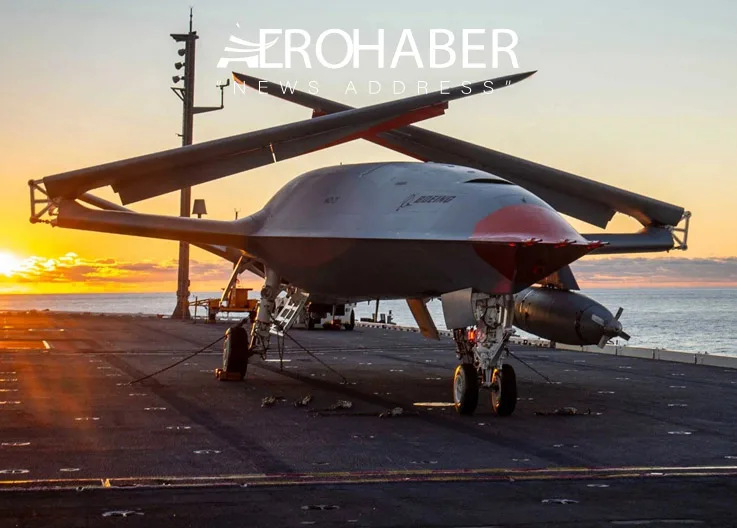


The U.S. Navy has confirmed that the expected first flight of the MQ-25 Stingray unmanned tanker aircraft, developed by Boeing, will not take place in 2025 as planned. It was announced that the critical flight has been delayed to early 2026 due to ongoing ground tests and system certification processes.
According to information reported by Aviation Week, extensive ground tests and certification work that must be completed before the aircraft begins flight are still ongoing. In a statement by the Navy, it was said, “The team is continuing system tests and preparations required for flight clearance. The first flight will take place once the certification process is complete and weather conditions are suitable.”
Boeing also confirmed this schedule, emphasising that system-level certification and the issuance of final airworthiness documents that will permit the flight require additional time.
Recent Completed Tests
Boeing summarised recent progress in the MQ-25 programme as follows:
- Extensive structural load tests on the MQ-25A Stingray
- Initial engine runs
- Completion of flight-certified software
- Remote command tests via the Unmanned Carrier Aviation Mission Control System (UMCS)
The company noted that the engine runs and UMCS integration tests were particularly critical phases for the programme.
First Flight Expected for the Production Aircraft
This flight will be a significant milestone for the MQ-25 programme because, unlike the T1 test platform—which previously conducted aerial refuelling for F/A-18F, F-35C and E-2D aircraft—this time the first production MQ-25 built for the U.S. Navy will take to the air.
The production version includes:
- Reinforced structural components
- Modernised avionics systems
- Updated mission equipment
These features are considered critical for the Navy’s long-term fleet requirements.
Optimism for 2025 Turns Into Delay
Despite optimistic statements by several military officials that the flight would take place in 2025, the MQ-25 programme has faced delays.
Commander of Naval Air Forces Vice Admiral Daniel Cheever stated earlier in the year, “We will fly the MQ-25 in 2025 and begin carrier integration in 2026.”
Boeing executives had also indicated that the first flight could be conducted within 2025. However, the duration of system tests, certification requirements and technical issues that needed to be resolved pushed this schedule forward.
A Critical Role for Aircraft Carrier Operations
The MQ-25 Stingray is set to become the first unmanned tanker aircraft system to be integrated into the U.S. Navy’s carrier air wing.
Its primary missions include:
- Reducing the tanker burden on the F/A-18E/F Super Hornet fleet
- Increasing the range and sortie rate of strike aircraft
- Providing uninterrupted aerial refuelling support for carrier operations
According to Navy reports, the MQ-25 is expected to deliver 14,000–16,000 lb of fuel at a distance of 500 nautical miles.
In addition, the MQ-25 is planned to be used in future ISR (intelligence, surveillance, reconnaissance) missions. Work continues on SIGINT, AIS and EO/IR sensor integrations.
The Future of the Programme and Schedule Pressure
According to Pentagon and GAO reports, the MQ-25 programme had previously experienced timeline revisions. Some key milestones in earlier development phases were delayed by about two years.
In the Navy’s fiscal year 2026 budget, $1.04 billion has been allocated for the MQ-25, while procurement of low-rate initial production (LRIP) aircraft and UMCS development continue.
Boeing opened a $200 million production facility at Illinois MidAmerica Airport in 2024 to meet increasing production demands. Lockheed Martin is also maintaining its collaboration with the Navy to mature the UMCS.
Recent tests confirmed that UMCS can control not only the MQ-25 but also other unmanned systems such as the MQ-20 Avenger.
Within the scope of manned–unmanned teaming technologies, Boeing has also successfully tested capabilities that allow F/A-18 pilots to control the MQ-25 during flight.