



Dear readers,
The data announced and the agreements signed in recent days show that Türkiye’s defense industry is no longer a “developing sector,” but has become a strategic field of power that has crossed the threshold of maturity. An export volume approaching 10 billion dollars, ROKETSAN’s foreign sales exceeding 750 million dollars, or HÜRJET opening the door to Europe… Each of these is important on its own. However, the real issue is what these pieces tell us when they come together.
To put it clearly, Türkiye is now in the position of a country aspiring to set the rules of the game in the defense industry.
Exports: A Story of Quality, Not Quantity
The most critical aspect of the increase in defense exports is not the size of the figures, but the change in the nature of exports. In the past, sales of platforms, parts, or limited systems were mostly discussed. Today, however, packages are being sold: including training, maintenance, software, simulation, and logistical support.
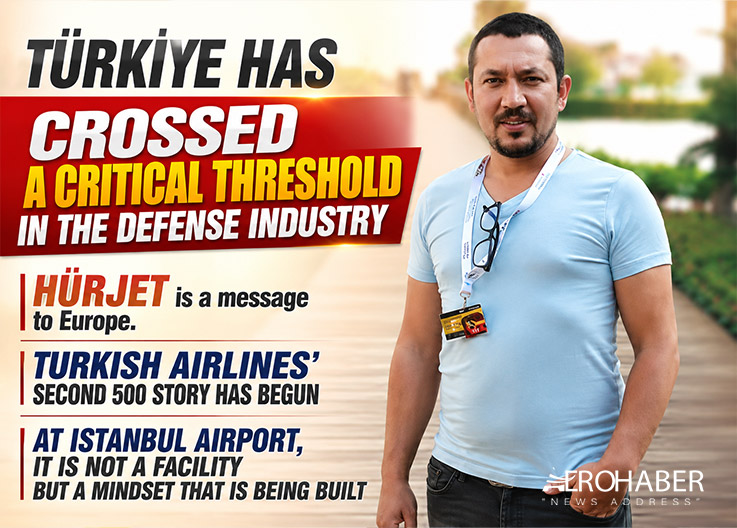
HÜRJET’s agreement with Spain is a turning point in this regard. This is not merely an aircraft sale; it is Türkiye’s way of telling Europe, “I can compete in this league.” Moreover, this league requires trust, sustainability, and political balance as much as technology. Türkiye is being tested in all these areas and, for now, it is passing the test.
Companies Are Growing, but the Real Question Is: Is the System Growing?
The momentum achieved by companies such as ROKETSAN in exports is, of course, encouraging. However, there is a deeper question that must be asked here: Is this growth institutional or ecosystem-based?
The emphasis placed in recent weeks on “talent management,” “qualified human resources,” and university–industry cooperation shows that decision-makers are aware of this question. The defense industry cannot be carried by only a few major players. What keeps it standing are SMEs, engineers, software developers, and the supply chain. The emphasis on human resources is therefore at least as strategic as a new missile system.
The Defense Industry Is Now the Silent Language of Foreign Policy
Another striking outcome is that the defense industry has clearly become an instrument of Türkiye’s foreign policy. Every system sold also creates a relationship, a bond, and a form of mutual dependence. It gives Türkiye a voice at the table, but it also places responsibilities on it.
The systems sold by Türkiye are now being tested in the field, observed by the world, and compared. This means a period in which mistakes are as visible as success. Therefore, every technical decision in the defense industry also carries the nature of a political decision.
Where Is the Risk?
In the shadow of this bright picture, however, there are two fundamental risks.
The first is excessive self-confidence. Success in the defense industry requires continuity. Today’s advantage is not a guarantee for tomorrow. Those who stand still in the technology race fall behind.
The second is complacency in the domestic market. Export successes must not lead to a weakening of internal oversight and quality culture. Because global competition is an area with no tolerance.
The picture of the past week is clear: Türkiye is no longer “at the beginning of the road” in the defense industry. But it is not “at the end of the road” either. It is at a truly critical turn.
If this turn is taken correctly, the defense industry will become one of Türkiye’s strongest levers not only in security, but also in technology, employment, and diplomacy. If it is taken incorrectly, today’s gains will quickly become ordinary.
In short, the issue is this:
Not producing weapons, but producing intelligence, systems, and sustainability.
The real test begins now.
Turkish Airlines’ Second 500 Story Has Begun
There are some investments whose meaning ends when the opening ceremony is over.
Others speak over time.
The latest foundations laid at Istanbul Airport on behalf of Turkish Airlines, in my opinion, belong to the second group. Because the issue here is not a few hangars or a few facilities. What is being built here is a mindset.
Turkish Airlines is no longer merely a company that operates aircraft. At least, that is not where it wants to remain. It has the ambition to establish an integrated aviation ecosystem extending from production to maintenance, from training to technology, and from logistics to data infrastructure. It is easy to underestimate this ambition, but the figures do not really allow it.
Let us make a comparison.
In the 70 years from 1933 to 2003, the number of aircraft in the fleet was 65.
In the past 23 years, it has been 500.
This is not random growth. We may appreciate it or criticize it, but it is clear that there is a patient and consistent plan in place. Now, Turkish Airlines is entering its second period of 500 aircraft with the experience gained from the first 500. This is the critical point.
The second phase of SmartIST, Europe’s largest wide-body engine maintenance center, catering facilities with a daily capacity of half a million, flight training centers, data infrastructures, door-to-door cargo services such as Widect… Each one is a “major undertaking” on its own. When brought together, however, they reveal an ambition to move Türkiye from the edge of the global aviation chain to its center.
The total investment exceeds 100 billion liras.
More than 26,000 additional jobs are being discussed.
At this point, it must be said: This is not merely the growth of a company. This is a matter of accumulated knowledge, supporting industries, human resources, and long-term development. The structure established by Turkish Airlines through 21 subsidiaries resembles a living ecosystem more than a conventional group of companies.
Of course, the world is not all sunshine and roses. The aviation sector is going through a difficult period. Geopolitical risks, economic fluctuations, fierce competition… But precisely for this reason, the approach of not giving up on long-term strategies stands out. Refusing to change course according to short-term storms is not something every institution is capable of.
Perhaps the least discussed but most important element of this picture is the concept of the “TK Family.” This understanding, which covers more than 100,000 employees, reminds me of this: No matter how large your aircraft are, it is people who fly them. Without a sense of corporate belonging, vision remains on paper.
The 500th aircraft is a summary of the past.
The targeted 1,000 aircraft represent the ambition of the future.
813 aircraft and 171 million passengers in 2033;
1,000 aircraft and more than 210 million passengers in 2036…
These are not dreams; they are targets whose foundations have already been laid.
Turkish Airlines is trying to fulfill the requirements of being the “national flag carrier” not merely through words, but through investment.
If this determination is maintained, the question we will be discussing in a few years will be who sets the standards in global aviation.
I wish all aviation professionals a safe and peaceful week.
