
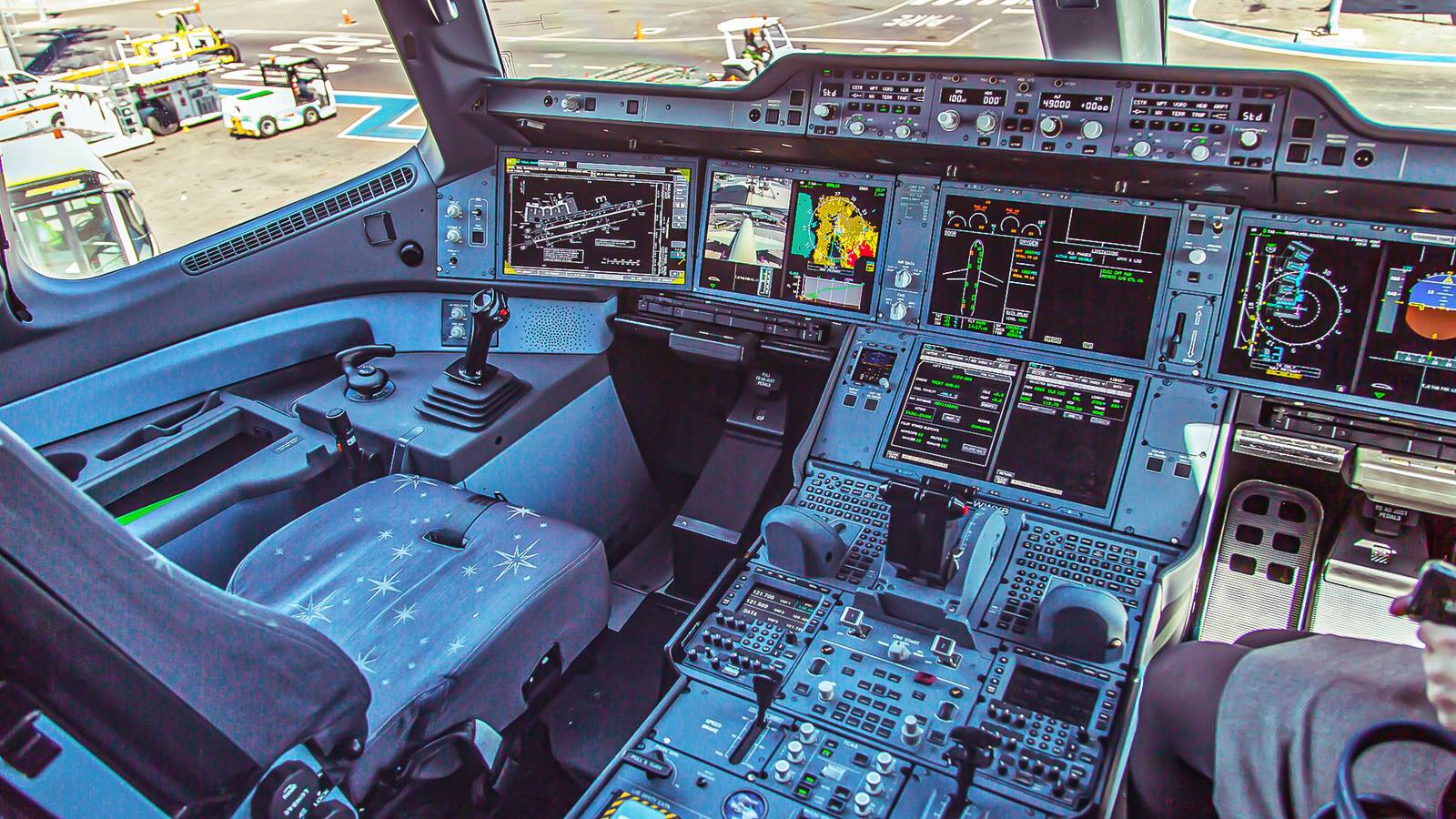


Airlines are always big spenders, even if many may run close to the brink of economic collapse. Billions of dollars are spent on advanced aerodynamic winglets, lightweight carbon-fiber wings, and ultra-high-bypass turbofans, but the true financial engine of an airline fleet decision sits entirely behind the reinforced cockpit door. Airlines actually pay far more attention to the cockpit than many realize, especially because a flight deck interface that reduces training footprints and streamlines pilot staffing flexibility can easily offset minor disparities in pure fuel efficiency.
Pilot training is easily one of the largest fixed operating costs for any major carrier. Setting up a completely independent fleet means millions of dollars spent on simulator leases, classroom instruction, and line-oriented flight training. When a manufacturer can design a flight deck that narrows the operational divide between a narrowbody jet and a massive long-haul widebody, they lock the airline into a closed ecosystem. The true battleground between manufacturers is not fought in the stratosphere, but in the simulator bay, where training timelines and staffing flexibility dictate airline profit margins long before the first revenue passenger boards.
Acquiring a new aircraft type is an immense operational hurdle that goes far beyond the price of the airframe itself. Under global aviation regulations, a pilot must hold a specific type rating to fly a commercial transport aircraft. Earning an initial type rating is traditionally a challenging process, requiring anywhere from eight to 11 weeks of intensive study, computer-based training, and simulator sessions. This long training pipeline represents a vast financial drain, with high-fidelity simulator devices that weigh upwards of 30,000 lb (13,608 kg) and are suspended on six axes of motion. Simulators easily cost several hundred dollars per hour, alongside the salary expenses of idle crews who are temporarily removed from active flight duty.
The inherent risk of simulator failure compounds the financial exposure, as simulator training is where 60% of all pilots end up failing across major airlines. When a pilot comes out of a transition program in this way, the airline loses tens of thousands of dollars in training investments and faces a sudden scheduling void that disrupts operations. Consequently, flight deck design and interface layout are critical financial levers. If a manufacturer can make a new, larger airplane feel and operate exactly like the smaller aircraft already in a carrier’s fleet, the training risk diminishes quite substantially.
Through the engineering of a universal system architecture, manufacturers can help combine full type rating programs. This allows airlines to avoid the expensive, high-risk simulator cycles that traditionally ground crews for months. Rather than maintaining isolated pilot pools for short-haul and long-haul networks, operators can treat their entire pilot workforce as a highly fluid, cross-functional asset. In this light, the flight deck interface is the ultimate customer retention mechanism, because it is always the people who operate the aircraft that cost airlines the most in expenditure and risk.
Airbus was the pioneer of a truly unified flight deck philosophy across its entire fly-by-wire product line, starting with the single-aisle Airbus A320. The design concept treats different aircraft models not as entirely distinct machines, but as variations of a single digital operating system. Whether a pilot is flying a short-haul route of 300 miles (482 km) or a long-haul sector of 5,000 miles (8,046 km), the primary flight displays, layout, and systemic logics remain virtually identical. The extreme level of commonality allows the manufacturer to sell airlines a highly streamlined, multi-tier crew footprint rather than just an individual jet.
Under this unified fly-by-wire philosophy, the transition between aircraft families is stripped of traditional regulatory friction. For instance, active A330 pilots can fully qualify to fly the highly advanced A350 in just eight working days. Airbus flight deck interfaces and operational logics are so tightly aligned that this transition requires zero mandated full flight simulator time, relying instead on brief classroom instruction and fixed-base training devices. Also, for crews moving from the A320, A340, or A380, Cross-Crew Qualification programs cut traditional training durations by up to 78%, a massive financial windfall for global operators.
What the streamlined qualification pipeline really does is change the role of the pilot, training them to act as high-level systems managers instead of purely hands-on aviators. The passive side-stick and automated flight control laws translate pilot inputs into smooth, computer-stabilized maneuvers, so the flight characteristics of a narrowbody are remarkably similar to those of a much larger widebody. Consequently, airlines can implement mixed fleet flying, allowing a single group of pilots to fly both short-haul and long-haul routes within the same scheduling period.
Modern airliners are incredibly automated, but pilots remain fully responsible for every decision during a flight. What do they actually do?
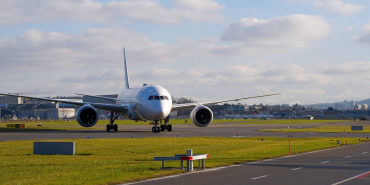
Airbus quite clearly prioritized digital commonality and software-defined handling; Boeing, on the other hand, took a radically different path with its widebody family. When designing the fly-by-wire Boeing 777 and the subsequent Boeing 787, engineers deliberately chose to retain the traditional, floor-mounted control yoke instead of shifting to a side-stick. Boeing’s decision came from its own distinct philosophy that prioritizes direct visual feedback and absolute crew coordination over cockpit spaciousness. The key for the US manufacturer is to keep the pilot controls linked across the flight deck, so that both crew members remain instantly aware of any manual inputs or automated adjustments.
If one pilot pulls back on the yoke, the opposite yoke moves in perfect unison, different from an Airbus cockpit, where both controls move independently. On the 787, for example, this design choice provides vital visual and sensory cues during critical flight phases, allowing a captain to immediately feel what the first officer or the autopilot is doing. However, preserving this legacy control interface comes at a high cost to training simplicity, as the 787 features a highly complex, integrated electrical system that departs heavily from older platforms. It explains why United Airlines has reported a high 14.2% pilot training failure rate on the 787.
A pilot transitions smoothly within a highly optimized differences course on the European side, but then moving to a widebody like the 787 is far less similar; more of an exhaustive, system-by-system re-education. Pilots need to master a completely different Flight Crew Operating Manual lineage, learning a vast array of interconnected systems that do not share a common software layer with older narrowbodies. Ultimately, this means airlines operating a mixed fleet from the US manufacturer face a much longer, more expensive, and structurally rigid training pipeline that lacks the rapid, fluid cross-fleet deployment pioneered by their rival.
The pursuit of flight deck commonality reaches its most controversial extreme in the Boeing 737 family. First certified in 1967, the original twinjet was designed for analog dials and manual cables. As the commercial aviation industry transitioned to digital systems, the manufacturer chose to repeatedly update the existing platform rather than design a clean-sheet narrowbody. The idea was to preserve the grandfathered type rating of the aircraft, so that pilots certified on the decades-old 737 Classic or Next Generation models could step into the advanced 737 MAX with only a brief computer-based training course. To achieve this certification miracle, the manufacturer had to ensure the heavy, aerodynamically altered MAX handled exactly like its lighter predecessors.
When the massive CFM LEAP-1B engines had to be mounted higher and further forward to maintain a ground clearance of only 18 inches (45.7 cm) under the low wing, it changed the pitching characteristics of the aircraft at high angles of attack. Rather than designing a new cockpit interface or mandating simulator training, engineers developed the Maneuvering Characteristics Augmentation System to run quietly in the background, replicating old handling qualities through automated stabilizer adjustments. The workaround was designed to remove the need for simulator differences training, protecting airlines from the millions of dollars in training expenses that would have been triggered by a new type rating.
What was meant to save money and time ended up costing lives. Following two tragic accidents, aviation authorities mandated comprehensive simulator training for all MAX pilots, breaking the very training exemption that served as the primary sales pitch for the program. Today, pilots need to study the unique systems differences, including the transition from a three-position landing gear lever on the 737 Next Generation to a simplified two-position system on the MAX. A seemingly minor tactile change actually brings with it strict mental adjustments, showing just how stretching a single flight deck identity across five decades introduces hidden complexities that simulator-free training can no longer safely paper over.
A closer look at how one key design choice from the 1960s still impacts the Boeing 737’s performance today.
Mixed fleet flying is the ultimate operational achievement of cockpit commonality, allowing a single pool of pilots to seamlessly switch between narrowbody and widebody operations. Under traditional rules, a pilot qualified on a narrowbody was locked into short-haul schedules, while widebody pilots remained strictly on long-haul routes. The division created massive scheduling inefficiencies, especially when a widebody flight was delayed and no qualified backup crew was available. Now unifying the digital cockpit layout and flight control characteristics across models, Airbus has helped remove these operational silos, allowing carriers to schedule a single pilot for a short regional hop in the morning and an intercontinental flight in the afternoon.
Scheduling flexibility translates directly into massive financial savings for major global operators. Airlines can run highly dynamic crew pairings, significantly reducing the reserve pilot padding normally required to cover unexpected sickness or flight disruptions. For example, a major carrier operating in the East Asian market, where slots are constrained and scheduling is notoriously complex, can dynamically swap an A320 for a high-capacity A350 on a busy trunk route without needing to scramble a separate crew. Takeoffs and landings on one Airbus model count toward the regulatory recency requirements of the other, meaning pilots maintain their legal currency across both types with minimal administrative overhead.
However, this fluid transition places a unique cognitive demand on the crew. While the flight control laws normalize the hand-flying feel of the aircraft, making a giant A350 handle with the responsiveness of a much smaller A320, pilots must remain highly disciplined regarding weight, inertia, and approach speeds. Spacing and stopping distances vary dramatically when transitioning from a jet weighing 170,000 lb (77,111 kg) to one that exceeds 600,000 lb (272,155 kg). The success of mixed fleet flying relies entirely on the software’s ability to mask these physical disparities, convincing the pilot’s muscle memory that they are operating the exact same aircraft, regardless of the reality outside the cockpit windows.
The next battleground for commercial aviation dominance will still be the software architecture of the flight deck itself, only likely a more intense battle. As manufacturers look toward the future, they are designing cockpits that resemble consumer electronics, featuring large panoramic touchscreens, synthetic vision systems, and highly automated flight guidance. These developments are laying the groundwork for single-pilot operations, where advanced artificial intelligence and ground-based support stations will replace the traditional two-pilot crew on long-haul routes.
When an airline buys a modern jet, how its pilots think, react, and train has to be considered. A carrier that has invested heavily in training its staff on one manufacturer’s computerized interface cannot easily purchase aircraft from a rival without incurring astronomical retraining costs. For a manufacturer, the software barrier acts as an invisible moat, protecting the market share and giving them immense leverage during fleet renewal negotiations.
Aviation is moving closer to fully autonomous operations, and this software lock-in will only intensify as a result. Future flight decks will likely feature single-pilot configurations assisted by advanced flight management algorithms that handle everything from routine navigation to complex emergency checklists. In this high-tech environment, the handling of the aircraft becomes completely secondary to the pilot’s interaction with the software suite.
Orijinal Haberi Görüntüle