



Aircraft design is a constant exercise in balancing various technologies. Engineers rarely have the luxury of maximizing every performance metric simultaneously; instead, they make carefully calculated compromises between fuel efficiency, weight, operating costs, emissions, passenger comfort, and regulatory compliance. One of the clearest examples of this balancing act can be found on three modern Boeing aircraft families: the 787 Dreamliner, 747-8, and 737 MAX.
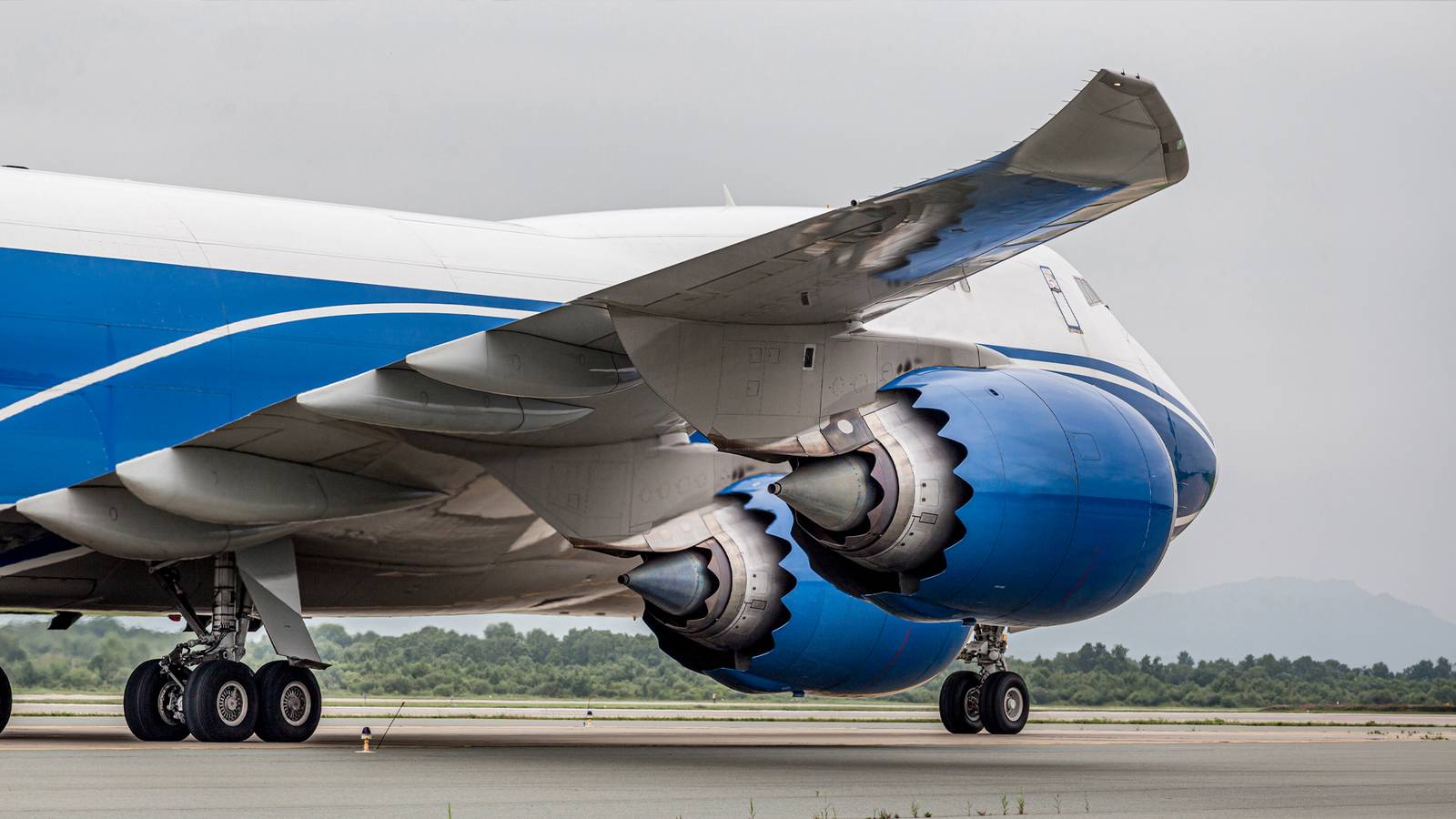
At first glance, the distinctive serrated edges on their engine nacelles appear to be an unusual styling feature. In reality, these “chevrons” represent years of research by Boeing, GE Aerospace, and NASA into reducing aircraft noise around airports. While the technology successfully makes aircraft quieter during takeoff and landing, it also introduces a small but measurable aerodynamic penalty that increases fuel consumption throughout every flight. As Boeing prepares the next generation of aircraft, the company has largely moved away from this technology, highlighting how even successful engineering solutions can eventually be superseded by better ones.
Why Boeing Added Serrated Engine Nozzles To Three Modern Aircraft
The sawtooth-shaped serrations found on the trailing edge of certain Boeing engine nacelles are officially known as chevrons. They were developed through a collaboration between Boeing, GE Aerospace, and NASA during the early 2000s as airlines faced increasingly stringent airport noise regulations and growing public concern over aircraft noise near major hubs. Instead of redesigning the entire engine, engineers looked for a way to reduce the sound generated as exhaust gases exited the engine. According to NASA, the solution was surprisingly elegant despite its unusual appearance: reshape the nozzle itself to control how the exhaust flows mix together.
Modern high-bypass turbofan engines produce two distinct exhaust streams. The extremely hot, high-speed core exhaust exits the center of the engine, while a much cooler, slower-moving bypass airflow surrounds it. When these two streams meet the surrounding atmosphere, they create intense turbulence that generates a significant proportion of an aircraft’s jet noise. Chevrons create carefully controlled vortices that encourage these flows to mix more gradually, reducing the abrupt velocity difference responsible for much of the characteristic engine roar. Boeing’s development program demonstrated that this smoother mixing process significantly reduced community noise without requiring major changes to the engine’s internal architecture.
Today, chevrons are fitted to every Boeing 787 Dreamliner regardless of engine choice, including both the Rolls-Royce Trent 1000 and GE GEnx. They also appear on the Boeing 747-8’s GEnx-2B engines and on every member of the Boeing 737 MAX family powered by the CFM LEAP-1B. These three aircraft represent Boeing’s largest adoption of the technology, making the serrated nacelles one of the manufacturer’s most recognizable modern design features. While other manufacturers experimented with similar concepts during testing, Boeing became the only major airframer to deploy chevrons across multiple commercial aircraft programs after securing patents covering the design.
Every Decibel Comes At A Cost: The Hidden Fuel Burn Penalty
Reducing jet noise is undeniably valuable, particularly for airports surrounded by dense urban development. However, the aerodynamic mechanism that makes chevrons effective also introduces an unavoidable compromise. The vortices generated by the serrated nozzle disturb the exhaust flow, reducing its overall efficiency and slightly decreasing the engine’s available thrust. Although the effect is relatively small, commercial aviation operates on margins where fractions of a percentage point can have significant financial consequences over thousands of annual flights.
According to the Mentour Pilot channel analysis, chevrons are estimated to reduce available engine thrust by approximately 0.5%. That figure may sound insignificant, but airlines spend billions of dollars each year on fuel, and even tiny increases in fuel burn can translate into millions in additional operating costs across an entire fleet. Because chevrons are permanently fixed to the nacelle, they remain in the exhaust stream during every phase of flight, not just during the noisy takeoff and landing segments when their acoustic benefits are actually needed. This means the thrust penalty continues during climb, cruise, and descent, where airport noise regulations are largely irrelevant.
Higher cumulative fuel burn over frequent short-haul operations
The compromise is arguably most significant on the 737 MAX, where aircraft often perform numerous short sectors every day. Unlike long-haul aircraft that spend many hours cruising after a single takeoff, narrowbody fleets repeatedly cycle through high-thrust phases while also accumulating the continuous cruise penalty across multiple flights. Over months and years of intensive utilization, even a fractional reduction in engine efficiency becomes meaningful for airlines seeking every possible fuel-saving opportunity. The chevrons therefore illustrate a classic engineering trade-off: improving one aspect of aircraft performance (in this case, noise), while knowingly accepting a measurable reduction in another.
Both of these engines power the Boeing 787 Dreamliner.
Why Airbus Refused To Adapt Boeing’s Chevron Technology
For many years, Boeing’s distinctive engine chevrons were unique within commercial aviation. Boeing even held patents covering the serrated nozzle design, preventing competitors from adopting the concept until those protections expired in 2021. During that period, Airbus had little choice but to pursue alternative methods of reducing engine noise. However, even after the patents lapsed, the European manufacturer showed no interest in adding chevrons to any of its aircraft, including the A320neo family, A330neo, and A350. That decision reveals how differently the two aerospace giants approached the same engineering challenge.
Instead of modifying the exhaust nozzle itself, Airbus concentrated on making the engine inherently quieter. Modern Rolls- Royce Trent XWB engines powering the A350, for example, combine extremely high bypass ratios with sophisticated acoustic liners inside the nacelle. These sound-absorbing materials reduce noise before it even exits the engine, while aerodynamic refinements minimize turbulence without introducing additional drag. According to A350 Chief Engineer Dougie Hunter, Airbus evaluated chevrons during development but ultimately concluded that they offered little real-world benefit once the complete aircraft design was considered. As Hunter explained:
“We didn’t get a noise advantage from chevrons, and there is a specific fuel consumption penalty, so we’ve not adopted them.”
His comments neatly summarize Airbus’ philosophy: if a technology increases fuel burn, it must deliver a substantial operational advantage to justify its inclusion. Boeing’s serrated nozzles did not clear that threshold in Airbus’ analysis, particularly as newer engine architectures continued becoming quieter through other means. Instead, Airbus invested heavily in nacelle acoustic treatments, fan design, and ever-larger bypass ratios, achieving compliance with increasingly strict international noise standards without adding permanent structures to the exhaust nozzle.
The differing philosophies also reflect broader design priorities. Boeing accepted a small reduction in cruise efficiency to satisfy community noise requirements around airports, while Airbus prioritized maintaining maximum engine performance throughout every phase of flight. Neither approach is inherently right or wrong; both satisfy certification requirements. However, the contrast demonstrates that aircraft design often involves multiple valid engineering pathways toward the same objective, with manufacturers making different decisions based on their overall optimization strategy rather than individual technologies alone.
The 787 Dreamliner Was The Exception That Made The Trade-Off Worthwhile
Although chevrons impose a measurable aerodynamic penalty, the Boeing 787 Dreamliner demonstrates why engineering decisions cannot be evaluated in isolation. That is why Boeing considered the aircraft as an integrated system. Because the GEnx and Trent 1000 engines produced significantly less cabin and external noise thanks to the chevrons, engineers discovered they could remove a considerable amount of traditional soundproofing from elsewhere in the aircraft.
According to Boeing, the quieter engines allowed approximately 600 lb (272 kg) of insulation material to be eliminated from the fuselage. Weight is one of the most valuable commodities in commercial aviation, and every pound removed reduces fuel consumption over the aircraft’s entire service life. The resulting weight savings partially compensated for the slight loss of thrust caused by the serrated exhaust nozzles. In other words, while the engines became marginally less efficient aerodynamically, the aircraft itself became lighter, offsetting much of the penalty during everyday operations.
The Dreamliner’s extensive use of carbon-fiber composites further amplified these benefits. Boeing designed the 787 around a philosophy of cumulative efficiency gains, where dozens of relatively small improvements combined to deliver a substantial overall reduction in operating costs compared with previous-generation widebodies. Composite structures reduced structural weight, advanced aerodynamics lowered drag, more-electric systems improved efficiency, and chevrons contributed to quieter operations while enabling lighter cabin construction. Seen individually, each innovation offered only incremental improvements. Together, they helped make the 787 one of the most fuel-efficient long-haul aircraft ever built.
The Dreamliner represents an important reminder that aircraft engineering is about system optimization rather than component optimization. A feature that appears disadvantageous on paper may become worthwhile once its secondary benefits are considered across the aircraft as a whole. In the case of the 787, the quieter engines did more than satisfy airport noise regulations, as they enabled Boeing to redesign the aircraft itself around a lighter, more efficient cabin structure, making the overall compromise far more attractive than it initially appears.
Discover the engineering behind the 777X’s engine.
Boeing’s Newest Widebody Shows The Future Lies Beyond Chevrons
The Boeing 777X demonstrates that even successful technologies eventually become stepping stones to something better. Early concepts for the aircraft featured the familiar serrated engine nacelles seen on the 787 and 747-8, leading many observers to assume Boeing would simply carry the design forward. Instead, the production aircraft abandoned chevrons altogether, replacing them with a completely new exhaust nozzle architecture developed jointly by Boeing and GE Aerospace for the GE9X, the world’s largest commercial turbofan.
The breakthrough came from advances in ceramic matrix composites (CMCs), a new generation of heat-resistant materials capable of withstanding temperatures far beyond conventional metal alloys. Because CMCs tolerate much higher operating temperatures while remaining significantly lighter, engineers were able to redesign the engine’s exhaust system to create a more naturally mixed flow of core and bypass air. Rather than relying on fixed serrations to generate vortices, the nozzle itself produces smoother airflow with less friction and lower drag. The result is comparable community noise levels without the continuous cruise performance penalty associated with chevrons.
GE Aerospace’s 777X Chief Project Engineer Terry Beezhold explained the reasoning behind the change:
“We are replacing the chevrons with a new nozzle design technology. It provides equivalent levels of noise for the cabin and community but is lighter in weight and has lower drag.”
Beyond eliminating the aerodynamic penalty, the redesigned nozzle is also around 20% lighter than previous exhaust systems, providing an additional efficiency benefit. For Boeing, this represents the natural evolution of engine design. The company did not abandon the principle of reducing aircraft noise. It just found a more elegant way of achieving the same objective using new materials and more advanced aerodynamics. As technologies continue to mature, fixed chevrons increasingly appear to be an intermediate solution rather than the long-term future of commercial engine design.
A Small Engineering Detail That Reveals How Aircraft Design Really Works
Passengers rarely pay attention to the sawtooth edges on a Boeing engine, but those distinctive serrations tell a much larger story about modern aircraft development. Commercial aviation is built on thousands of engineering compromises, where improvements in one area often require sacrifices elsewhere. Chevrons illustrate this reality perfectly. They reduced aircraft noise enough to satisfy increasingly demanding environmental standards around airports, but they also imposed a small aerodynamic cost that airlines carry throughout every flight.
Perhaps the most interesting lesson is that the “best” solution depends entirely on the aircraft itself. On the 787 Dreamliner, the quieter engines enabled Boeing to remove around 600 lb (272 kg) of insulation, helping offset the thrust penalty through lower aircraft weight. On the high-utilization 737 MAX, however, the cumulative fuel burn penalty is more difficult to recover because the aircraft performs multiple sectors every day. Meanwhile, the 747-8 benefited from quieter operations at noise-sensitive airports, while the 777X demonstrates that advances in materials science have largely eliminated the need for the technology altogether. The same feature therefore delivers different overall value depending on the aircraft’s mission, design philosophy and operating environment.
Chevrons remain one of the most recognizable visual signatures of modern Boeing aircraft, but their legacy extends well beyond appearance. They represent an important chapter in the evolution of quieter commercial aviation and demonstrate how aerospace engineers constantly refine existing ideas rather than searching for perfect solutions. As future engines become quieter through improved aerodynamics, higher bypass ratios and advanced composite materials, the serrated nacelles of the Boeing aircraft may ultimately be remembered as a clever transitional technology that successfully balanced competing priorities until something even better arrived.
Orijinal Haberi Görüntüle