
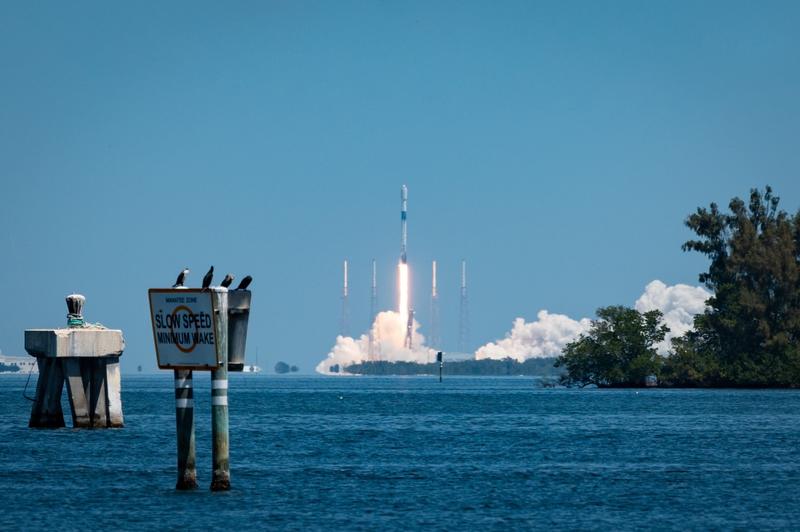


SpaceX (SPCX +1.08%) finally got Starship into orbit. On Monday, Sept. 28, the huge rocket's upper stage reached orbit for the first time and released 26 of the company's next-generation V3 Starlink satellites. An engine issue ended the mission early.
This might look like bad news for Rocket Lab (RKLB -0.03%). The space company is spending a lot on Neutron, a reusable rocket designed to compete for the sort of launch work SpaceX's Falcon 9 does now. And shares of the growth stock trade near $70 as I write, under half the 52-week high of $151.
Does a working Starship threaten Rocket Lab? I think it does, but mainly through Neutron, which hasn't flown yet.
A full Starship load of V3 satellites is designed to add as much capacity to Starlink as around 20 Falcon 9 flights of the smaller satellites SpaceX launches now. The flight carried 26 of the up to 60 V3 satellites SpaceX eventually plans to fly on every mission.
Most of SpaceX's launches already go to Starlink. The company flew 78 launches in the first half of 2026, and 61 of those were internal launches, mainly for Starlink. Just 17 were customer launches, down from 21 in the first half of 2025.
Put simply, Starship's job for now is building out SpaceX's own network.
Rocket Lab is a satellite company as much as a rocket company.
Launch services brought in around $108 million of its $434 million in first-half revenue, or about 25% — a falling share, down from about 33% for all of 2025. Space systems (spacecraft, satellite components, and related services) made up the rest. That business grew 76% from the first half of 2025, helped by acquisitions, much faster than launch revenue's 32% rise. And around $1.4 billion of the company's $2.36 billion backlog at the end of June was linked to space systems.
Most of that doesn't rely on beating SpaceX to a launch contract.
The launch backlog, though, is growing faster. It almost doubled over six months: around $476 million when 2025 ended, $921 million by March 31, and $940 million by June 30. Launch now makes up 40% of the total backlog, up from about 26% at the start of the year.
Most of the rise was in the first quarter, when Rocket Lab signed five new dedicated Neutron launches and said it sold more launches than in all of 2025.
Rocket Lab doesn't say how much of the backlog is tied to Neutron. But some of the launch growth investors are banking on rides on a rocket that hasn't flown.
Neutron is a medium-lift rocket built to carry around 13,000 kilograms to low Earth orbit in its reusable version. Rocket Lab says it's tailored for commercial and U.S. government constellation launches. That pits it against Falcon 9 much more than Starship.
Some of Neutron's demand also comes bundled with spacecraft Rocket Lab makes itself. The U.S. Space Force awarded the company a $397 million contract (including options) to build Flatellite spacecraft that will launch on Neutron. A customer buying the satellites and the ride together is arguably tougher for a rival rocket to lure away.
I think the bigger risk is indirect. If Starship takes over Starlink deployment, Falcon 9 flights now used for SpaceX's own satellites might free up for paying customers — the same constellation operators Neutron is after. More available Falcon 9 capacity may pressure launch prices right as Neutron tries to break in.
Of course, Starship isn't flying Starlink on a regular schedule yet, and SpaceX is still working toward the full and rapid reusability it's relying on to lower launch costs.
But Neutron isn't in the market yet, either. Rocket Lab said in August that it still aims to deliver the rocket to its pad in the fourth quarter, though the chance of a first launch before the end of 2026 is fading.
Still, is Starship a threat to Rocket Lab stock? I'd say yes, even though it hardly affects the space systems business that pays most of Rocket Lab's bills today. The pressure falls on launch growth, and launch growth is a big part of what investors are paying for in the stock's valuation.
At around $70 a share, Rocket Lab trades at over 40 times its annualized revenue. Its free cash flow was also negative by about $188 million in the first half. Plus, the company's next growth engine might face a cheaper, more available Falcon 9 by the time it flies. I think the stock's too pricey to own through that uncertainty.