

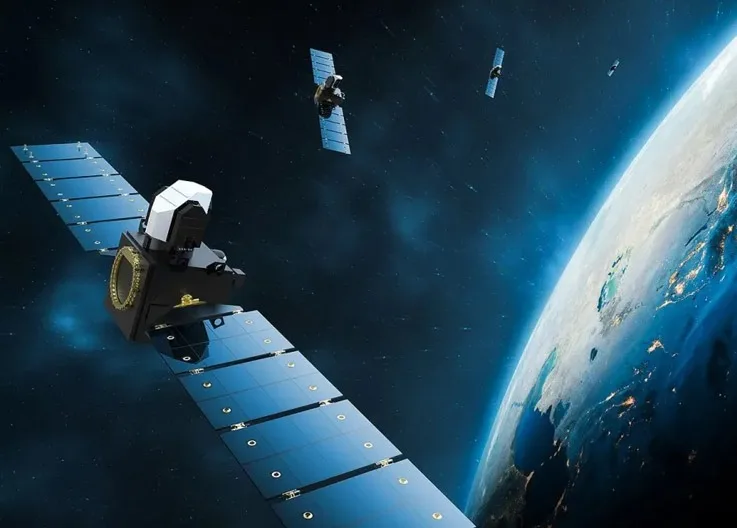


SEATTLE — Boeing is set to unveil its sensor fusion technology aimed at enhancing military situational awareness by integrating data from both aerial and space sources. Kay Sears, Boeing’s Vice President and General Manager of Space, Intelligence, and Weapons Systems, emphasized that the goal is to provide timely and relevant information to operators and personnel on the ground or in cockpits.
Boeing’s initiative includes integrating data from the E-7 command and control aircraft, developed for the U.S. Air Force, with missile-tracking satellites developed by Millennium Space for the U.S. Space Force. This air-space fusion aims to deliver faster, more effective information for military operations. Sears introduced this technology at the Air, Space, and Cyber Conference on September 16, stressing the importance of real-time data by saying, “We need to make sure those lightning strikes are really happening.”
Missile Tracking with LEO and MEO Satellites
Boeing’s sensor fusion effort encompasses two key satellite programs awarded to Millennium Space. The first is the “Foo Fighter” constellation, a $414 million low Earth orbit (LEO) missile-tracking satellite network developed for the U.S. Space Development Agency. These satellites are equipped with electro-optical and infrared sensors to detect and track advanced missile threats, including hypersonic missiles.
The second integration target includes medium Earth orbit (MEO) missile-warning satellites, built by Millennium Space under a $500 million contract for the U.S. Space Force. Sears highlighted that when combined with the electronically scanned array radar of the E-7 Wedgetail, this integration will provide a multi-domain operational picture.
Expanding Capabilities and Challenges
The E-7 Wedgetail, used by several militaries, can simultaneously track moving air and sea targets. Integrating space-based data will significantly expand these aircraft’s capabilities, allowing real-time tracking of missile threats over greater distances.
The sensor fusion initiative aligns with the Department of Defense’s broader efforts to integrate siloed technologies. However, Sears pointed out that the DoD’s organizational structure poses challenges to such integrations.