
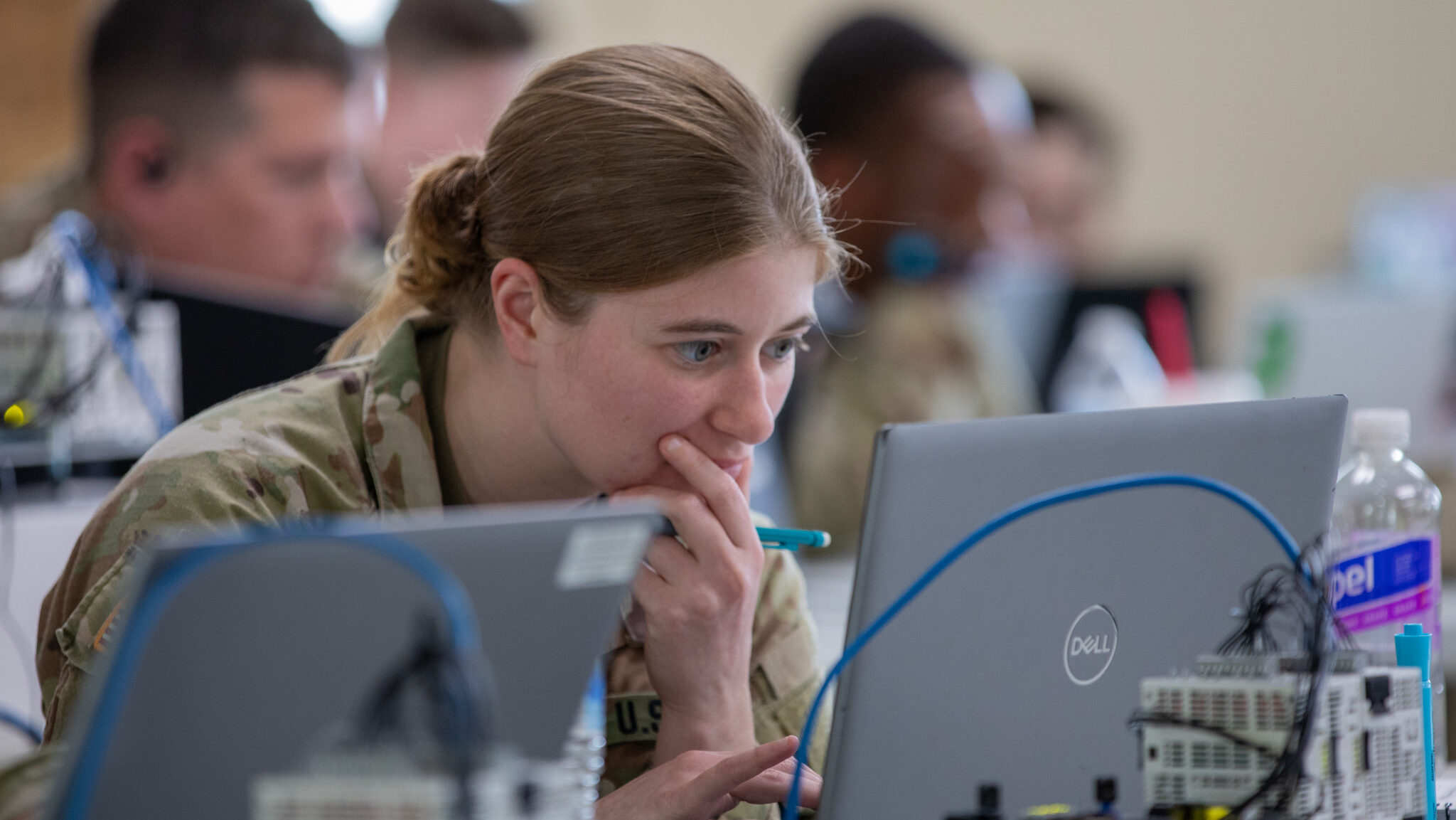


AUGUSTA, Ga. — Army Cyber Command is training AI agents in various “work roles” to serve alongside humans to operate at machine speed, according to its commander.
“Every agent we create is trained in a work role inside the cyber force,” Lt. Gen. Christopher Eubank, commander of ARCYBER, said on Tuesday at the TechNet Augusta conference. “We’ve created developers, data engineers, host analysts, exploitation analysts. You name the work role, we’re creating those. And then we’re training them to the same standard that humans get trained to. So agents have a work role; they’re JQR [Job Qualification Readiness-approved]. They get trained. They get set on a mission with a human watching and deliver results.”
When those agents make mistakes, he said, they’re taught the way to do it, and the agent goes back in and retrains itself.
The work is housed under the command’s Task Force Lexington, a clearing house for all its AI efforts, led by a soon-to-be colonel with a team of around 10 “high-speed folks,” Eubank added.
AI agents are performing critical work such as hunting on the network for cyber threat and intrusions, Eubank said. AI tools are also performing cybersecurity service provider risk management framework and Enterprise Mission Assurance Support Service. ARCYBER also now has an agentic red team and 17 cyber protection team mission elements focused on the network every day.
“Defending and operating the network is definitely a thing that humans are doing right now. We’re doing it at human speed … But our adversaries are doing it at machine speed and we must catch up and we must get ahead,” Lt. Gen. Jeth Rey, Deputy Chief of Staff, G-6, said during the same panel. “That’s the reason why that this is important for agentic AI to be leading the way on this effort that we’re doing. Because the network, what we call the weapon system, our warfighting weapon system, is actually the foundation to everything that we do right now. We can’t fire rounds without it, we can’t move people without it, we can’t operate on a daily basis without it.”
Eubank was sure to caution that AI agents are not yet performing work that assumes risk — a task still reserved for humans.
“Each and every day, we sit down as a group, we figure out the guardrails we’re going to apply to these agents. We ask ourselves, ‘Is it risk that a human should be answering, or is it risk that an agent can answer?’” he said. “We have not turned any agents loose to assume risk on their own behalf. But this is a monumental point as we operate, secure, defend, and attack the network.”
He added that there is a “delicate dance” on balancing risk because the agents move much faster than humans. The agents check in with their human counterparts, who checks the work and send the analytic support officer agent back on task.
To ensure these engineers within the command are at the top of their game, Eubank said he sent the entire Task Force Lexington to the Defense Innovation Unit recently to sit down with senior engineers to improve their technical expertise.
Orijinal Haberi Görüntüle