
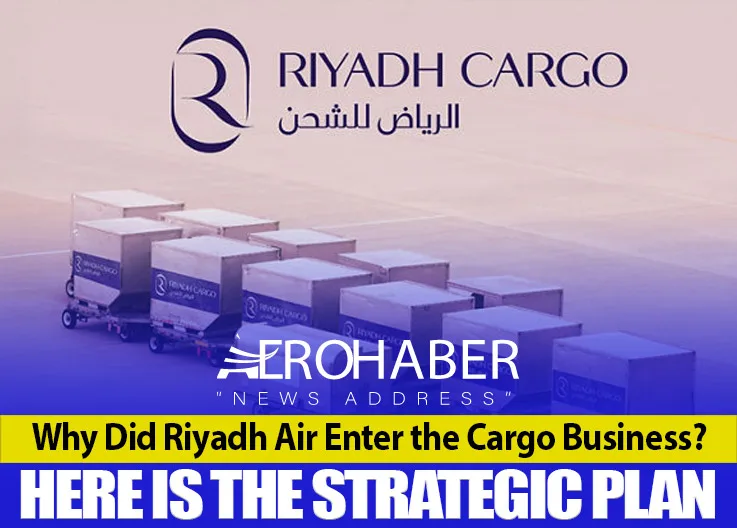


Saudi Arabia’s new national airline, Riyadh Air, has taken its first concrete step towards transforming Riyadh into a global logistics hub by launching its cargo operations under the brand “Riyadh Cargo”.
Riyadh Air, Saudi Arabia’s new national airline, announced that it has officially launched its cargo operations under the “Riyadh Cargo” brand. This move marks the airline’s entry into the global air cargo market and the activation of cargo transportation within its wide-body aircraft fleet.
Riyadh Cargo has been designed with a scalable structure to utilise the cargo capacity of more than 120 modern wide-body aircraft ordered by Riyadh Air. Operations are set to grow in parallel with the airline’s passenger network, aiming to make global trade flows more efficient and reliable.
Strategic Contribution to Vision 2030
Saudi Arabia aims to advance its Vision 2030 goals by establishing a large-scale air cargo operation that will enable global trade and connectivity. The launch of Riyadh Cargo is considered a strategic step towards creating an integrated, Riyadh-based logistics ecosystem that will grow progressively over time.
Operational Launch on the London Route
As part of Riyadh Air’s “Path to Excellence” programme, Riyadh Cargo successfully carried out its first operations on the Riyadh – London Heathrow route. Within this scope, time-sensitive, perishable and high-value goods such as apparel and textiles, fresh flowers, seafood, tea and coffee were transported.
These operations demonstrated Riyadh Cargo’s capability to manage different cargo segments in a reliable and consistent manner.
“Built with a Focus on Long-Term Scalability”
Pravin Singh, Global Head of Cargo at Riyadh Air, made the following remarks regarding the launch of Riyadh Cargo:
“Riyadh Cargo has been built with a focus on operational discipline, reliability and long-term scalability. Becoming operational in a real-world environment allows us to test our processes, learn and continuously improve. This launch is a fundamental step towards building a cargo business that grows alongside our network and supports Saudi Arabia’s logistics ambitions.”
Digitally Focused Cargo Ecosystem
While digital capability is among Riyadh Air’s core values, Riyadh Cargo operations have also integrated dedicated cargo management systems, centralised air waybill control and advanced data visibility solutions. Round-the-clock accessible air waybill stock management provides a critical advantage in terms of operational efficiency.
In this context, Riyadh Cargo has partnered with CHAMP Cargosystems to implement the Cargo Spot-neo platform, enabling an end-to-end digital cargo management infrastructure. The system supports service reliability despite increasing volumes and network complexity.
In addition, as part of a collaboration with Unilode, digitally trackable, lightweight and durable Unit Load Devices (ULDs) are being used. These investments enable real-time tracking, inventory optimisation and sustainable cargo operations.
Strategic Partnership in Ground Handling
Riyadh Cargo’s ground handling and hub operations are carried out in partnership with SATS Saudi Arabia. Services are provided at key airports across the Kingdom, including:
- King Khalid International Airport, Riyadh (KKIA)
- King Fahd International Airport, Dammam (KFIA)
- King Abdulaziz International Airport, Jeddah (KAIA)
Thanks to modern facilities and a centralised management structure, real-time oversight and seamless cargo connectivity are ensured.
A Key Pillar of Global Growth
Riyadh Air aims to reach more than 100 destinations by 2030 and operate a fleet of over 180 aircraft. The airline is expected to contribute approximately USD 20 billion to Saudi Arabia’s non-oil GDP and support more than 200,000 direct and indirect jobs.