
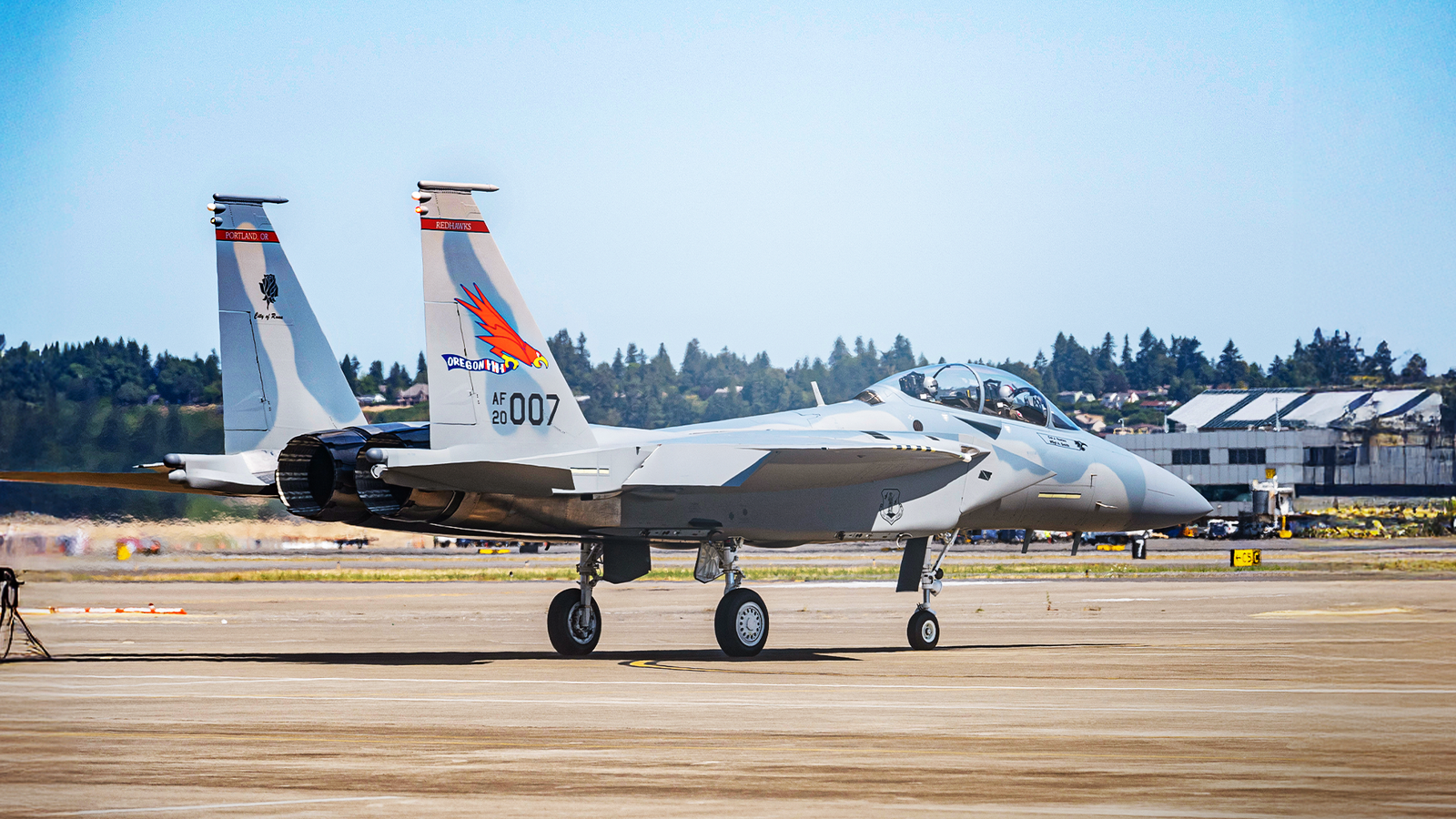


Despite serving for half a century, the McDonnell Douglas F-15 Eagle, a super fighter of the Cold War, continues to roll off the line even in the era of fifth- and sixth-generation stealth fighters. Leveraging the plane's incredible performance and massive ordnance payload as key selling points, the assembly line is unlikely to be shuttered in the near future under Boeing's leadership. The venerable strike fighter's reputation is backed by the demonstrated readiness level of the first batch delivered to an active-duty squadron.
At a time when the US Air Force (USAF) has its smallest fleet since it was established as its own service branch, every plane matters. The first 16 F-15EX Eagle II fighters averaged a 72.4% availability rate in fiscal 2026. While this performance comfortably clears the program's 60% rapid fielding threshold, it falls 7.6 points short of the long-term 80% objective.
Additionally, the 42 losses the USAF suffered during Operation Epic Fury have stretched its available airframes even further. The multirole qualities combined with cutting-edge technology make the 4.5-gen Eagle II an exceptionally versatile and capable plane to fill gaps across the force. The technical maturity of the design and familiarity of the plane also make it a highly valuable platform simply considering reliability alone.
As part of its ongoing 'divest to invest' procurement strategy, the Air Force plans to permanently station 36 F-15EX Eagle IIs at Kadena Air Base to replace 48 retired F-15C and F-15D fighters. However, those planes are already gone, and their replacements have not arrived. Ever since those older jets left, temporary fighter squadrons have been rotating through the base to keep it covered.
The first new Eagle IIs were supposed to land at Kadena, 5,081 miles (8,177 km) away from the manufacturing line, by early 2026. However, a factory strike threw a wrench in that timeline, forcing rotational squadrons to substitute. That has included several Lockheed Martin F-35A and F-16C squadrons, all of which were forced to stretch their deployments.
Earlier this year, 18th Wing Commander Brigadier General John Gallemore commented to Air and Space Forces Magazine:
“The F-15EX represents the next chapter of airpower at Kadena. Our Airmen have the opportunity to train with the aircraft, build confidence in its capabilities, and ensure we’re ready to project lethality and integrate into operations as we continue providing combat power in support of a free and open Indo-Pacific.”
“The F-15EX represents the next chapter of airpower at Kadena. Our Airmen have the opportunity to train with the aircraft, build confidence in its capabilities, and ensure we’re ready to project lethality and integrate into operations as we continue providing combat power in support of a free and open Indo-Pacific.”
Since then, the delivery schedule has slipped even further. Production delays have pushed the first overseas shipments to the first quarter of fiscal 2027, delaying the permanent Kadena buildup deep into the calendar year. Even the training pipeline at Portland Air National Guard Base in Oregon is jammed up, as the schoolhouse won't get its full batch of jets until later this year.
Material availability measures the exact share of a fighter fleet fit to fly its assigned missions at any given moment, rather than sitting in maintenance or waiting on parts. Official reporting shows that the F-15EX fleet achieved a 72.4% availability rate earlier this year. However, two major cautions apply to these positive numbers.
First, the data snapshot only covers 16 relatively new airframes, which says very little about how a massive fleet of 268 jets will perform over time. Secondly, the tracking window represents less than five months of flight operations rather than a full year of fleet performance.
Commenting on the transition, Lieutenant Colonel Casey Watts remarked to Air and Space Forces Magazine:
“Building familiarity with the aircraft now will help ensure a smooth transition as the Eagle II becomes part of Kadena’s long-term mission and strengthens combat readiness across the Indo-Pacific.”
“Building familiarity with the aircraft now will help ensure a smooth transition as the Eagle II becomes part of Kadena’s long-term mission and strengthens combat readiness across the Indo-Pacific.”
Still, this performance figure easily clears the 60% minimum threshold set by Air Combat Command, sitting 12.4 points above the baseline requirement and only slightly below the 80% ideal objective. While the available reports do not itemize exactly what kept the rate below the 80% finish line, the Pentagon has stated that the aircraft continues to meet all approved technical performance and cost thresholds. The jet has shown no significant software problems, unlike the F-35 Joint Strike Fighter. That suggests the minor availability gap is an operational hurdle rather than a fundamental design flaw.
A massive strike by the International Association of Machinists shut down the St. Louis production line for months. By mid-April 2026, the company had handed over only 18 aircraft instead of the required 33. The third production batch of 12 jets was supposed to finish early this year, but now only six will arrive before next year, pushing the rest of the batch into mid-2027.
Air Force leadership considers these delays unrecoverable, largely because the previous batch was already running significantly behind schedule. This production bottleneck directly breaks the timeline for full operational capability. Reaching this milestone depends completely on the delivery of the 44th aircraft, which has now slipped from the original summer 2027 target to early 2028.
Colonel Jessica Kashka, F-15EX Program Manager, remarked to Air Force Materiel Command on the efforts by Boeing's production team to resume deliveries at full pace following the labor disruption. She gave a positive outlook on the situation, saying:
“The rapid turnaround highlights the strength and dedication of the joint government and industry team. Their success ensures that the nation's warfighters receive the advanced capabilities of the F-15EX, reinforcing the Air Force's commitment to maintaining a ready and lethal force.”
“The rapid turnaround highlights the strength and dedication of the joint government and industry team. Their success ensures that the nation's warfighters receive the advanced capabilities of the F-15EX, reinforcing the Air Force's commitment to maintaining a ready and lethal force.”
The USAF had to submit a formal program deviation report because of the delivery interruptions to the F-15EX program. The service was forced to completely rewrite its schedule. To try to speed things up, the company is adding assembly workers, using digital tools on complex parts, and bringing in outside manufacturing specialists. The company needs to build two aircraft every single month just to meet its next set of commitments.
In July, USAF Under Secretary Matt Lohmeier delivered a sober assessment of the fleet's current readiness. During his address at the AFMC Life Cycle Industry Days, he issued a warning about chronic underinvestment, saying:
"We have incredible systems, platforms, and munitions… but we need more of just about everything. We have to keep the quality, increase the quantity, decrease the cost, and accelerate delivery… If we can't recapitalize our platforms at the rate that we're forced to retire them, the math is simple: we will continue to get smaller."
"We have incredible systems, platforms, and munitions… but we need more of just about everything. We have to keep the quality, increase the quantity, decrease the cost, and accelerate delivery… If we can't recapitalize our platforms at the rate that we're forced to retire them, the math is simple: we will continue to get smaller."
However, the exact timeline for the arrival of the next batch remains unclear. Some industry observers point to a mid-2027 start, while others are projecting a slip into 2028. Inventory counts also vary depending on whether test aircraft are included, but the bottom line is that these manufacturing delays directly hurt the front-line units waiting for new fighters.
Comparing the top brawlers of air warfare in 2026.
Another complication is the fact that the planned purchase quantity for the F-15EX has fluctuated wildly since Boeing won the contract. The target shifted from an initial 144 jets down to 80, bounced back up to 104 and then 129, and finally spiked to a planned 267 aircraft under the fiscal 2027 budget request.
Official Pentagon reports frame this massive expansion against a stricter June 2024 baseline of 96 production aircraft and two development models, meaning the program has essentially tripled relative to its formal baseline. The 170 additional fighters needed to reach the new target include 21 jets covered by fiscal 2024 supplemental funds, one tacked on by Congress, and 148 scheduled through fiscal 2031.
This aggressive scale-up directly shifts the fighter's long-term operational role. Rather than just replacing the retired F-15C and F-15D models, the newly added aircraft will begin phasing out the aging F-15E Strike Eagle fleet.
The bases that power America's massive counter-missile dome.
Air Force Secretary Troy E. Meink has repeatedly endorsed the idea of multiyear procurement for fighter jets, including next-gen stealth fighters and the 4.5-gen F-15EX. He enthusiastically endorsed the 'Airpower Acceleration Act' in April. It was introduced by Senator Ted Budd and Senator Jeanne Shaheen, and was later largely incorporated into the 2027 National Defense authorization bill.
According to Air and Space Forces Magazine, Meink remarked:
“Because [of] the instability in the [F-15EX] production rates and the unknown future, the contractor [Boeing] just couldn’t make the investments necessary to tool up and improve. [Long-term] stability allows a contractor to do those things that eventually save the government money, and allow us to produce those aircraft quicker.”
“Because [of] the instability in the [F-15EX] production rates and the unknown future, the contractor [Boeing] just couldn’t make the investments necessary to tool up and improve. [Long-term] stability allows a contractor to do those things that eventually save the government money, and allow us to produce those aircraft quicker.”
Air Force leadership maintains that they must buy at least 72 total fighters annually to prevent the overall fleet from shrinking, using high-capacity F-15EX models alongside stealth F-35As to balance raw payload volume with radar evasion. Despite the expanded production run keeping average long-term procurement costs relatively steady, critics point out that individual flyaway costs have already climbed near the mid-$90 million range, putting the aircraft on par with the stealth fighters it was initially meant to be a cheaper alternative to.