

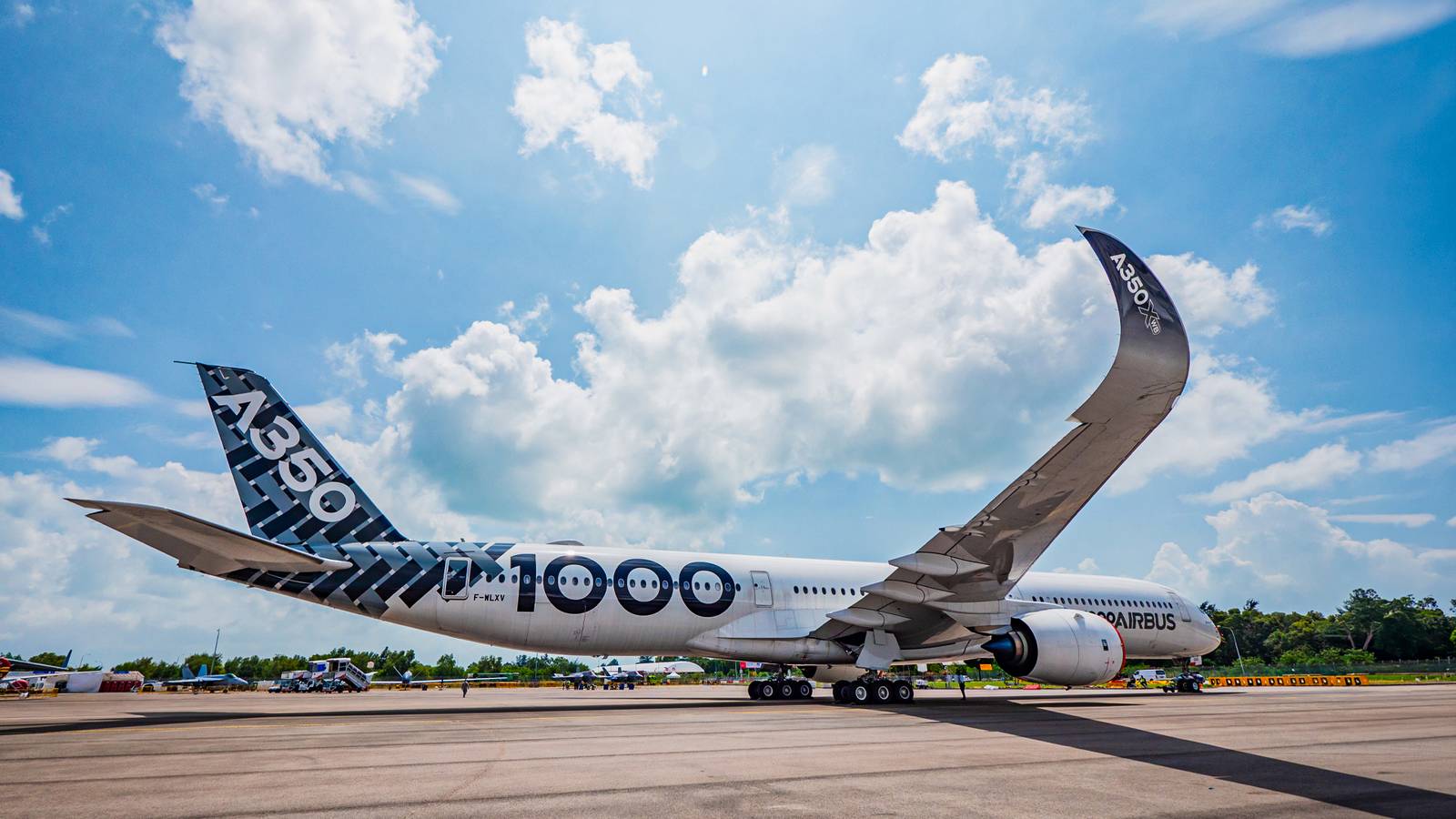


Passenger-to-freighter (P2F) conversions have become an established part of the commercial aviation ecosystem. By transforming aging passenger aircraft into dedicated cargo haulers, operators can extend airframe life while avoiding the cost of purchasing new-build freighters. Aircraft such as the Boeing 767, Boeing 737, and Airbus A321 have all found successful second careers in freight service through conversion programs. Now the Airbus A350features a modern design, long range, and impressive fuel efficiency, so it might seem like a natural candidate for a future P2F program. As the global cargo market continues to evolve and airlines gradually retire older aircraft, questions occasionally arise about whether the A350 could eventually follow the same path as earlier widebody passenger jets.
The short answer is that an A350 conversion is not technically impossible. Airbus has acknowledged that such a project could be engineered. However, feasibility from a purely technical standpoint is very different from economic viability. According to Airbus A350F Chief Engineer Joel Rocker, converting an A350 into a freighter is structurally possible, but the resulting aircraft would be significantly less efficient than a purpose-built freighter and would require extensive modifications that undermine the financial rationale for conversion.
As a result, the more accurate conclusion is not that an A350 P2F conversion cannot happen, but that it is highly unlikely to happen in practice. The combination of composite construction, structural reinforcement requirements, unfavorable fuselage geometry, extensive redesign needs, and poor economic returns creates a scenario in which no company has launched a conversion program, and none is currently planned. The reasons become clear when examining the aircraft’s design in detail.
Composite Fuselage Makes Major Structural Modifications Exceptionally Difficult
The most obvious obstacle facing any A350 conversion program is the aircraft’s construction. Traditional P2F candidates are overwhelmingly aluminum aircraft. Aircraft such as the 767 and Airbus A330 were designed around metallic fuselage structures that can be modified using established engineering techniques. Although adding a large cargo door is never simple, decades of experience have created a well-understood process for cutting, reinforcing, and certifying aluminum airframes.
The A350 presents a very different challenge because approximately 53% of its structure is made of composite materials, primarily carbon fiber-reinforced polymer (CFRP). These materials deliver substantial operational advantages, including reduced weight, improved corrosion resistance, and lower maintenance requirements. However, they also complicate major structural modifications. Every freighter conversion requires the installation of a large main-deck cargo door. Creating that opening involves removing a significant section of the fuselage while ensuring that loads continue to flow safely through the surrounding structure. On a composite aircraft, this process requires specialized tooling, carefully sequenced reinforcement work, and extensive analysis of stress concentrations around the modified area. Composite airframes are far more difficult and expensive to modify than aluminum designs. Older metallic aircraft remain the preferred candidates because structural alterations can be accomplished more economically and with lower certification risk.
The challenge is evident in the A350F itself. Airbus designed the freighter’s enormous main-deck cargo door into the aircraft from the outset rather than adapting an existing passenger airframe later. The surrounding structure was engineered specifically to accommodate cargo operations, eliminating many of the compromises associated with retrofitting an aircraft after production. That design approach illustrates how difficult it would be to introduce the same capability through conversion rather than original manufacture.
Freighter Floor Loads Require Extensive Structural Reconstruction
The cabin floor represents another major barrier. Passenger aircraft and freighters may appear similar externally, but they experience fundamentally different loading conditions. Airline cabins distribute weight relatively evenly through seats, passengers, baggage compartments, and furnishings. Cargo aircraft concentrate much heavier loads onto standardized pallets and containers that impose significantly greater stress on the floor structure.
Consequently, virtually every freighter conversion requires floor reinforcement. In many cases, the original floor beams cannot simply be retained without modification because they were not designed to support concentrated freight loads. The issue becomes substantially more complicated on composite aircraft. Industry patents and engineering studies on cargo conversion concepts have discussed replacing composite floor beams with stronger metallic alternatives in order to achieve the necessary load-bearing capability. While technically feasible, the process requires extensive labor and structural disassembly.
The expense associated with this work can be enormous, and floor-related modifications alone can be upwards of tens of millions of dollars. Modifying floor structures deep within the fuselage often involves removing significant portions of the interior to access primary structural components that were never intended to be replaced during normal service. The challenge is not limited to the floor itself either. Freight loads must ultimately be transferred into surrounding fuselage structures and wing attachments. Strengthening one area frequently necessitates reinforcing adjacent sections to maintain certification standards and structural integrity. What begins as a floor modification therefore expands into a much broader engineering effort. For an aircraft intended to compete in a cost-sensitive cargo market, those expenses create a substantial obstacle before any other conversion work has even begun.
A phenomenon known as barely visible impact damage makes composite aircraft like the A350 much more difficult to repair after rough landings.
Passenger A350 Has The Wrong Fuselage Proportions For An Efficient Freighter
One of the most revealing aspects of the A350F program is that Airbus did not simply remove passenger seats and install cargo equipment. Instead, the manufacturer redesigned the aircraft’s geometry. The A350F is based on the A350-1000, but Airbus shortened the fuselage by removing five frames forward of the wing. This modification was implemented to achieve a more favorable balance between payload capability, cargo volume, and center-of-gravity management.
That decision highlights a fundamental problem for any future conversion effort. Freight aircraft operate under different weight-distribution requirements than passenger aircraft. Cargo loads are concentrated in specific locations and can vary dramatically from flight to flight. The resulting center-of-gravity considerations differ substantially from those associated with passenger seating arrangements. According to Airbus officials involved in the A350F program, shortening the fuselage was necessary to optimize the aircraft for freight operations. In other words, the passenger version possesses more forward volume than is desirable for an efficient freighter.
A conversion program cannot economically replicate that change. Removing multiple fuselage frames from an aircraft that has already been manufactured would require a structural rebuild of extraordinary complexity. The process would involve separating major fuselage sections, redesigning systems installations, reconnecting structural members, and recertifying the modified airframe. At that point, the project would cease to resemble a conventional passenger-to-freighter conversion. Instead, it would become a remanufacturing effort that would destroy the cost advantage conversions are intended to provide. The fact that Airbus itself concluded the fuselage needed shortening for cargo service is one of the strongest indications that the passenger A350 is not naturally suited to conversion.
Required Reinforcements Extend Throughout The Airframe
The structural differences between the passenger A350 and the A350F extend well beyond the cargo door and fuselage length. The freighter incorporates reinforced floor beams, a strengthened center wing box, a revised nose landing gear arrangement, and a dedicated full-length cargo loading system integrated into the main deck. These changes were incorporated during development because cargo operations impose demands that differ significantly from those encountered in passenger service. Each modification serves a specific purpose. Reinforced structural elements allow the aircraft to support heavier payload concentrations. The cargo handling system enables efficient movement of standardized freight containers. Landing gear changes help manage weight distribution and operational characteristics under cargo loading conditions.
The key point is that these features were engineered into the aircraft before construction. Retrofitting them into an existing passenger airframe would require invasive structural work extending across multiple sections of the aircraft. The center wing box alone illustrates the scale of the challenge. This structure forms one of the most critical load-bearing areas of the aircraft because it transfers forces between the wings and fuselage. Modifying such a component after production is far more complicated than replacing interior furnishings or installing cargo equipment.
When viewed collectively, the required alterations resemble the creation of an entirely new aircraft configuration rather than a traditional conversion program. Every major modification adds engineering cost, certification complexity, and downtime. The cumulative effect erodes any potential economic advantage that a converted aircraft might otherwise offer.
A retired Emirates 777 gets cut open, rebuilt as a freighter, and handed to Kalitta Air. Here is how it works and why the cargo industry needs it.
A Converted A350 Would Still Be Less Efficient Than The A350F
Even if all structural challenges can be overcome, the final obstacle is decisive: operating economics. Successful P2F programs exist because converted aircraft can generate acceptable financial returns despite certain compromises. Cargo operators accept certain performance limitations because acquisition costs are substantially lower than those of purchasing new freighters. Joel Rocker, Chief Engineer for the A350F program, has stated that a converted A350 would be approximately 15% to 20% less efficient than a purpose-built A350F. He also noted that achieving optimal freight performance would still require shortening the forward fuselage section, adding that the efficiency of a converted aircraft would never match that of the dedicated freighter.
A gap of that magnitude carries major financial implications. Cargo airlines evaluate aircraft primarily on long-term operating costs, payload capability, fuel consumption, and revenue potential. An aircraft that is 15% to 20% less efficient begins each mission at a significant disadvantage. The problem becomes even more pronounced because Airbus already offers a factory-built alternative. The A350F was specifically designed to meet future freight requirements while complying with evolving environmental standards and delivering competitive operating economics.
Consequently, a hypothetical conversion program would need to justify substantial development costs while producing an aircraft that performs worse than the existing factory solution. There is no obvious market niche in which such a product would be attractive. Investors would face high certification costs, operators would inherit reduced efficiency, and competing against the purpose-built A350F would be extremely difficult. The commercial logic simply does not support the investment.
The A350 demonstrates that technical feasibility and commercial viability are not the same thing. While engineers could theoretically convert a passenger A350 into a freighter, the practical obstacles are so substantial that the concept remains largely academic. The aircraft’s composite fuselage makes structural modification far more complex than on traditional aluminum conversion candidates; floor structures require extensive reinforcement, and the passenger fuselage geometry is not optimized for freight operations. Finally, even after completing all of that work, the resulting aircraft would still suffer a 15% to 20% efficiency disadvantage compared with the purpose-built A350F.
Taken individually, each obstacle is significant. Combined, they eliminate the economic rationale for launching a conversion program. That reality explains why no A350 passenger-to-freighter initiative exists today and why industry expectations remain firmly focused on the dedicated A350F instead. In the end, the A350 is not a case of engineering impossibility. It is a case of economics, design optimization, and operational practicality pointing in the same direction. For those reasons, a P2F-converted Airbus A350 will likely never happen.
Found an error? Send it info@simpleflying.com so it can be corrected.
Orijinal Haberi Görüntüle