


Emirates has reached a significant milestone in its multi-billion dollar retrofit program with the reconfiguration of its first previously two-class Airbus A380 aircraft. The newly upgraded aircraft now feature a three-class layout consisting of 76 Business Class seats, 56 Premium Economy seats, and 437 Economy Class seats, with the retrofit program scheduled for completion by November this year.
This article will explore the striking differences between Emirates First Class and Business Class on the Airbus A380 in 2026, focusing on the most important feature in any cabin: the seats. It will also examine the onboard dining experience as well as other luxury features, and the ticket prices that set the two classes apart.
While the majority of Emirates’ superjumbos are in a standard three-class or four-class configuration with 14 enclosed First Class suites on the upper deck, the airline also operates a fleet of high-density, two-class A380s. These specific aircraft are dedicated exclusively to Business and Economy classes to maximize passenger capacity on high-volume routes.
However, Emirates announced in May that it had completed the first-ever retrofit of two of its previously two-class A380 aircraft. These are the first of 15 two-class A380s in the fleet that Emirates plans to renovate as part of its commitment to delivering a more consistent and premium onboard experience for passengers. The refurbishment is part of Emirates’ multi-billion-dollar retrofit program, which has been underway for the past few years. Managed entirely in-house by Emirates Engineering in Dubai, the program has so far upgraded 95 aircraft, including 42 Airbus A380s and 53 Boeing 777s — representing more than one-third of Emirates’ current fleet.
As part of the retrofit, Emirates is converting aircraft from a two-class to a three-class configuration, featuring 76 Business Class seats, 56 Premium Economy seats, and 437 Economy Class seats. The A380s are finally receiving entirely new Business Class seats. Until now, Emirates had only refreshed the existing A380 Business Class cabins with updated upholstery and minor improvements rather than installing completely new seats. The upgraded aircraft will now feature the same Safran S Lounge Business Class seats already introduced on Emirates’ A350s and recently retrofitted Boeing 777s. One of the newly refurbished aircraft, registered A6-EUX, has already entered service operating Emirates flight EK39/40 between Dubai and Birmingham, showcasing the airline’s latest cabin interiors and upgraded products across all three classes.
Emirates has strategically divided its A380 fleet between aircraft focused on delivering an ultra-premium experience and aircraft optimized for greater operational efficiency and higher passenger capacity.
When it comes to First Class, Emirates limits the A380 cabin to just 14 suites — a deliberate trade-off driven by the weight and space required for features such as the onboard Shower Spa, marble finishes, and other luxuries. While this significantly reduces passenger capacity, it allows Emirates to offer one of the most luxurious commercial aviation experiences in the world without compromising aircraft performance on ultra-long-haul routes.
On the newly configured three-class A380s, Emirates has removed First Class entirely in favor of 56 Premium Economy seats, allowing Emirates to accommodate more passengers while still maintaining a strong premium offering. These aircraft now feature 76 Business Class seats in a staggered 1-2-1 configuration across the upper deck, spanning rows 5 to 18. The layout alternates between center “couple seats” and more private “honeymoon” or solo window seats, depending on the row configuration.
Suites vs. Seats — What Do They Actually Offer?
Emirates offers a full 3D virtual tour of its cabins on its website, allowing travelers to explore the onboard experience before booking. Its premium cabins focus on comfort, privacy, entertainment, and a smooth ground-to-air journey, although First Class offers a much higher level of exclusivity than Business Class.
Emirates Business Class provides a spacious and comfortable long-haul experience. On selected aircraft, seats are arranged in a 1-2-1 layout, giving every passenger direct aisle access. The seats convert into fully flat lie-flat beds and include a personal minibar, USB ports, a universal power outlet, and a large 23-inch entertainment screen with Emirates’ ICE system. Passengers also receive Bulgari amenity kits, with essentials such as face cream, lip balm, and fragrance. On longer routes, lounge wear and slippers are also provided. Business Class also includes priority boarding, expedited immigration at selected airports, chauffeur-driven service in eligible cities, and access to the A380 onboard social lounge.
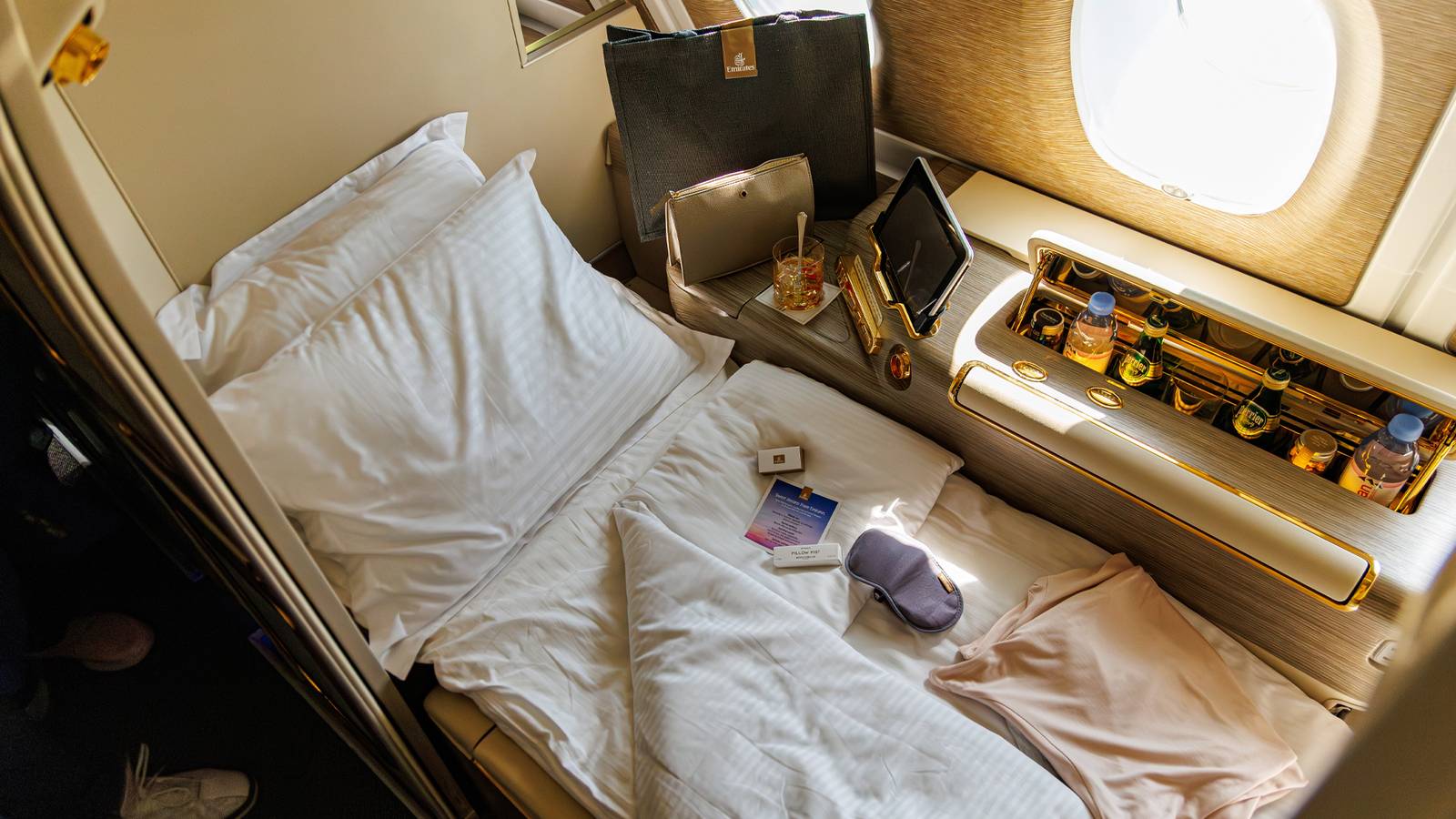
Emirates First Class is a more private and luxurious experience than Business Class. The cabin features 14 fully enclosed suites arranged in a 1-2-1 configuration, with each suite offering an 86-inch seat pitch, 23-inch seat width, and a 78-inch fully flat bed when converted for sleeping. Privacy is enhanced by 5-foot-high walls and sliding doors, creating a personal space so intimate that crew members are instructed to knock before entering. Unlike Business Class, there are no overhead bins; instead, each suite includes a dedicated wardrobe for hanging clothes and sufficient floor space for carry-on luggage. Suites are also equipped with a personal minibar, vanity table, mirror, and widescreen entertainment system. Passengers receive premium Bulgari amenity kits, luxury lounge wear, slippers, an eye mask, and a branded tote bag. On the ground, First Class travelers have access to dedicated First Class lounges offering fine dining, spa-style services, and, at some airports, direct boarding from the lounge.
Overall, Business Class offers premium comfort and convenience, while First Class adds greater privacy, space, and a more personalized luxury experience.
One of the most distinctive features of Emirates A380 First Class is the exclusive Shower Spa, a luxury that sets it apart from most commercial airline experiences. Located at the front of the upper deck, the shower suites provide passengers with a private space to freshen up during long-haul (or short-haul) flights, offering a level of comfort rarely found in air travel.
The A380 has two Shower Spas that passengers can reserve after boarding. Due to limited availability, passengers are advised to book their slot as soon as they board. For example, on short flights (e.g. 3 hour flights), each reservation lasts 15 minutes, including approximately five minutes of running water. The A380 remains the only aircraft in the Emirates fleet capable of accommodating the weight and space requirements of the Shower Spa, meaning the feature will not be carried over to the airline’s future Boeing 777X aircraft.
Each shower suite is stocked with VOYA organic seaweed-based spa products, plush towels, and premium amenities. A dedicated bathroom attendant ensures the facilities remain clean and fully prepared throughout the flight, helping to create a spa-like atmosphere at 40,000 feet. The experience is designed to allow passengers to arrive feeling refreshed, particularly on ultra-long-haul routes.
Step onboard the Emirates A380 Suites, Qatar Airways QSuite, and more in our list of the 5 most innovative widebody premium seats you can book today.
Emirates Business Class offers a premium dining experience with regionally inspired menus served on Royal Doulton fine china and accompanied by Robert Welch cutlery. Passengers can pre-order meals before their flight, a relatively uncommon feature in Business Class that allows for a more personalized experience. Meals are complemented by a carefully curated beverage selection, including fine wines, champagne, and non-alcoholic options.
Emirates First Class takes inflight dining to another level with a fully à la carte, dine-on-demand service, allowing passengers to eat whenever they choose. The experience begins with a traditional Arabic welcome of freshly poured Arabic coffee and premium dates, then progresses to a menu featuring dishes such as unlimited caviar, gourmet appetizers, and regionally inspired main courses. Meals are paired with an award-winning wine list selected by Emirates’ sommeliers, often featuring prestigious vintages from renowned wine regions, alongside premium champagne and luxury spirits.
Overall, dining is one of Emirates’ strongest premium-cabin offerings. While Business Class provides a refined restaurant-style experience, First Class delivers a highly personalized fine-dining service widely regarded as one of the best available in commercial aviation.
The Difference In Ticket Prices Between The Classes
Neither Emirates Business Class nor First Class can be purchased at a low fare. Passengers are paying not only for a seat, but for an entire premium travel experience that includes luxury amenities, enhanced comfort, exclusive airport services, and unique onboard features. These range from chauffeur-driven transfers and premium lounges to the A380’s onboard bar and, in First Class, the famous Shower Spa.
One of the most iconic features of the Emirates A380 is the onboard lounge and bar located at the rear of the upper deck. Available exclusively to Business and First Class passengers, this social space features a staffed bar, light refreshments, and comfortable seating. It allows passengers to socialize, meet fellow travelers, or simply stretch their legs during long-haul flights, adding significant value to the premium cabin experience.
Like many airlines, Emirates uses dynamic pricing, meaning fares fluctuate based on demand, booking timing, seasonality, and competition. Prices often rise substantially closer to departure, particularly on routes with strong corporate demand where travelers tend to book late. Competition from airlines such as Qatar Airways, Etihad Airways, Singapore Airlines, Turkish Airlines, and British Airways can also influence pricing. Major routes including Dubai–London, Dubai–New York, Dubai–Sydney, and Dubai–Paris consistently attract strong premium demand, allowing Emirates to charge higher fares.
Business Class fares vary considerably. Passengers booking well in advance can often find one-way fares between $2,500 and $4,000, while round-trip tickets frequently range from $7,000 to $9,000. However, fares on high-demand routes can increase to $4,000–$7,000 one way, with last-minute bookings occasionally reaching $12,000–$13,000. Emirates also offers different fare categories, including Saver, Flex, and Flex Plus, which provide varying levels of flexibility and benefits. Overall, Emirates’ premium cabin pricing reflects the airline’s position as a luxury carrier and the extensive range of services offered throughout the journey.
Orijinal Haberi Görüntüle