


Things have been going from bad to worse for Boeingin recent years. A lesser-known black spot in the last decade’s challenging history is its poor production output in the first quarter of the 2024 financial year. It followed the Alaska Airlines Boeing 737 MAX 9 blowout and a string of challenging FAA safety audits. Boeing is still recovering, and Airbus has taken advantage, securing major wins for the Airbus A330neo and Airbus A350, particularly from Delta Air Lines, which placed a substantial order in 2026.
What we can see over the last few years is Boeing being hit from both ends. It has faced internal failures in quality control and production cadence, while Airbus’ proactivity has weakened its market position.
Just 83 aircraft rolled off Boeing’s production lines in Q1 2024. Investopedia reports that this was the lowest quarterly production number since 2021. 67 of these aircraft were Boeing 737 MAX. The same quarter in 2024 had seen Boeing deliver 130 aircraft. The deliveries also represented a drop of 47% from the prior quarter (Q4 2023).
The last time things were this bad was in 2021, when the carrier delivered just 79 aircraft in the second quarter. The abysmal results hit shareholders hard. The company’s stock price had fallen 32% that calendar year, with Investopedia dropping its report on April 9, 2024.
The manufacturer’s widebody production lines were also suffering. It delivered just 16 widebody aircraft (3 Boeing 767s and 13 Boeing 787s) in Q1 2024. The 767 deliveries had a significant impact as the airframe was in high demand for freighter conversions and the KC-46 Pegasus tanker program. Meanwhile, the poor Dreamliner deliveries stemmed from issues with fuselage certification and supplier bottlenecks. These 787 delays had an impact on carriers awaiting delivery like United Airlines, All Nippon Airways, and Air India, who were forced to cope with capacity constraints by keeping their creaking Boeing 777-200ER and Boeing 767-300ER fleets in the skies.
A substantial cause of Boeing’s horrendous quarter was an incident aboard an Alaska Airlines 737 MAX, registered as N704AL, but operating as AS1282. After takeoff in January 2024 at 5:07 PM, the door plug blew out at almost 15,000 feet (4,600 meters). In the National Transportation Safety Board (NTSB) final report on the incident, issued in July 2025, investigators concluded that a lack of adequate training, guidance, and oversight of maintenance procedures from Boeing caused the incident.
The NTSB also criticized the Federal Aviation Administration (FAA) in the final report. Investigators found that the regulator had failed to ensure that Boeing had properly addressed systemic issues at its Renton, Washington, facility. This was the factory where 737 MAX assembly was carried out.
This specific incident continues to cause Boeing problems beyond the production delays and groundings that followed. The Alaska Airlines pilot, Captain Brandon Fisher, has sued Boeing for $10 million in damages. Captain Fisher alleges that Boeing attempted to wrongfully attribute the harm that came to the flight’s passengers to the crew. “Instead of praising Captain Fisher’s bravery, Boeing inexplicably impugned the reputations of the pilots who had prevented Boeing from having to explain to the families of all passengers and crew why its defective aircraft had resulted in the loss of their loved ones,” said Fisher’s representative.
It will become the carrier’s new longest narrowbody service ever, but there’s a twist…
The consequences of the manufacturing delays have extended well beyond simply making customers wait longer for their aircraft. The reputational damage has substantially aided Boeing’s principal rival, Airbus, in both widebody and narrowbody aircraft. The European manufacturer has stepped up its manufacturing and ordering ambitions to capitalize on Boeing’s ongoing production struggles. Simple Flying previously noted that Airbus has announced plans to deliver 870 aircraft in 2026, over 200 more than Boeing’s plans for this financial year.
Aerospace Global News has reported that Airbus’ ambition is already coming to fruition. In March, Airbus delivered 60 new aircraft to 38 customers, with widebody production increasing. These numbers round out a successful first quarter with 100 narrowbody and 14 widebody planes delivered. Airlines showed their confidence in the European manufacturer by placing over 330 new orders.
The table below shows a full breakdown of all the Airbus planes delivered this March:
The 331 aircraft ordered brought the total for Q1 up to 408. 356 of these orders were for narrowbody aircraft, with 20 A220-300s, 92 A320neos, and 244 A321neos. The largest single order was to China Eastern Airlines, with leasing companies also well represented on the order sheet.
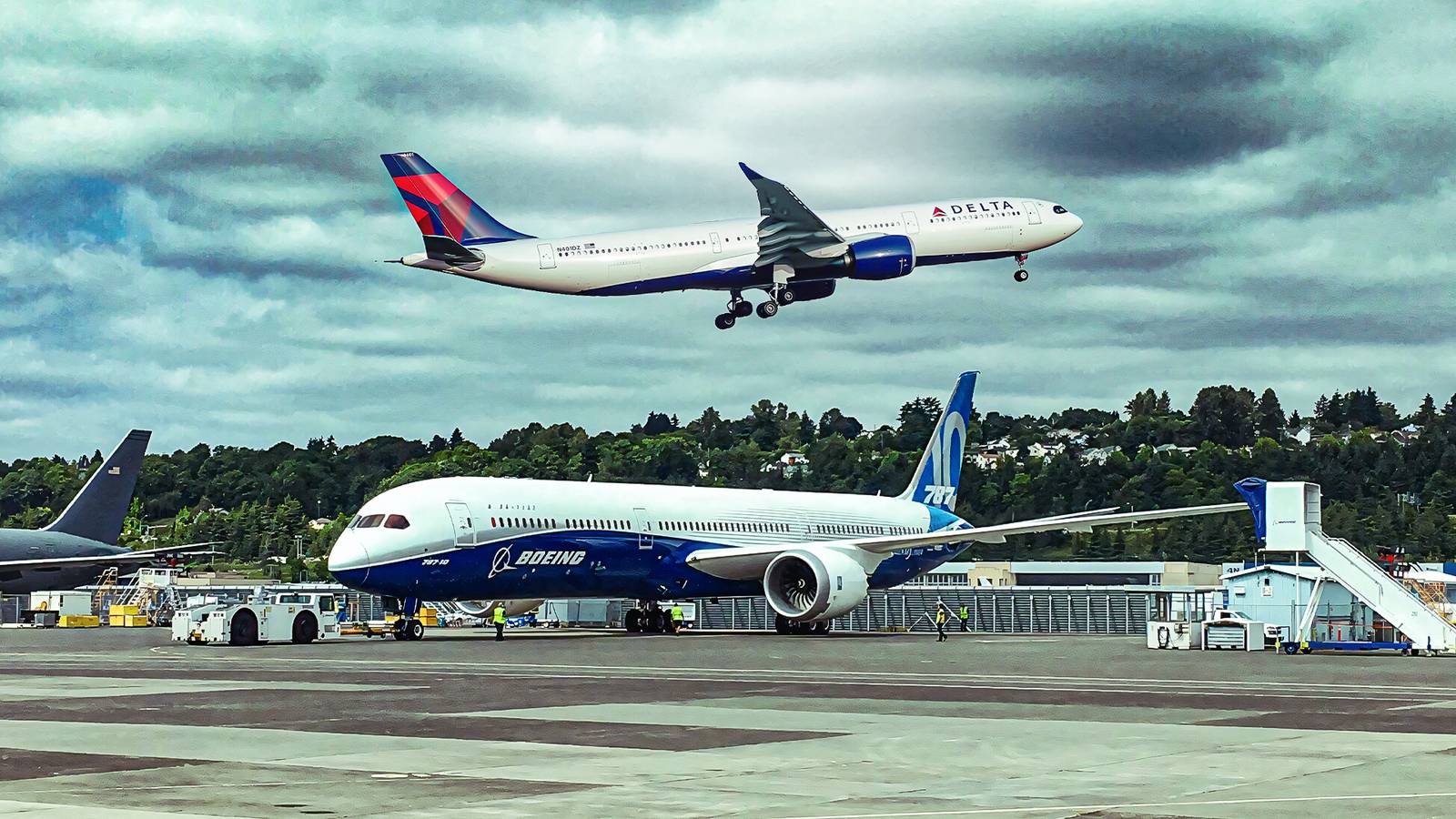
Another airline making a substantial commitment to Airbus is Delta Air Lines. The US legacy carrier ordered 16 A330-900s and 15 A350-900s in January 2026. The order includes the exercising of ten options. Delta has also added 20 additional future widebody options. Delta CEO Ed Bastian said, “We value our long-standing partnership with Airbus, and with these widebody aircraft we will see long-term growth and cost benefits for years to come.”
The table below shows the Airbus fleet and order sheet for Delta, using data from planespotters.net.
Meanwhile, Robin Hayes, Chairman and CEO of Airbus in North America, said, “We are grateful for Delta’s continued trust in Airbus products and our people. It is a privilege to power their global growth with the A330neo and A350, providing the flexibility and performance Delta needs to connect more of the world.” The order was also significant for British aeroengine firm Rolls-Royce. The A330-900s ordered use the Rolls-Royce Trent 7000, while Delta’s incoming A350-900s use the Trent XWB-84 EP, making Delta Rolls-Royce’s biggest partner in the Americas.
Boeing Hopes A New Assembly Line Will Turn Things Around
The American manufacturer is seeking ways to turn around its poor manufacturing performance. A new assembly line at Everett could be the answer. Known as the North Line, this facility will be used for 737 MAX production, bringing Boeing 737 production outside the Renton plant for the first time since production consolidation in 1970. The radical move is needed to address the roughly 4,870 unfilled 737 MAX orders.
The first aircraft to emerge from the production line is set to be a MAX 10. Boeing’s CEO, Kelly Ortberg, told CNBC, “We’ll be loading our first airplane on July 6, so just about a month from now, we’ll be bringing that [fourth] line alive… We’re trying to reset that track record, and I think we’ve done a good job as we’ve come back up here in the last 18 months and increased rate, and we’ve done it differently.”
Boeing believes that this assembly line will become a catalyst for increasing production to 52 jets a month, with the firm currently building 47 of the type a month, already up from 52 at the start of the year. The final goal will be to produce 63 aircraft per month. Given the extensive manufacturing issues Boeing has faced in recent times, we can only hope that the increased pace won’t be matched by an increase in problems falling through the cracks.
Things Could Continue To Get Worse For Boeing
Maintenance issues are once more plaguing Boeing, following the collapse of the front landing gear on a new Lufthansa 787, although it is still too soon to fully understand the impact on manufacturing. The collapse occurred shortly after midday earlier this month, involving an aircraft scheduled to operate LH450. This flight travels from Frankfurt Airport (FRA) to Los Angeles International Airport (LAX).
Thankfully, no passengers were on board, but the incident injured several Lufthansa employees, who required medical attention. During the impact, the engines struck the ground, and at least one of the gear flaps was severed. The damage unsurprisingly led to the flight being canceled. It is worth noting that the fuselage’s composite nature makes it more vulnerable to such impacts than older aircraft made of more traditional materials.
This is not the first time that a Dreamliner landing gear has collapsed. A similar issue struck a British Airways Boeing 787-8 in June 2021 before a cargo flight from London Heathrow (LHR) to Frankfurt. Over a year later, the United Kingdom’s Air Accidents Investigations Branch (AAIB) gave its report, which stated “the NLG downlock pin had inadvertently been inserted in the downlock link assembly apex pin bore instead of the downlock pin hole.” “An expensive bit of kit like that, and putting a pin in the wrong hole is all it takes to bring the plane down on its nose,” commented one Simple Flying reader.
Orijinal Haberi Görüntüle