
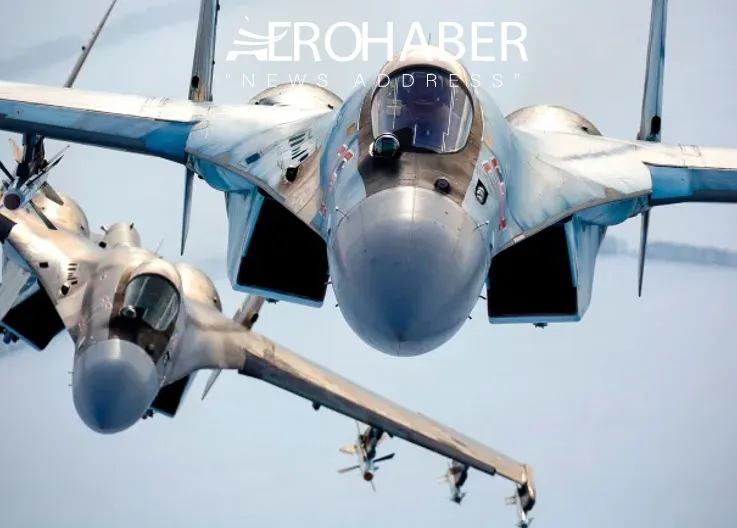


New documents leaked from Russia’s defence industry infrastructure reveal that Moscow has officially begun the assembly process of the first 16 Su-35 multirole fighter jets to be produced for Iran. The approximately 6.5-billion-dollar agreement is considered the most comprehensive manned combat aviation modernisation Iran has undertaken in the past forty years.
According to claims, assembly operations are ongoing at the Komsomolsk-na-Amure Aviation Plant (KnAAZ), the main production centre for Sukhoi fighter aircraft. All deliveries are planned to be completed by the end of 2027.
This leak follows documents that emerged in October 2025 confirming a major deal covering a total of 48 Su-35 fighter jets. Analysts emphasise that this transfer between Moscow and Tehran represents one of the largest military cooperation steps between the two countries in modern history.
Regional Power Balance May Shift
Experts state that Iran forming a Su-35 inventory could lead to significant changes in the balance of air power in the Middle East. It is assessed that competition dynamics with regional actors such as Israel, Saudi Arabia and the United States may be reshaped.
According to an analysis by Defense Security Asia, the leak is believed to have emerged as a result of Ukraine-linked hacker groups breaching the Russian defence industry.
Details of the Leak and the Production Process
Documents dated 28 November 2025 detail the technical and production schedule of the first 16 Su-35s allocated for the Iranian Ministry of Defence:
- Production activities began in 2024,
- Officials from the Russian Ministry of Defence oversaw subsystem integration and compliance with export standards,
- KnAAZ invested in increasing its annual capacity of 14 aircraft,
- It was announced in mid-2025 that the facility had been expanded for “large international orders”.
The leaked documents also once again confirm that Iran is referred to with the code “364”, as in previous paperwork, and that deliveries are spread over the 2026–2028 period.
A Step Closing Iran’s 40-Year Modernisation Gap
The current inventory of the Iranian Air Force largely consists of platforms dating back to the 1960s and 1970s, such as the F-4 Phantom, F-5 Tiger, F-14 Tomcat, MiG-29 and Su-24. Due to the fleet’s age, spare-parts shortages and outdated avionics, Tehran has long been seeking a modernisation breakthrough.
The Su-35 deal is seen as the most concrete step in Iran’s search for comprehensive modernisation. The country had only achieved limited improvements through domestic initiatives such as Saika and Kowsar.
Delivery Schedule
According to the leaked production plan:
- The first 16 aircraft will be delivered between 2026 and 2027,
- The procurement of a total of 48 aircraft will be completed by 2028,
- The aircraft will be produced in configurations customised to Iran’s operational requirements.
Experts note that Russia’s ability to adhere to the delivery schedule is under pressure due to sanctions, microelectronics supply constraints and the need to compensate for its own wartime losses. Nevertheless, the expansion of KnAAZ indicates Moscow’s determination regarding the project.
What Will the Su-35 Provide for Iran?
The Su-35, Russia’s most advanced fourth-generation fighter jet, stands out with the following features:
- Superior manoeuvrability with a maximum speed of Mach 2.25 and 3D thrust vectoring
- Over 1,500 km combat radius (up to 3,600 km with external tanks)
- 350 km target detection with the Irbis-E PESA radar
- Capability to track 30 targets simultaneously and engage 8
- Advanced engagement capability with long-range air-to-air munitions such as the R-77-1 and R-37M
These capabilities could provide Iran with regional power projection over the Persian Gulf, the Arabian Sea and the Eastern Mediterranean.