
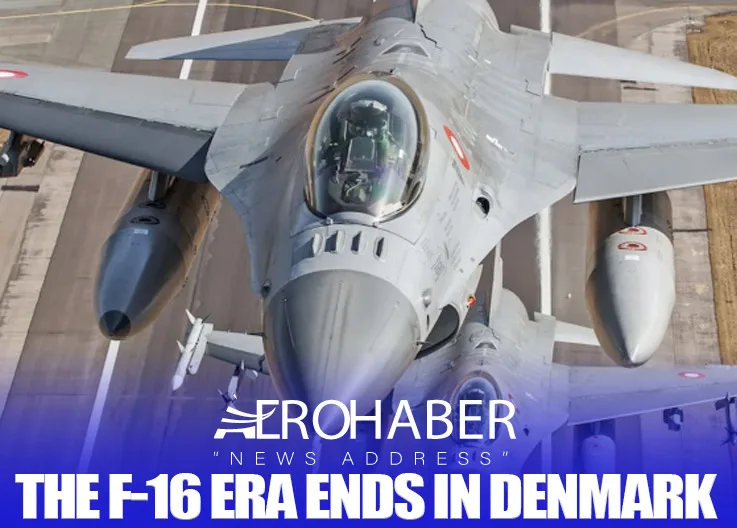


The Royal Danish Air Force officially retired its F-16 fighter jets, which had been in service for 46 years, as of 18 January 2026. With a ceremony held at Skrydstrup Air Base, the F-16s flew for the last time in Danish skies.
Farewell flight at Skrydstrup
A farewell ceremony was held in Hangar No. 3 at Skrydstrup Air Base for the F-16 fighter jets that Denmark has operated since 1980. During the ceremony, four F-16s carried out one final salute flight over Danish territory before landing back at the base.
Pilots, technicians and maintenance personnel who had served with the aircraft over the years welcomed guests and displayed the F-16s for the last time. The ceremony was recorded as a symbolic milestone for the Danish Air Force.
The end of a 77-aircraft fleet
Denmark has purchased a total of 77 F-16s to date. Thanks to their multi-role capability, the F-16s were used for decades in air defence, close air support and bombing missions. Despite modernisation packages, they are now among the platforms that have become technologically outdated.
The birth of the F-16: the “Lightweight Fighter Mafia”
The story of the F-16 began in the early 1970s with a group of engineers working at General Dynamics who referred to themselves as the “Lightweight Fighter Mafia”. This team opposed the trend towards heavy and expensive fighter aircraft and designed a platform focused on high speed and agility.
The resulting F-16;
- Superior manoeuvrability,
- Fly-by-wire flight control system,
- Head-up display (HUD) technology
was far ahead of its time. Over time, it was also developed for close air support and precision strike missions.
From Desert Storm to today
The F-16 proved its versatility by playing an active role in strikes against Iraqi targets during Operation Desert Storm in 1991 and in the shootdown of an Iraqi MiG aircraft. To date, more than 4,500 F-16s have been produced, making it one of the most widely used fighter aircraft in the world.
F-35A replaces the F-16
Denmark is replacing its F-16 fleet with F-35A Lightning II fighter jets. The first F-35s were delivered in 2023. On 1 April 2025, Denmark’s F-35s replaced the F-16s in NATO’s Quick Reaction Alert (QRA) mission.
The Danish Ministry of Defence has ordered a total of 43 F-35As:
- 27 aircraft were ordered in 2016
- 16 aircraft were ordered in 2025
- The F-35A produces 40,000 pounds of thrust with its Pratt & Whitney F135-PW-100 engine.
A fully fifth-generation air force
With the full transition to the F-35A, Denmark became the third European air force composed entirely of fifth-generation fighter aircraft, after:
- Norway in 2022,
- The Netherlands in 2024.
This transformation process extended over many years due to global delays in F-35 production.
Three different variants of the F-35
The F-35 programme consists of three main variants:
- F-35A: Conventional take-off and landing (US Air Force and Denmark)
- F-35B: Short take-off and vertical landing (US Marine Corps)
- F-35C: For aircraft carriers (US Navy)
New destinations for retired F-16s
Denmark’s F-16 fleet will be directed to two different countries:
Donation to Ukraine
Some of the 19 F-16s that Denmark pledged to donate to Ukraine in 2023 are being delivered to the Ukrainian Air Force. The first Danish F-16 arrived in Ukraine in August 2024.
Denmark also provides:
- Training for Ukrainian pilots,
- Financial support for maintenance and operational costs.
Ukraine primarily uses the F-16s for air defence and close air support missions with precision-guided munitions.
Sale to Argentina
A total of 24 F-16s will be sold to Argentina, which has not had supersonic fighter aircraft in its inventory since 2015. The US government played a key role in the agreement due to export restrictions.
The Argentine package includes comprehensive logistical support, including:
- Training,
- Spare parts,
- Simulators.
The first six aircraft were delivered in December, with the remaining aircraft to be delivered gradually by 2028.