
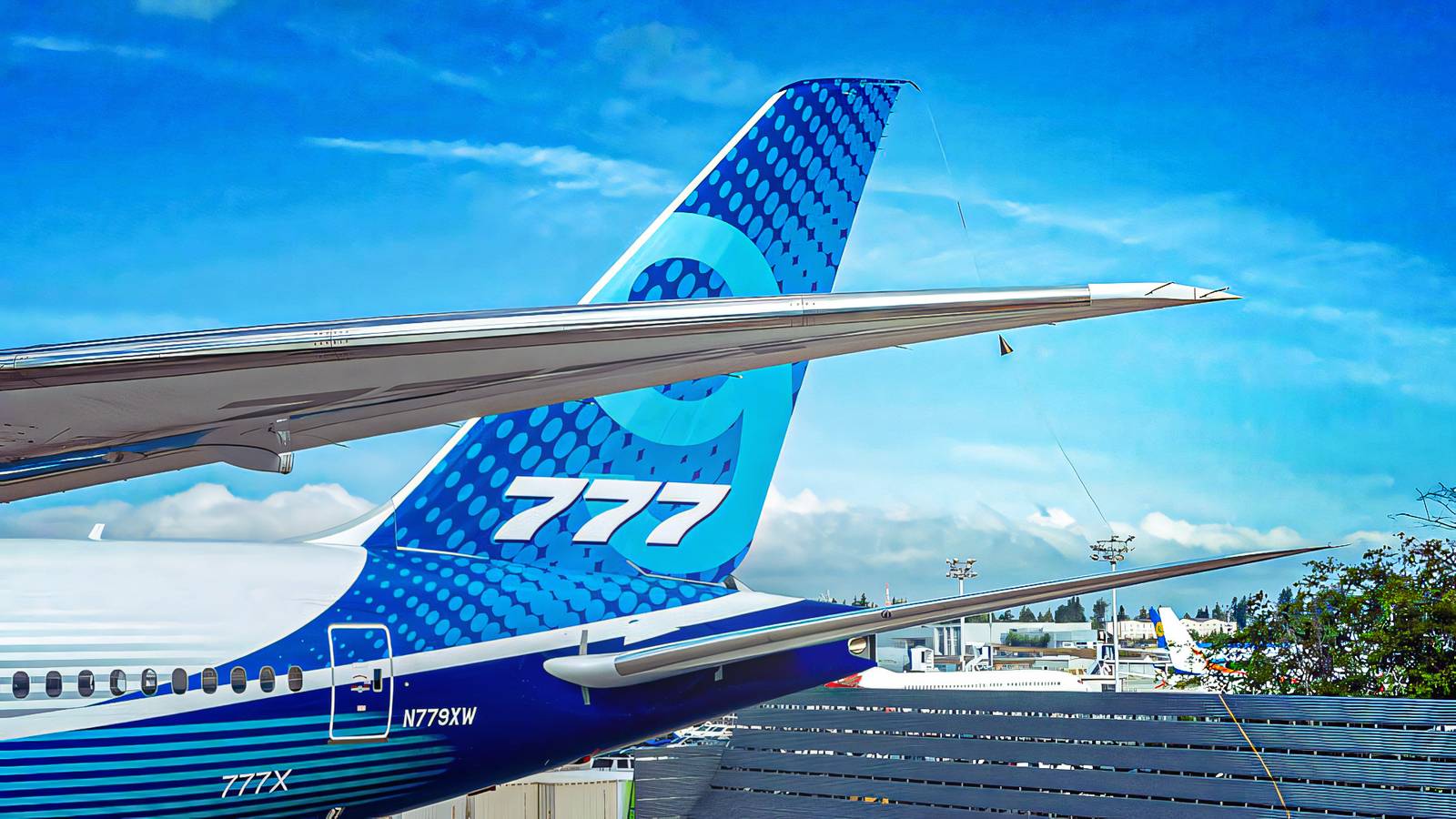


When Boeing launched its flagship 777X program, the aircraft was supposed to become the next evolution of long-haul travel, building on the success of the 777-300ER with greater efficiency, longer range, and a redesigned passenger cabin. Major airlines, including Emirates, Qatar Airways, Cathay Pacific, and Singapore Airlines all committed heavily to the aircraft, expecting it to enter service by 2020 and eventually dominate premium long-haul markets for decades.
Instead, the Boeing 777X has become one of the most delayed and heavily scrutinized commercial aircraft programs in modern aviation history. By 2026, the aircraft had spent more cumulative time grounded than actively flying in certification testing, with repeated technical problems, redesign work, and much stricter oversight from the US Federal Aviation Administration (FAA), pushing entry into service toward 2027, seven years later than Boeing originally planned. Let’s take a closer look…
The first major disruption to the Boeing 777X program arrived before the certification campaign had even properly started. In September 2019, Boeing was conducting an extreme pressurization test under FAA supervision when a cargo door blew off the aircraft inside a Boeing hangar. The incident immediately halted progress and forced engineers to reassess portions of the structure before flight testing could continue.
The aircraft eventually made its maiden flight in January 2020, but the timing coincided with the aftermath of the Boeing 737 MAX crisis, which dramatically changed the FAA’s approach to Boeing certification programs. Regulators imposed much stricter oversight and required far more direct validation of systems, software, and structural performance than Boeing had originally expected when the aircraft was launched earlier in the decade.
By December 2020, the program was effectively paused again after concerns emerged involving the aircraft’s flight control systems. Boeing and regulators spent years evaluating software behavior, system redundancy, and operational performance before the certification campaign could properly resume, and meaningful test activity did not fully restart until July 2024, creating a nearly four-year gap in active certification progress.
Even after testing restarted, another major issue quickly emerged when, in August 2024, Boeing grounded the fleet once again after structural damage was discovered in the engine pylon system. Flight testing eventually resumed in January 2025, but by late 2025, the aircraft had accumulated only around 4,500 flight-test hours across roughly 1,600 flights despite originally being scheduled to complete certification years earlier.
Those figures sound impressive in isolation, but they reflect the unusually drawn-out nature of the campaign rather than a normal development process. A program originally expected to complete certification around 2020 instead entered 2026, still working through major regulatory milestones, while airlines continued waiting for deliveries.
Over 20 777X aircraft have already been built despite a delayed 2027 entry date.
The latest grounding centered around one of the aircraft’s most critical structural components. During a post-flight inspection in August 2024, Boeing engineers discovered cracks in the titanium thrust link inside the engine pylon assembly, which connects the General Electric GE9X engines to the wing. These engines are the largest commercial aircraft engines ever built.
The thrust link transfers engine thrust loads to the wing structure during flight, meaning any failure could create severe structural consequences. Although no in-flight failure occurred, the discovery immediately forced Boeing to ground all four active test aircraft while engineers investigated the issue and determined how widespread the problem might be across the fleet.
Regulators treated the problem extremely seriously because of the safety implications and because the FAA now applies much stricter standards to Boeing programs than it did before the MAX accidents. Boeing could not simply repair the damaged components and continue testing. Instead, the company had to redesign portions of the thrust link attachment system, validate the updated design, and retrofit the revised hardware across the fleet before regulators would authorize the resumption of flights.
The grounding lasted approximately five months before flights resumed in January 2025. Boeing later stated that the modified design performed within expected limits during subsequent testing, but the episode reinforced how vulnerable the program remained to further delays. Even a single structural concern could now suspend the certification campaign for months because every redesign required engineering reviews, hardware replacement, analysis work, and direct FAA validation before additional testing could proceed.
The pylon issue also highlighted how advanced and heavily loaded the aircraft’s overall design has become. The Boeing 777X combines the largest engines ever fitted to a commercial airliner with folding composite wings and significantly revised aerodynamics, all of which increase the complexity of structural integration compared to previous 777 variants.
One of the biggest reasons the Boeing 777X certification campaign became so prolonged was the regulatory environment created after the two 737 MAX crashes. Before those accidents, Boeing had significantly more authority to validate portions of its own aircraft systems internally through delegated certification processes, allowing manufacturers to move through certification campaigns more efficiently. After the 737 MAX investigations, however, the FAA adopted a much more conservative approach. The 777X became the first major Boeing widebody developed entirely under those tighter standards, and the result was a dramatically expanded certification campaign involving far more direct regulatory oversight than Boeing had initially anticipated.
Instead of relying heavily on Boeing-generated validation data, regulators demanded direct oversight across numerous stages of testing. The FAA required extensive work involving flight controls, software integration, structural resilience, lightning protection, electromagnetic interference, and ETOPS certification for long-haul operations over remote oceanic routes. The agency also required Phase 2D community noise testing and direct FAA-conducted evaluation flights, both of which added additional complexity and scheduling pressure to the campaign. Each testing phase depended on the successful completion of the previous one, meaning any delay quickly disrupted the wider schedule. Even isolated technical concerns could therefore halt progress for months.
The scale of the campaign eventually became extraordinary by commercial aviation standards, and more than 4,500 flight-test hours have been accumulated across the fleet, making the Boeing 777X one of the most heavily tested Boeing aircraft programs ever conducted. Under normal circumstances, that level of testing might be associated with an entirely new aircraft family rather than a derivative of an existing platform. Boeing originally approached the aircraft as a relatively manageable evolution of the Boeing 777 family, but regulators increasingly treated the certification effort as something much larger due to the amount of new technology integrated into the aircraft and the broader shift in FAA oversight philosophy after the 737 MAX crisis.
FAA plans to streamline aircraft certification. Here’s how delays with Boeing’s 777X and 737 MAX may shape the planes you’ll fly soon.
While certification delays continued, Boeing also faced another growing challenge at its Everett facility. Over the years, the company has built approximately 30 production-standard 777X aircraft that still cannot be delivered until certification is completed. At first glance, having aircraft already assembled might appear beneficial because deliveries could theoretically begin immediately after certification approval, but in reality, the situation has become increasingly complicated because the aircraft were built over a period during which systems, software, and structural specifications continued evolving.
As a result, many stored aircraft no longer fully match the latest production standard and now require extensive rework before delivery. That work can involve updating avionics software, replacing components, modifying wiring systems, and incorporating revised structural elements introduced during the prolonged certification process. The longer the delays continue, the more complicated the rework becomes, and aircraft originally assembled years ago now need to be updated to match a configuration that has evolved continuously during the seven-year delay period. Some aircraft may spend years undergoing inspections, modifications, and recertification work before they can finally enter airline service.
The financial impact is substantial, with stored aircraft generating no delivery revenue while still consuming maintenance, storage, and modification costs. Combined with development delays, the Boeing 777X program has accumulated roughly $15 billion in charges for the US manufacturer, turning what was once expected to become the company’s flagship long-haul product into one of its most expensive commercial aircraft programs.
30 Boeing 777X jets are built, stored, and not going anywhere for years.
Airlines Have Been Forced To Adjust Their Fleets
The delays have also created major problems for airlines that built future fleet plans around the Boeing 777X. Emirates in particular expected the aircraft to become the backbone of their long-haul operations, gradually replacing older Boeing 777-300ER across its global network. Instead, airlines have repeatedly extended leases on existing aircraft while delaying retirement plans.
Many carriers expected the Boeing 777X to arrive years ago and structured long-term fleet transitions around those assumptions, but as the timeline continued slipping, they were forced to keep older aircraft in service far longer than planned. Several carriers also increased Airbus A350 orders to compensate for the uncertainty surrounding the 777X timeline. For some airlines, the A350 became the only realistic option for maintaining long-haul expansion plans while Boeing continued working through certification. The table below outlines the largest orders currently in place for the 777X:
The disruption extended beyond fleet replacement, and some airlines had already designed future premium cabin products specifically around the interior dimensions of the Boeing 777X, only to repeatedly revise those plans as delivery schedules slipped further into the future. Cabin concepts, route launches, and marketing strategies all had to be adjusted multiple times. The constantly shifting timeline also complicated pilot training, route planning, maintenance preparation, and financing strategies. Modern airline planning depends heavily on predictable delivery schedules, and the 777X repeatedly failed to meet them, creating operational uncertainty across multiple global carriers.
By early 2026, Boeing executives acknowledged that certification would likely require the entire year, pushing realistic entry into service toward 2027. Although the manufacturer stopped short of formally announcing another delay, Boeing increasingly described 2027 as the practical target for first deliveries.
Several major testing phases still remained incomplete, including final ETOPS validation, FAA-conducted evaluation flights, and production-standard aircraft integration testing. Because regulators now participate far more directly in the process, progress depends not only on Boeing completing the work but also on the FAA independently validating the results before certification can be granted.
That regulatory environment fundamentally changed the nature of the program. Boeing originally viewed the 777X as a relatively manageable development of the existing 777 family, but instead, the aircraft evolved into one of the largest and most demanding certification efforts in commercial aviation history, shaped as much by changing regulatory philosophy as by engineering complexity itself.
As a result, Boeing entered 2027 facing the remarkable situation that one of its most advanced airliners still had not carried a single paying passenger despite years of testing, repeated redesigns, and one of the longest certification processes the aviation industry has ever seen.
Found an error? Send it info@simpleflying.com so it can be corrected.
Orijinal Haberi Görüntüle