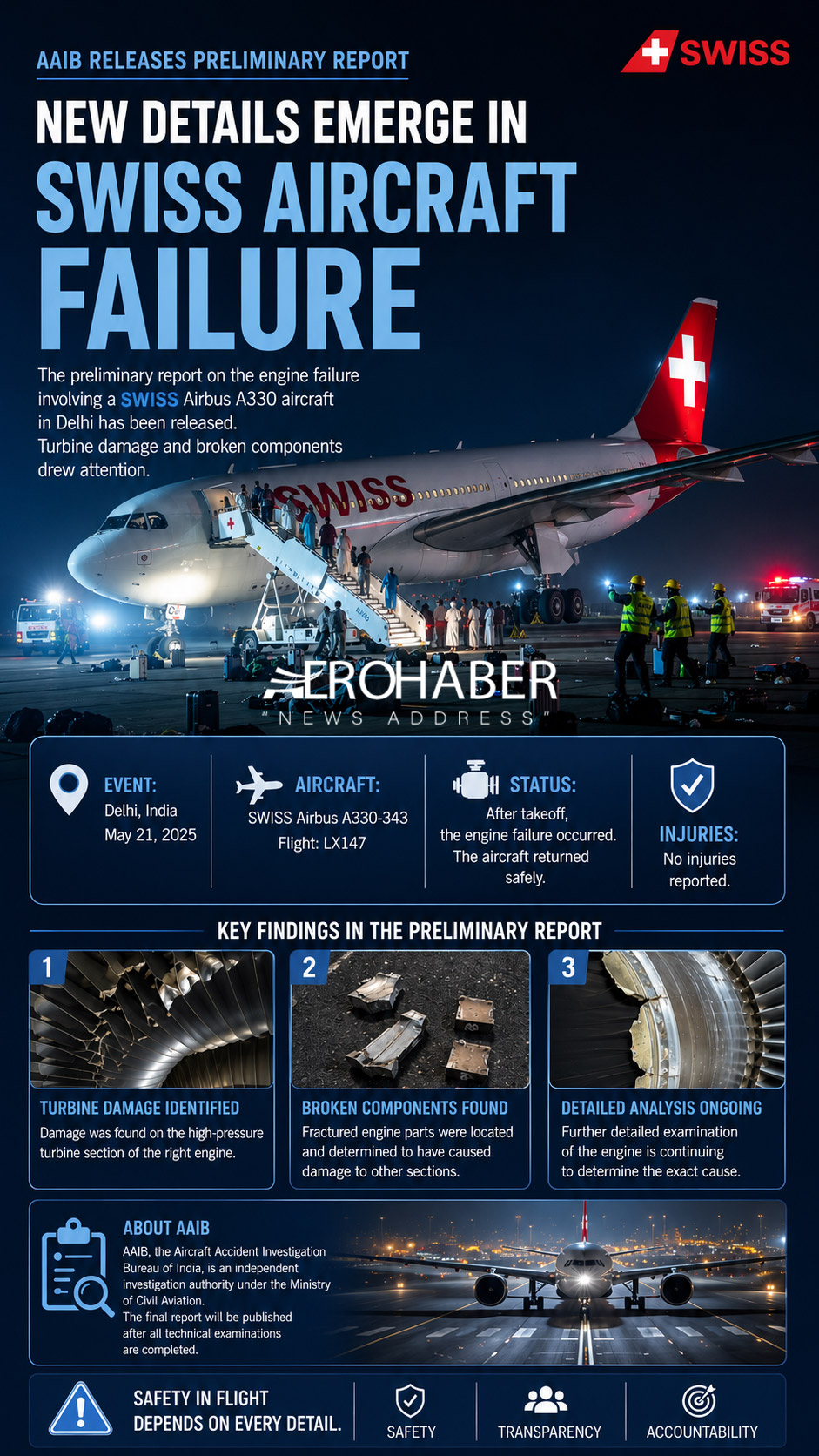



The preliminary report regarding the incident involving a SWISS Airbus A330 that suffered an engine failure during takeoff in Delhi has been published. Technical examinations revealed broken bolt fragments and turbine damage.
Critical details have emerged regarding the engine failure involving Swiss International Air Lines flight LX147, an Airbus A330-343, at Delhi Indira Gandhi International Airport. The preliminary report published by India’s Aircraft Accident Investigation Bureau (AAIB) revealed striking technical findings related to the serious incident that occurred during takeoff.
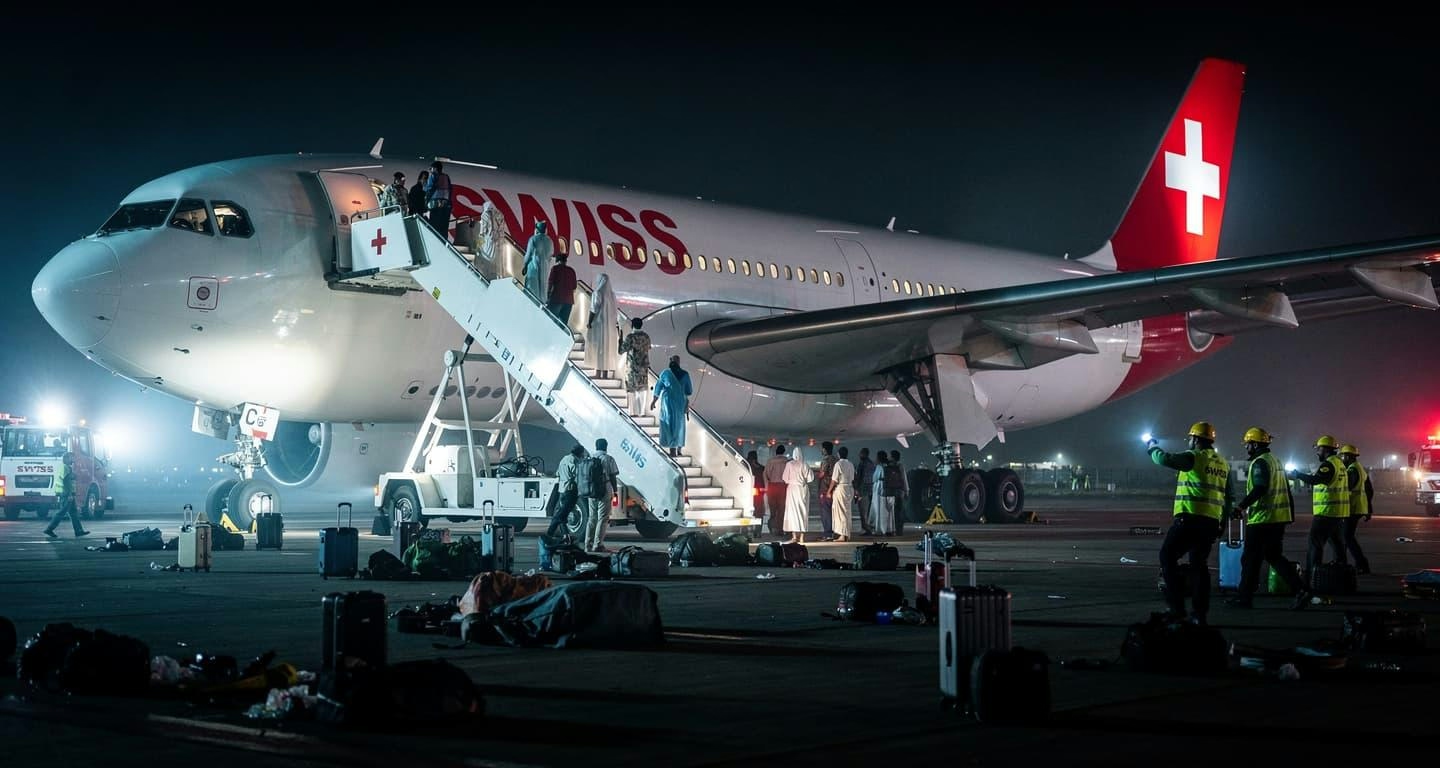
Following the failure on the aircraft carrying 232 passengers and 13 crew members, the takeoff was aborted at the last moment, while six people were injured during the incident. In particular, the large flame coming from the engine and the loud explosion sound heard by the cockpit crew highlighted the severity of the event.
Explosion Sound and Flames Observed During Takeoff
The incident occurred at approximately 01:27 on the night of April 26. The Airbus A330-343 operated by Swiss International Air Lines was continuing its takeoff roll at around 110 knots when a serious failure occurred in the left engine (Engine No.1).
The flight crew reported a loud explosion sound accompanied by a large flame coming from the engine. The pilots immediately rejected the takeoff.
While the aircraft experienced a brief directional deviation on the runway, it was brought to a safe stop, and full emergency procedures were activated at the airport. During the evacuation process, all seven emergency exits were opened. Four passengers were injured during the panic.
Critical Damage Identified During Technical Inspection
AAIB’s preliminary examination found small metal particles and various debris in the exhaust section of the engine.
Investigators also identified in the thrust reverser ducts:
- broken bolt fragments,
- spacer remnants,
- damage to the high-pressure and intermediate-pressure bearing support section.
Severe Damage in Turbine and Compressor Sections
Borescope inspections revealed damage in several critical sections of the engine:
- High Pressure Turbine blades,
- Nozzle Guide Vanes,
- Intermediate and Low Pressure Turbine blades,
- High Pressure Compressor blades and stator vanes.
One of the most striking details in the report was that although there were no visible impact marks or blade deformation in the Intermediate Pressure Compressor section, the related shaft was found seized.
Experts believe this situation makes the investigation into the root cause of the failure significantly more complex.
Black Boxes Under Examination
Following the incident:
- the Solid State Flight Data Recorder (FDR),
- and the Cockpit Voice Recorder (CVR) were secured and sent for detailed technical analysis.
AAIB is analyzing data obtained from the flight recorders along with the engine components in order to determine the root cause of the failure.
Airbus, EASA and BEA Join the Investigation
The investigation has now taken on an international dimension.
France’s Bureau of Enquiry and Analysis for Civil Aviation Safety (BEA) appointed an accredited representative to the investigation, while Airbus and the European Union Aviation Safety Agency (EASA) also began actively supporting the technical examination.
Experts note that additional safety recommendations may be issued during the later stages of the investigation.
Warning of Reputational and Financial Risks for SWISS
In addition to the technical failure, the incident is also believed to potentially create commercial consequences for Swiss International Air Lines.
According to experts:
- emergency evacuation footage,
- reports of engine failure, and possible damage to public safety perception
could place pressure on the company’s brand reputation.
It is also stated that regulatory authorities may initiate stricter inspection processes, while possible compensation claims and insurance liabilities could create financial impacts.
Competing airlines in the aviation industry may also attempt to turn this development into a commercial advantage by emphasizing their own safety performance.
Investigation Continues
AAIB announced that the investigation is still ongoing and that new technical findings and additional safety recommendations may be shared with the public in the coming stages.
In particular, whether the broken components inside the engine were the starting point of the failure remains one of the most critical aspects of the investigation.