



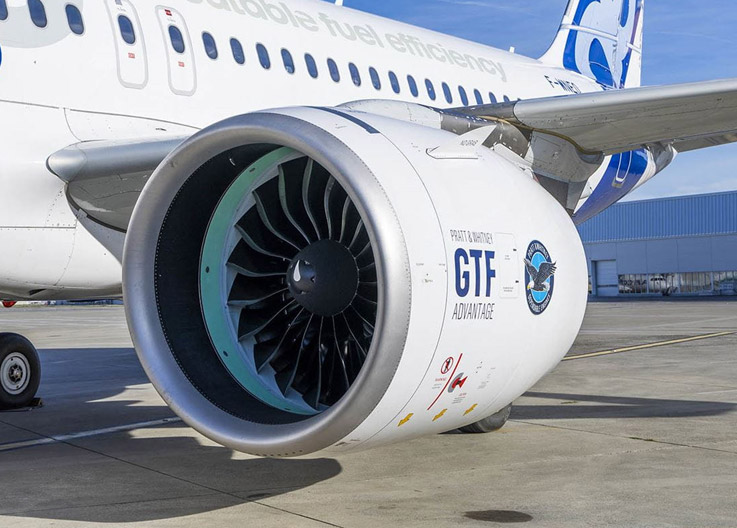
Pratt & Whitney’s GTF Advantage engine has received EASA certification. The new-generation engine for the A320neo family is set to reshape competition in aviation with higher thrust, longer range, and lower cost advantages.
EASA approval accelerates delivery and entry-into-service process
US-based Pratt & Whitney announced that its newly developed GTF Advantage engine has been certified by the European Union Aviation Safety Agency. With this development, the path has been cleared for the delivery and entry into service of Airbus A320neo aircraft powered by the GTF Advantage engine.
The engine had previously been certified by the Federal Aviation Administration in February 2025, while EASA approved the type certificate in October 2025.
New standard in fuel efficiency and performance
Rick Deurloo, President of Commercial Engines at Pratt & Whitney, emphasized that the GTF engine family delivers the lowest fuel consumption in the single-aisle aircraft segment. According to Deurloo, the GTF Advantage takes this benefit further by doubling the engine’s “time on wing” and increasing operational capability.
The new engine will provide 4% to 8% more thrust at takeoff, offering higher payload capacity and longer range. This means new route opportunities and increased operational flexibility for airlines.
Seamless fleet transition and 2028 target
The GTF Advantage engine has been designed to be fully compatible with existing GTF engines. This allows airlines to transition to next-generation engine technology without requiring major structural changes to their current fleets.
The company announced that the GTF Advantage will become the production standard by 2028.
Upgrade opportunity for existing operators
A significant advantage is also offered to operators currently using the PW1100G-JM engine. With the GTF Hot Section Plus (HS+) upgrade, which can be integrated during maintenance processes within the year, users will be able to achieve 90–95% of the durability gains of the GTF Advantage.
Rising demand drives production investments
In line with strong demand growth, Pratt & Whitney continues to invest in expanding its production capacity. The company has invested approximately $1 billion in its turbine blade facility in Asheville, North Carolina, and $200 million in its forging facility in Columbus, Georgia.
To date, more than 2,700 GTF-powered aircraft have been delivered to over 90 customers worldwide, while total orders and commitments have exceeded 13,000 engines.
Analysis: Could shift the balance in single-aisle competition
The certification of the GTF Advantage represents a critical milestone for Pratt & Whitney, particularly in its competition with CFM International in the single-aisle aircraft market.
Increased thrust and improved durability will help airlines reduce unit seat costs, while extended range capability may make new medium-haul routes economically viable. This could create new opportunities, especially for low-cost carriers and airlines adopting hybrid business models, in their network planning.
On the other hand, considering the maintenance and durability issues previously experienced with GTF engines, the real-world performance of the GTF Advantage will be closely monitored by the industry. The promised “twice as long time on wing” represents a significant improvement in maintenance cycles, which will be decisive in the total cost of ownership.