
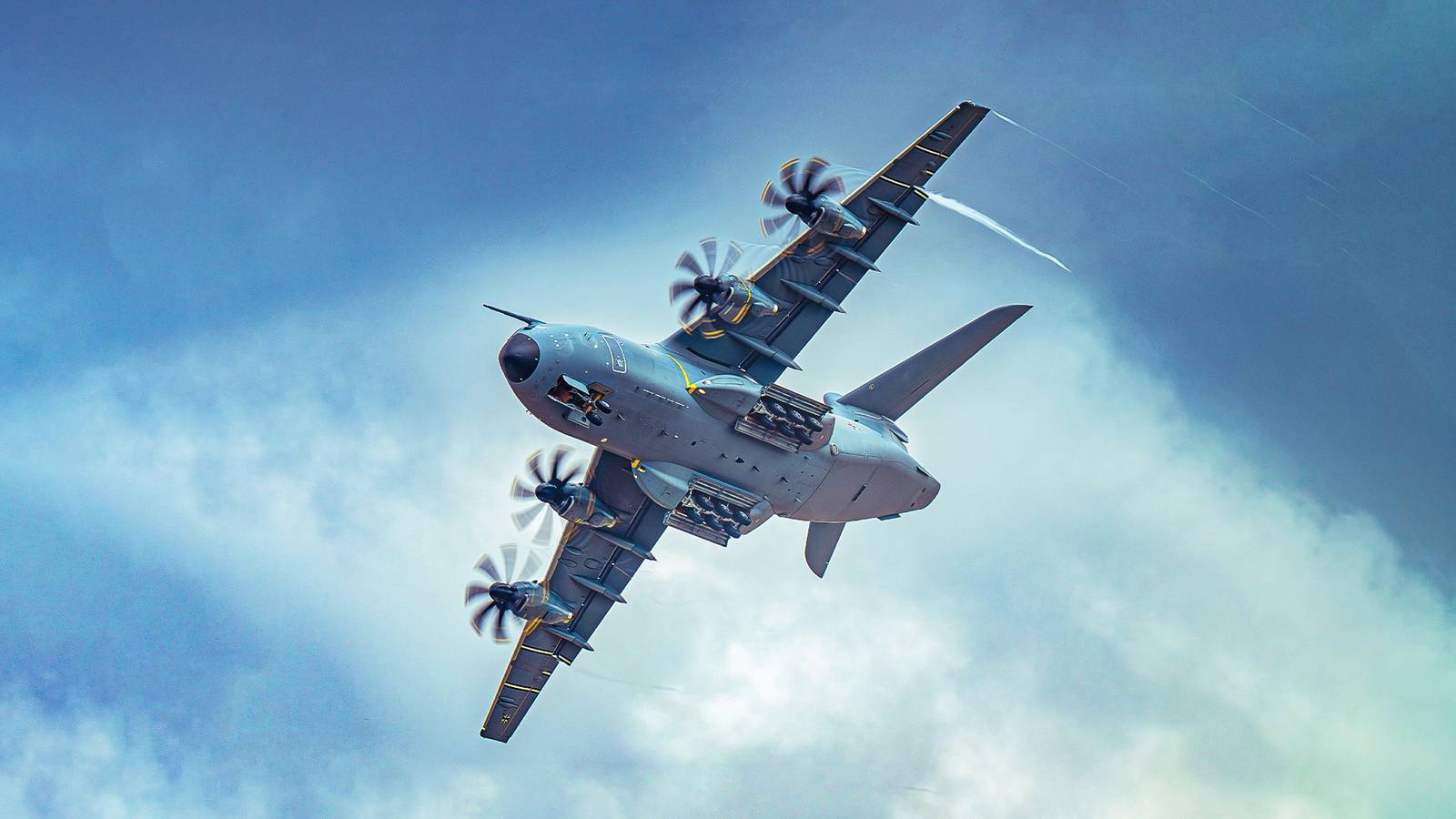


The Airbus A400M Atlas has succeeded the role of the Lockheed C-130 Hercules for many air forces around Europe. It is one of the most unique airlift planes and turboprop-powered aircraft ever made with a number of design features, but most notably its down between engines propeller arrangement. The A400M is the only aircraft ever built with the DBE counter-rotating propeller scheme, and it also happens to be equipped with the most powerful turboprop engines ever built.
Airbus’ unique DBE gives the plane several unique performance qualities, such as superior lift over the wings in all flight profiles and a smaller vertical tail, but it also significantly reduces the vibration and noise inside the cabin. While that may not sound like the highest priority for a military aircraft, it offers operators many advantages in practical and tactical terms. In addition to making long transits less fatiguing to troops or other passengers, it also makes air drop operations more efficient because communication is easier.
This makes the complex and hazardous procedure of deploying paratroopers safer and more precise. The crew and troops can perform their duties with faster execution thanks to the lower volume of engine noise, which also enhances safety for the soldiers jumping out of the plane. It also increases precision and deployment efficiency when timing the exact drop over a target zone. All in all, the combination of immensely powerful turboprop engines and the DBE configuration makes the Atlas one of the world’s highest performing combat airlifters.
What Exactly Do Down Between Engines Propellers Do?
On conventional multi-engine turboprops, all propellers rotate in the same direction as on the C-130, or they mirror each other across the entire aircraft midline. A good example of the wing-level-mirroring is the Antonov AN-70 made in Ukraine, where the engines on each wing have opposing spin directions. The A400M Atlas goes a step further by splitting counter-rotational forces on each wing as a unit, which is referred to as DBE.
Airbus designed the two Europrop TP400-D6 turboprops on each wing to rotate inward and downward toward each other. Because the inner and outer propellers on each wing spin toward the center gap between them, the upward stroke of the propeller blades occurs on the outermost and innermost boundaries. The downward stroke happens directly between the engine nacelles. In this layout, the shock waves and tip vortices from the propellers meet in the space between the nacelles instead of hitting the skin of the fuselage.
The actual arrangement follows this pattern: the outermost prop, engine one of the port wing, rotates clockwise while prop number two, inboard on the same wing, rotates counterclockwise. Engine number 3, positioned closest to the fuselage on the starboard wing, rotates clockwise while the outer starboard engine, number four, rotates counterclockwise.
The A400M Atlas can transport up to 116 fully equipped paratroopers, and the DBE configuration directly alters the safety, speed, and precision of airborne deployments. The C-130, which preceded the A400M in many of the air forces that it replaced, such as the Royal Air Force, had propellers that subjected the cabin to a powerful updraft of airflow on one side and downdraft on the other. This created vibration and asymmetric airflow, which made the cabin noisier, but also had to be considered by the troops jumping out of the door during aerial insertion.
The most basic and obvious enhancement of DBE’s quieter airflow is the reduction of internal noise, which improves the environment inside the jump staging area. Jumpmasters can clearly issue voice commands and countdowns without relying entirely on physical hand signs or screaming over a deafening drone, reducing human error during high-stress static line operations. Yet even before the main event starts, the troops are already benefiting from reduced fatigue during the transit from home base to the drop zone.
In addition to simply giving paratroopers a more comfortable ride, a quieter cabin environment allows for unit-level briefings and tactical coordination right up until the final moment before the jump light turns on. This is highly beneficial for trainees who have received coaching or correction after embarking on the plane to perform a safe jump. Similarly, while it’s not as quiet as a commercial airliner, the A400M is less harsh than the C-130 for non-military passengers such as diplomats, refugees, or medical evacuees.
A quieter ride is also very useful for active troops on combat missions. A better working environment in flight means last-minute changes to the plan are simpler. Thus, soldiers about to drop into harm’s way are better prepared for what they will encounter on the ground. Minuscule details can often be the determining factor in the success or failure of an operation for soldiers in the battlefield. By facilitating better communication in the cabin, the A400M directly improves mission preparations that can be the difference between life and death.
The 23 German Air Force Airbus A400M Atlas military transport aircraft will be equipped with infrared protection systems.
DBE causes the pressure waves from the tips of the propellers to meet in an upward wash between engines, which leads to destructive interference and dampens the acoustic vibration in the air. They reduce vibration on the airframe, which cuts down on component wear and tear as well as material fatigue in the aerostructures. Additionally, engine torque loads cancel out, which allows Airbus to make a 17% smaller vertical stabilizer, and in the event of single or multiple engine failures, asymmetric thrust is greatly reduced. These characteristics make the plane more efficient and safer over the airframe’s lifetime.
One of the most important ways in which DBE improves the mission of the A400M is by boosting clean aerodynamic lift at low speeds. This enhances short takeoff and landing performance, which means it can operate from many small airstrips that are unpaved, unprepared, and austere. The Atlas can also do it with a higher payload than the C-130 because of its more powerful engines and superior aerodynamics. DBE even allowed the Atlas to be lighter thanks to reduced load on the airframe, which also increases STOVL capability.
Standard, single-direction propeller rotations create uneven torque and asymmetric lifting loads across the wingspan. So legacy airframes, like the Hercules, require heavier internal structural reinforcements to cope with the stress. The minimization of these twisting forces on the plane structure allows for the elimination of some heavier materials like steel and aluminum.
The efficient propeller arrangement allows the A400M to be much lighter than its large size would imply, especially combined with carbon fiber materials used on 30% of its exterior skin. It delivers twice the payload capacity of a C-130J, and it can carry physically larger outsized cargo like heavy equipment and vehicles, including helicopters. Yet, despite being so much larger, the Atlas can match the short-field performance of the Hercules in virtually any scenario.
Transforming military might into aerial firefighting innovation
The A400M is a direct result of a highly specific operational requirement created by the leadership of the North Atlantic Treaty Organization during the late 1980s. The European Air Forces of the United Kingdom, France, Germany, and Spain determined that an operational gap existed between the C-130 Hercules and the McDonnell Douglas C-17 Globemaster III. The inability to transport outsized cargo like large vehicles in the C-130 was considered a critical limitation. At the same time, the short field performance of the C-17 could not satisfy all the needs of the RAF or NATO.
To lift a heavy aircraft off a short runway, you must generate immense lift quickly. Thanks to DBE on the A400M, the inboard and outboard propellers on a single wing turn toward each other. This channels their individual slipstreams into one collective and perfectly symmetrical sheet of high-velocity air. The A400M compensates for low forward speed by using its 11,000-horsepower engines to accelerate the air over the wing surface. Because the DBE configuration prevents air separation and turbulence, it maximizes lifting power to get off the ground at slower rolling speeds.
This high-energy airflow that results from DBE behaves like a virtual flap. The wing behaves like it is flying much faster than the aircraft is actually moving across the ground. DBE forces the air to stay tightly bound to the upper surface of the wing at incredibly steep angles of attack without stalling. This allows the plane to get airborne as quickly as possible and climb away without taking time to gain airspeed first.
The dynamic aircraft has some impressive capabilities.
The characteristics of a DBE propeller arrangement also have advantageous safety characteristics during STOL operations thanks to its symmetrical engine forces. In the case of an emergency like engine failure during takeoff or landing, the plane will not violently yaw in one direction as it would on a C-130. Not only does the sudden change in direction create a safety of flight issue for pilot control, but it also bleeds energy off of the plane, which can cause a stall as it suddenly slows down.
Because the thrust vectors of the A400M’s counter-rotating props are perfectly balanced, the ‘critical engine’ effect is entirely eliminated. If an engine fails during a maximum-effort STOL takeoff, the asymmetric yawing moment is minimal. The pilot does not have to waste engine power fighting aerodynamic drag from a heavily deflected rudder. The aircraft retains its climb performance, allowing it to safely clear an obstacle at the end of a short runway even on three engines.
Orijinal Haberi Görüntüle