


New Dataset at the Intersection of Operational Growth and Sustainability
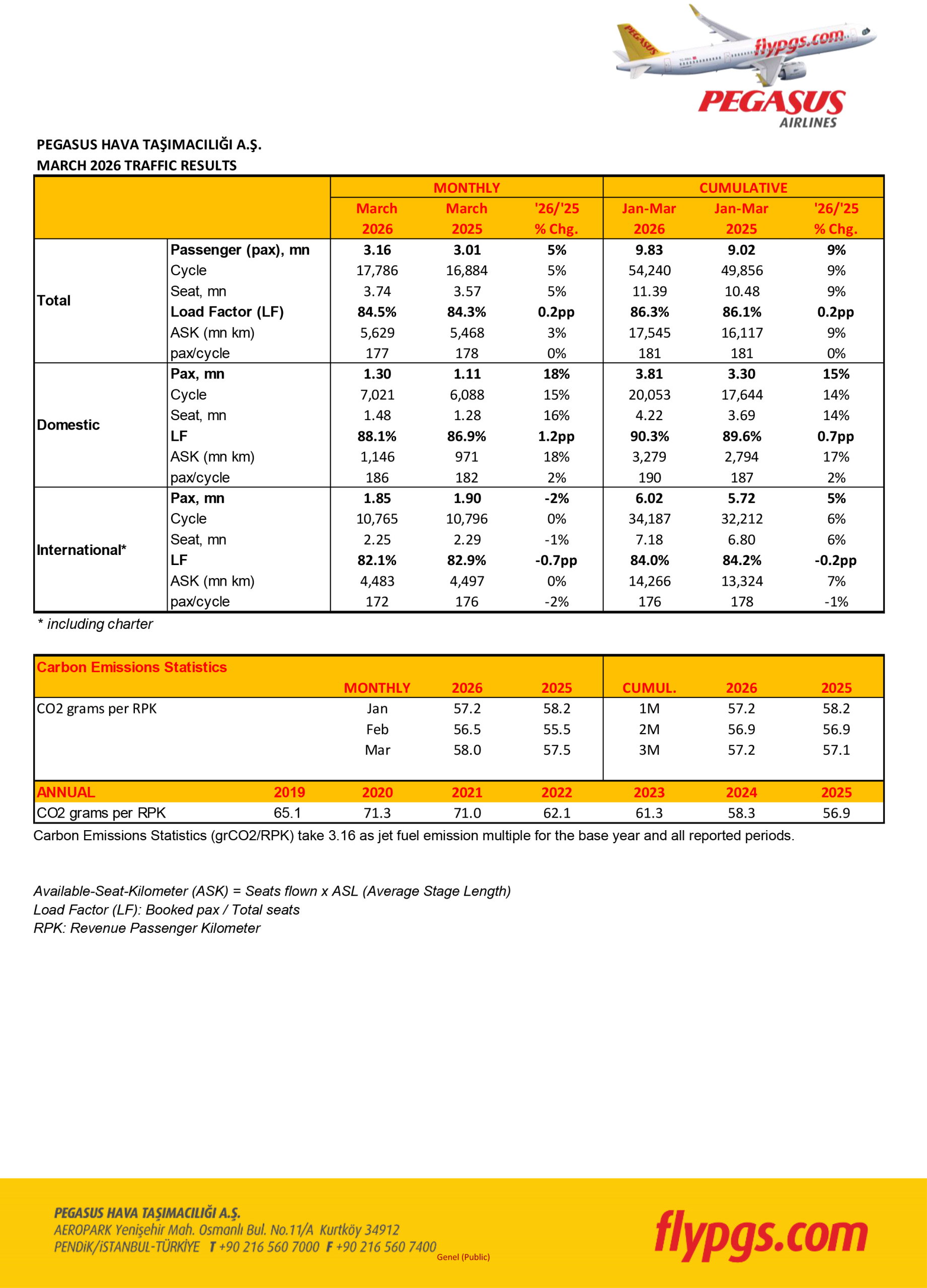
Pegasus Airlines Inc. announced its March 2026 traffic results. The data revealed that the company continues to expand its passenger capacity while maintaining a long-term downward trend in carbon emission intensity.
The company’s performance stood out particularly with load factors remaining stable at high levels and gradual improvement in CO₂ gram/RPK values.
Increase in Passenger Numbers, Capacity Expanding
In March 2026, Pegasus’ total number of guests increased by 5% compared to the same month last year, reaching 3.16 million. In the first quarter of the year, this increase reached 9%.
Operational indicators:
- Seat capacity: 5% increase (3.74 million)
- Landings (take-offs and landings): 5% increase (17,786)
- ASK (Available Seat Kilometers): 3% increase (5,629 million km)
- Load factor: 84.5% (yearly +0.2 points)
Different Dynamics in Domestic and International Segments
When evaluated on a segment basis, the data reveals a different picture:
Domestic operations
- Passenger increase: 18%
- ASK increase: 18%
- Load factor: 88.1% (+1.2 points)
- Landings: 15% increase
International and charter operations
- Passengers: 2% decrease
- ASK: flat trend
- Load factor: 82.1% (-0.7 points)
While a more limited demand outlook stands out in international routes, capacity optimization appears to be ongoing.
Efficiency-Focused Structure in ASK and RPK Balance
Available Seat Kilometer (ASK), one of the critical metrics in aviation, reflects Pegasus’ growing capacity. When evaluated together with Revenue Passenger Kilometer (RPK), which measures revenue performance, it is seen that the company maintains its efficiency-oriented growth model.
Long-Term Decline Trend in Carbon Emissions
One of the most critical highlights of the report was carbon performance. While the jet fuel emission coefficient was assumed to be constant at 3.16 grCO₂/RPK across all periods, the actual operational emission intensity showed a downward trend.
CO₂ gram/RPK data:
- January 2026: 57.2
- February 2026: 56.5
- March 2026: 58.0
Annual trend:
- 2019: 65.1
- 2022: 62.1
- 2024: 58.3
- 2025: 56.9
- 2026 (first quarter): ~57.2
Analysis: A Balanced Model Between Growth and Emissions
The March 2026 results show that Pegasus is progressing along two main axes:
- Capacity expansion and passenger growth
- Reduction in emissions per passenger-kilometer
This model indicates that both competitive pricing and environmental efficiency targets are being managed simultaneously within the low-cost airline structure.
For Pegasus Hava Taşımacılığı A.Ş., the March 2026 data shows that operational growth continues and strong demand, particularly in domestic routes, persists. On the other hand, the long-term decline in carbon emission intensity demonstrates that the company’s sustainability strategy is delivering results.
Considering the increasing environmental pressures in the aviation sector, Pegasus’ dual performance represents a critical reference for the upcoming period.