
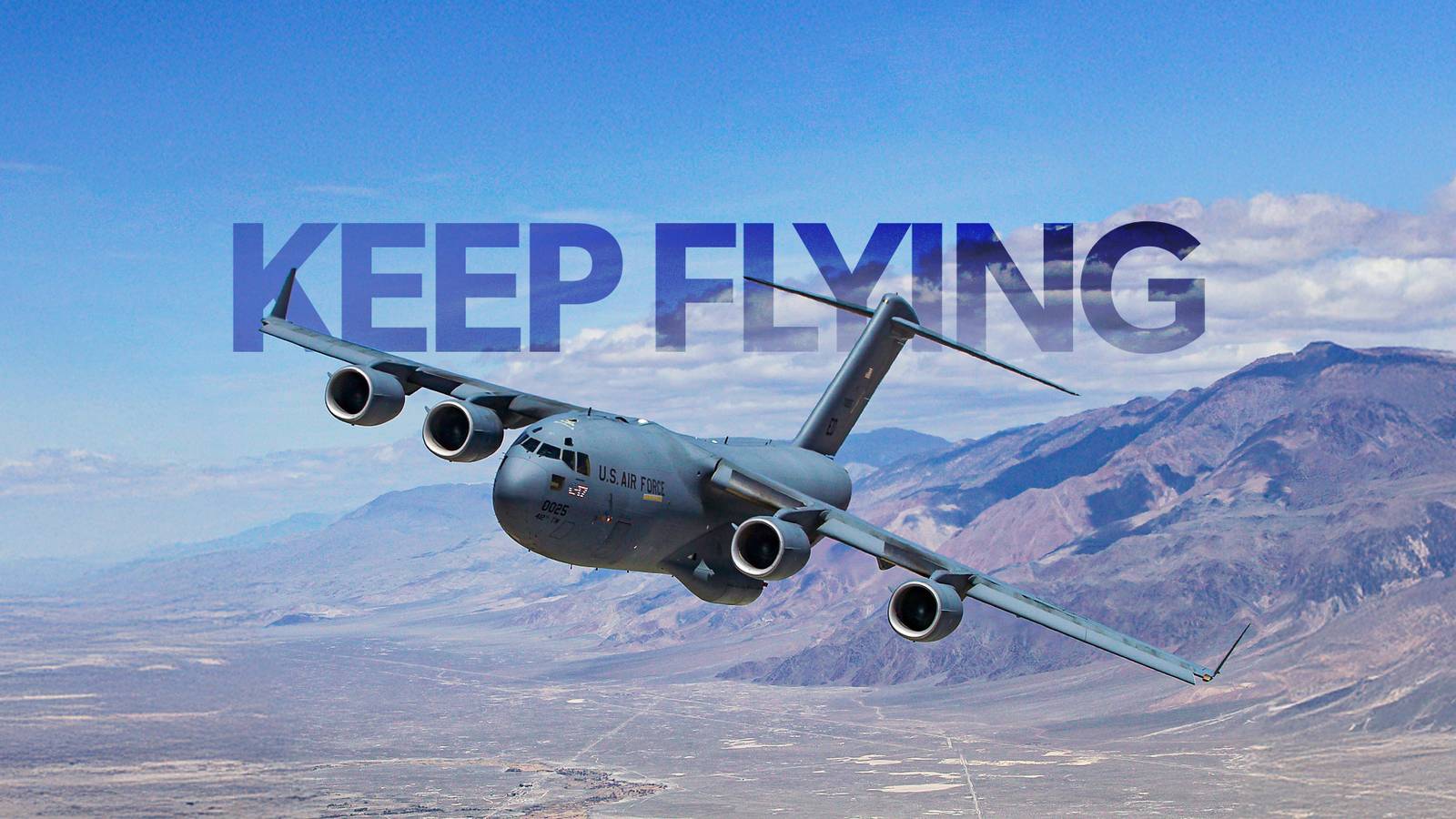


The last McDonnell Douglas C-17 Globemaster III left the assembly line in 2015, and it is expected to remain a vital airlift platform of the US Air Force for decades to come. The last C-17 rolled out the doors just as Boeing absorbed the storied planemaker in one of the largest aerospace mergers in history. Now, as the caretaker of the Globemaster, Boeing is preparing to deliver a major upgrade through its new Aircraft Data Reasoner.
The software-driven enhancement will power the C-17 fleet to its 2075 horizon. The 222 airframes owned by the US Air Force are expected to serve for another five decades despite already accumulating 4.5 million collective fleet hours across the fleet. The ADR will deliver predictive maintenance through massive amounts of system data paired with forecasting algorithms designed to find faults before they happen.
The ADR upgrade will not only improve the fleet readiness levels and significantly reduce supply chain risks, but also eliminate additional wear and tear that would have occurred if the flagged parts were allowed to fail before removal or replacement. But getting ahead of the curve, Boeing is ensuring that its most adaptable airlifter will not only continue to serve the USAF but also the other international operators around the world as well, who all share a single unified sustainment model.
The Globemaster Gets Smart: Boeing’s Aircraft Data Reasoner
The true value of ADR isn’t just flagging a faulty fuel probe on one runway; it is the fact that its data feeds into Boeing’s C-17 Digital Engineering Services database. This centralized database forecasts part failures across the unified Virtual Fleet Spares Pool. This directly increases combat capability by optimizing maintenance intervals but also saves money by reducing the number of redundant high-value components necessary to keep the global fleet in the air.
Enhancing the maintenance forecasting of every individual airplane to a highly accurate degree greatly improves the time on wing of every critical part in demand by all operators around the world. While the US Air Force has the fullest flightline of C-17s, 53 are flown by international partners that include Australia, Canada, the United Kingdom, India, Kuwait, Qatar, the United Arab Emirates, and even the North Atlantic Treaty Organization.
In fact, foreign military sales partners began receiving early iterations of the core data analysis stream years ago in advance of the ADR rollout, according to Aviation Week. The best example of the international collaboration behind the global C-17 inventory is the cross-servicing agreement between the USAF and the Royal Australian Air Force from 2019. Under this initiative, the Australian and American maintenance practices were synchronized to the point where mixed crews from either service could work on aircraft belonging to either nation interchangeably.
By The Numbers: How ADR Keeps The C-17 Flying
Historical data across a decade of C-17 operations shows that utilizing ADR predictive data yields a 2% to 3% increase in aircraft availability. And although that number seems small, it equals thousands of flight hours per year of uptime that is otherwise not possible, as well as potentially millions of dollars in savings on spare parts and labor. Then there’s the incalculable cost of the potentially life-changing difference that these planes could make by being ready for a mission to evacuate disaster victims or deliver badly needed supplies to troops on the front line.
The USAF can calculate its savings and force enhancement in exceptionally large numbers given unparalleled flightline depth, and those data points are a compelling case. Yet, the other operators around the world that have a very small number of planes gain similarly high value, as every malfunction or aborted sortie has an outsized impact on operations. Consider Australia, where keeping an extra 3% of a small eight-plane cadre mission-ready prevents a single unexpected mechanical failure from erasing up to 12.5% of the country’s total strategic heavy airlift capacity overnight.
Travis Williams, vice president of Mobility and Surveillance Aircraft Services, made this remark in the company’s press release from April of this year:
“With the Aircraft Data Reasoner, operators gain near-real-time insight into component health so we can act before failures occur. That predictive visibility not only improves C-17 mission readiness and reduces unscheduled downtime, it also drives smarter parts positioning and sustainment decisions across the fleet.”
Now we look to the ground side of the benefits that ADR presents by reducing downtime, which also means significantly fewer total maintenance hours spent to sustain a single airplane. The ADR system continuously assesses data from over 65,000 onboard aircraft parameters and runs them through 36,000 sensor-based algorithms. Early trials from Boeing estimated that the software successfully mitigates over 17,000 non-mission-capable hours and cuts down 28,000 maintenance hours by eliminating blind troubleshooting.
The C-17’s short-field landing capability comes from a system that no other military transport uses. It also creates a noise problem.
As much as the flyers of the C-17 Globemaster III stand to gain from the ADR upgrades, so too does Boeing, which has been struggling with profitability and its defense division for years. Boeing needs ADR because predictive maintenance protects its own profit margins under the fixed-fee contract. For a manufacturing company, supporting a closed line with components designed in the 1980s is an economic disaster.
Because Boeing can no longer sell new C-17 airframes, its entire business model for this platform relies on sustainment services. The C-17 Global Integrated Sustainment Program grants fixed multi-billion dollar fees for fleet readiness; however, it must ensure that the aircraft achieve those rates. This is the basic premise of the Performance-Based Logistics contract model that Boeing must adhere to. If maintenance costs rise, Boeing’s profit margins shrink.
If Boeing keeps the fleet flying efficiently and cheaply, the company retains the savings as pure profit. On the other hand, if an aircraft breaks down unpredictably on a runway in a remote region, Boeing must absorb the cost. That means shelling out for emergency engineering teams, diagnostic flights, and rush shipping any parts on its own dime. Replacing a component during standard ground time costs a fraction of an emergency off-station field repair.
Boeing is contracting Elbit Systems to provide HUD upgrades to its fleets of C-17 Globemasters (including for export aircraft).
One Team One Fight: Unified Ops In The Globemaster
While the ADR modernization standardizes operations across the entire nine-nation alliance, its deepest impact is felt by the USAF, which operates over 80% of the entire global inventory. For the USAF’s massive inventory, a 3% availability bump effectively injects five to seven additional heavy transport aircraft into active mission status daily across the global staging bases, without the multi-billion-dollar price tag of acquiring or building new airframes. At the same time, because smaller fleets are so highly leveraged, they cannot afford a ‘wait until it breaks’ model.
When a C-17 breaks down unexpectedly at a forward operating location, it generates an emergency parts request. Shipping a heavy component, like an engine part or landing gear actuator, via high-priority air freight is incredibly expensive and sidelines an airframe for days. ADR flags these failure signs weeks in advance. Additionally, because ADR runs identical sensor-based algorithms uniformly across all 275 global aircraft, Boeing gets a consolidated, real-time health map of every active Globemaster.
Without ADR, a partner nation trying to manage its own warehouse would have to spend billions buying ‘just-in-case’ spare parts that sit on shelves rotting. By sharing live sensor data with Boeing’s centralized supply chain model, every force benefits from the logistical might of the US Armed Forces. It allows an eight-plane fleet like the RAAF to operate with the logistical confidence and reliability of the USAF’s 200-plane force.
Boeing is also increasing the future-proof quality of the C-17 by transitioning the flight deck to a modular open systems approach that will complement the ADR and ensure the fleet achieves its maximum potential on every mission until retirement. Under the $400 million Flight Deck Obsolescence and Technology Refresh contract, Boeing will replace the ’80s-vintage flight management system and displays with new mission computers. Not only will the systems be more durable and capable, but they will also be plug-and-play as software upgrades roll out or hardware replacement is needed.
From the C-141 Starlifter to the C-17 Globemaster III, the USAF’s airlift capabilities have evolved over time.
How ADR Keeps C-17s Out of the Depot And In The Air
Historically, planes arrived at the depot, got torn down, and then mechanics discovered hidden component failures, extending the depot timeline. Critical high-value assets, particularly the Pratt & Whitney F117 engines, are heavily bottlenecked in the supply chain due to manufacturing backlogs and component scarcity. ADR monitors internal engine telemetry to target maintenance only when a specific part actually needs intervention, breaking the cycle of pulling engines based on fixed hourly schedules. And when the planes do go to depot-level maintenance, ADR provides preliminary information that focuses efforts where they are needed the most.
For one of the smaller C-17 international operators around the world, preventing one unscheduled grounding a year does not just save money; it preserves their baseline national capability. The USAF can rotate high-intensity missions across different bases to balance out the flight hours on its airframes. A country with a handful of planes is forced to fly those exact same airframes repeatedly for every single major deployment, accelerating wear and tear. When a component fails prematurely or operates inefficiently, it burns throughout the airframe’s finite lifespan.
This flight-hour loss hurts small operators disproportionately. Before predictive software, troubleshooting a complex, intermittent error required mechanics to turn the engines on, run ground tests, and fly diagnostic check-flights. These hours count against the airframe’s structural life but deliver zero mission value. For a small fleet, those saved hours mean extending the actual calendar lifespan of their eight airframes toward the 2075 target without prematurely burning them out on the ground.
Orijinal Haberi Görüntüle