
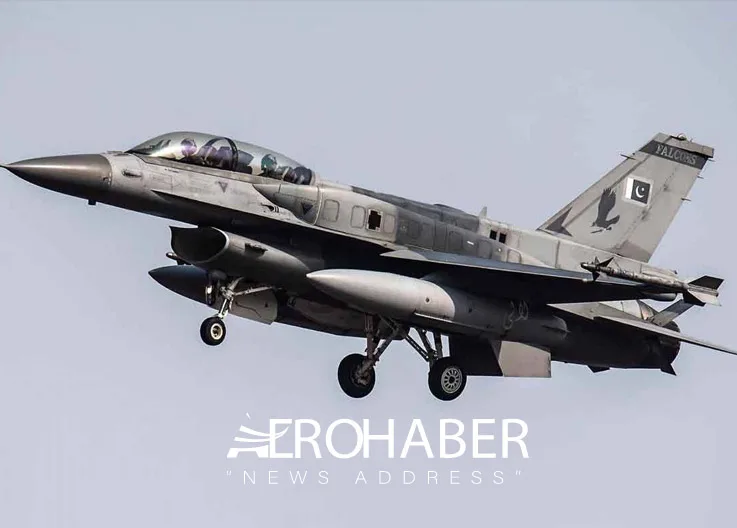


Facing airframe fatigue and Washington-imposed operational restrictions, the Pakistan Air Force (PAF) has begun advanced technical discussions with Turkish Aerospace Industries (TUSAŞ) to keep its ageing F-16 fighter jets in service.
The proposed cooperation aims to create a comprehensive survivability and mission sustainability package for Pakistan’s F-16 “Viper” fleet, as the United States does not permit modernisations that enhance strike capability.
The US Department of State approved a USD 686 million maintenance and sustainment package for the PAF’s F-16 fleet in December 2025. However, according to open-source defence analysts, this agreement was limited to flight safety, engine spare parts, and communications interoperability. Deep structural reinforcements and modern weapons integrations required to preserve the jets’ combat capability were excluded from the package.
This situation has pushed Islamabad towards Ankara in search of a more comprehensive solution.
STRUCTURAL CRISIS AND TAI’S SLEP PROPOSAL
Sources close to the talks confirm that a senior PAF delegation visited TUSAŞ facilities in Kazan, Ankara, in October 2025. The main objective of the visit was to develop a Service Life Extension Program (SLEP) for the PAF’s oldest F-16s.
At the centre of the issue are the Block-15 F-16A/B aircraft delivered between 1983 and 1987. Estimated to number between 55 and 60, these jets have reached around 40 years of service life and accumulated approximately 7,500–8,000 flight hours. Given their current structural condition, their retirement by 2030 is considered inevitable without significant intervention.
TUSAŞ has proposed a structural refurbishment package similar to the indigenous “Özgür” modernisation project, which extended the service life of the Turkish Air Force’s F-16 Block-30 fleet from 8,000 to 12,000 hours. Under the programme planned for Pakistan, the renewal of critical load-bearing components is envisaged, including:
- Wing carry-through structures
- Longitudinal spars
- Landing gear attachment points
To save time and ensure technology transfer, the modernisation is planned to be carried out at Pakistan’s F-16 maintenance facility in Kamra, using Turkish-made structural kits.
A SOLUTION THAT BYPASSES US RESTRICTIONS: UBAS
One of the most critical elements of the proposed agreement is the integration of the Universal Battlefield Armament System (UBAS).
Developed by TUSAŞ in cooperation with ASELSAN, UBAS offers an alternative to the restrictive source-code controls applied by Lockheed Martin on F-16s. The system is described as a “tablet-based” fire control interface that operates independently of the aircraft and bypasses the main mission computers.
Communicating directly with weapon stations via an open-architecture data bus, UBAS enables the integration of non-US munitions without US approval. This would allow Pakistan to equip its F-16 fleet with Turkish-made modern weapons.
Prominent munitions include:
- GÖKDOĞAN: An active radar-guided BVR air-to-air missile with a range exceeding 100 km (AIM-120 AMRAAM equivalent)
- BOZDOĞAN: A short-range missile with an imaging infrared seeker and high off-boresight capability (AIM-9X equivalent)
- Precision-guided bombs: JDAM-like HGK kits and laser/GPS-guided TEBER kits
Open-source reports indicate that Turkey has successfully tested these munitions both on its own F-16s and on the Kızılelma unmanned combat aircraft, with the systems having reached operational maturity.
INCREASED URGENCY AFTER “SINDOR OPERATION”
The urgency of the modernisation requirement became even more apparent during the “Sindor Operation” in May 2025. During the clashes, the vulnerabilities of Block-15 F-16s armed with older AIM-9L/M Sidewinder missiles against modern air defence systems were exposed.
Indian Air Force Commander Air Chief Marshal AP Singh stated that India’s S-400 systems engaged PAF F-16s from extended ranges and that at least two aircraft were shot down. Additionally, it was claimed that some aircraft were destroyed on the ground during Indian Air Force precision strikes against the Mushaf and Rafiqui air bases.
Following these developments, Chinese-made J-10CE fighter jets became Pakistan’s primary air superiority platform, while F-16s were relegated to secondary roles.
2029 TARGET: 45 MODERNISED F-16s
If the Turkish–Pakistani cooperation, which officials say is “95 per cent complete,” is implemented, Pakistan aims to return approximately 45 modernised F-16s to active service by 2029.
This solution is viewed as a temporary but critical bridge to maintain fleet strength until Pakistan’s AZM fifth-generation fighter programme matures in the mid-2030s.