


Russia has passed a long-awaited milestone in the Sukhoi Su-57 fifth-generation fighter programme. In line with its goal of developing a more powerful and efficient power unit, Moscow has launched the first flight tests of the new-generation engine designed for the Su-57.
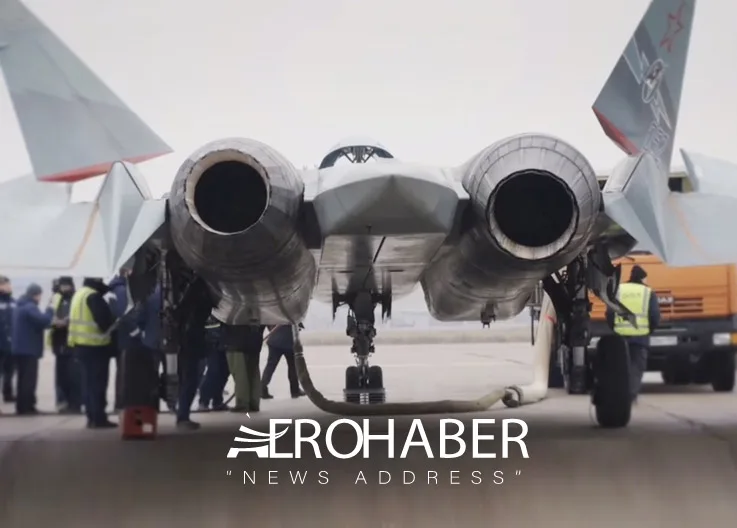
Russia’s state-owned defence industry corporation Rostec announced on 22 December 2025 that the Su-57 had taken off for the first time with its new “Product 177” engine. The company described the engine as an advanced power unit developed specifically for fifth-generation fighter aircraft. It was stated that the test flight was carried out by experienced pilot Roman Kondratyev and that no abnormalities were observed.
CRITICAL THRESHOLD IN THE SU-57 PROGRAMME
The start of flight tests is regarded as a critical turning point for the Su-57 programme. The engine development process has been one of the greatest technical challenges faced by the programme to date. The first production Su-57 aircraft entered service with interim engines, while Russia continued work on a next-generation engine offering higher thrust, better fuel efficiency and longer service life.
According to Rostec, the Product 177 engine produces 16,000 kilograms-force (approximately 35,000 pounds) of thrust in afterburner mode. It is stated that the new engine not only increases thrust but also reduces fuel consumption and significantly improves durability. The engine was developed for fifth-generation air platforms by United Engine Corporation (UEC), a subsidiary of Rostec.
PERFORMANCE INCREASE AND FUTURE DEVELOPMENTS
Russian officials state that the new engine will not only enhance the Su-57’s flight performance but also form a basis for the aircraft’s future modernisations. The Su-57 is designed for multi-role missions against air, land and sea targets, featuring internal weapons bays, an airframe design that provides low radar visibility, and a high level of automation aimed at reducing pilot workload.
The Su-57 made its first flight in 2010 and was developed as Russia’s response to the US-made F-22 Raptor, F-35 Lightning II and China’s Chengdu J-20 fighter aircraft. However, the programme progressed slowly over the years due to development delays, funding constraints and production challenges.
Estimates based on open sources indicate that only a few dozen Su-57s have been produced to date, which remains quite limited compared with US or Chinese fifth-generation fleets. Although Russia has stated that the Su-57 has seen limited operational use in some missions linked to the war in Ukraine, independent assessments of the aircraft’s combat performance remain very limited.
PRODUCTION AND EXPORT TARGETS
In parallel with engine tests, Rostec announced that United Aircraft Corporation (UAC) has increased its Su-57 production capacity and that accelerating deliveries to the Russian Armed Forces is being targeted. In addition, Moscow continues to actively market the export version offered as the Su-57E. Although it was previously announced that the first foreign sales contract had been signed, customer countries and delivery schedules have not been disclosed to the public.
Reports and leaks published in recent years indicate that Algeria, India and some other countries are interested in the Su-57, particularly as Russia continues its efforts to maintain defence exports under international sanctions. However, in terms of production numbers, the Su-57 continues to lag behind its Western and Chinese rivals.
While the US-led F-35 programme has delivered hundreds of aircraft to air forces around the world, China is also steadily expanding its J-20 fleet. Russia, for its part, positions the Su-57 as a long-term platform and continues to develop the aircraft incrementally, particularly in engines, avionics and weapons systems.