
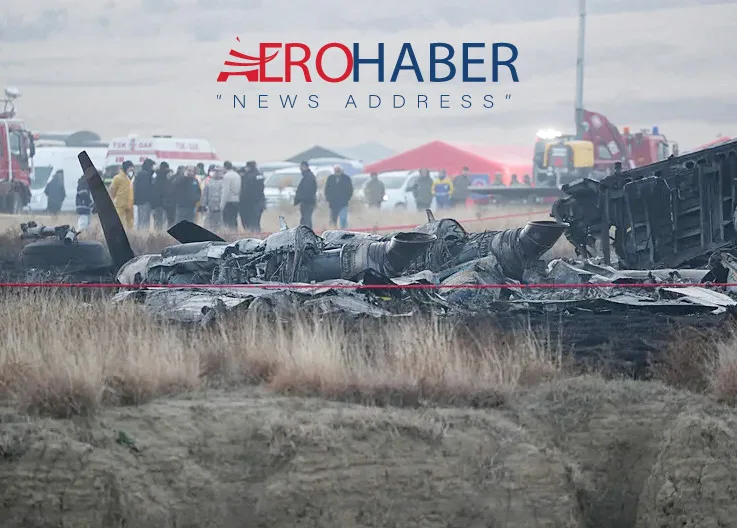


Following the loss of our 20 soldiers who were martyred in the crash of a C-130 military cargo aircraft in Georgia on its return route from Azerbaijan to Türkiye, the initial findings in the technical investigation have begun to take shape. According to early assessments regarding the aircraft’s descent, it is being considered that consecutive failures in two of the cargo aircraft’s engines may have triggered the crash.
In the accident that occurred on 11 November, the C-130 aircraft of the Turkish Air Force with flight number TUAF543 took off smoothly from Ganja towards the 5th Jet Base in Merzifon. After reaching an altitude of 22,000 feet, the aircraft entered straight and level flight in Georgian airspace. According to initial findings, shortly thereafter, a technical malfunction occurred in engine number 4, and the propeller blades went into a “feather” position, causing abnormal acceleration. At the same time, the aircraft suddenly climbed 1,500 feet.
According to claims, while the pilots were trying to respond to this extraordinary situation, engine number 2 on the opposite wing gave an oil pressure failure and detached due to the resonance caused by excessive acceleration. The aircraft completely lost control after the detached parts struck the fuselage. The tail, mid-fuselage, and cockpit sections broke apart in a short time and scattered across a wide area.
According to expert assessments, since the entire process occurred within seconds, the pilots did not even have time to make an emergency call.
Black Box Analysis Continues, Accident Simulation to Be Conducted
The definitive results regarding the cause of the accident will become clear after the analysis of the Cockpit Voice Recorder (CVR) and Flight Data Recorder (FDR) devices. The aircraft’s manufacturer, Lockheed Martin, will also participate in the investigation and will simulate the accident to reconstruct the breakup sequence.
MoD: “No external attack, no overload, no munitions”
The initial assessments of the Ministry of National Defence eliminate several possibilities:
There was no overload on the aircraft.
The cargo did not contain munitions or explosive materials.
No missile, drone strike, or any other external attack occurred.
There were no holes, burn marks, or external impact traces on the fuselage.
The Ministry’s statements largely rule out the possibility of external sabotage, while increasing the importance of investigating technical failures or altitude-related sudden stress effects.
C-130 Fleet Grounded
Following the accident, all C-130 aircraft in the Turkish Air Force fleet were temporarily grounded. While comprehensive technical inspections of the aircraft continue, experts emphasise that although the aircraft is old, it has been modernised and used by dozens of countries worldwide.
It is stated that determining the exact causes of the accident may take months, while aviation and safety authorities are conducting the investigation from multiple angles.