
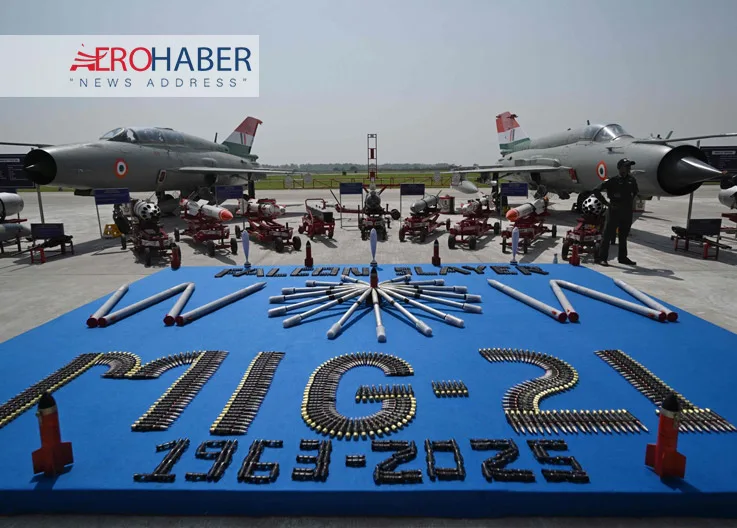


The Indian Air Force has officially retired its Soviet-made MiG-21 fighter jets, which had been in service for more than 60 years. Nicknamed the “flying coffin” due to their involvement in numerous accidents, the retirement of the MiG-21s reduces India’s fighter fleet to 29 squadrons. This figure falls short of the government’s previously approved target of 42 squadrons.

Since the 1960s, the MiG-21s had played an active role in India’s wars with China and Pakistan. However, accidents damaged not only the aircraft’s reputation but also its reliability. According to official data, between 1971 and 2012, 482 MiG crashes claimed the lives of 171 pilots, 39 civilians, 8 service personnel, and 1 crew member. Later accident data has not been updated.
India’s current fleet consists of French-made Rafale and Mirage 2000 jets, Russian-made Su-30s and MiG-29s, along with the domestically produced Tejas fighter jets.

New Strategy: Strengthening with Indigenous Tejas
Defence analysts warn that the retirement of the MiG-21s could create short-term risks by leaving a gap in India’s air power. New Delhi–based defence expert N.C. Bipindra stated, “If the decline in the fighter fleet is not compensated quickly, India will find it difficult to counter neighbouring adversaries in modern warfare.”
In response to these concerns, the Indian government approved a $7.4 billion project on 20 August for 97 domestically produced Tejas Light Combat Aircraft (LCA) Mark-1A. These new aircraft are expected to replace the MiG-21s and enhance the capacity of the air force.