
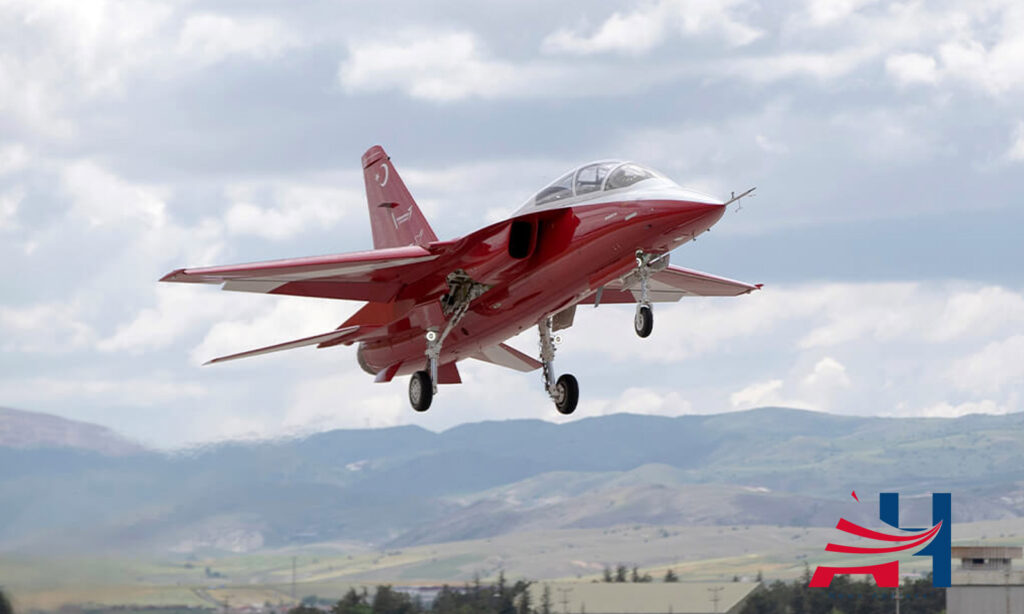


Turkey’s first jet-powered training aircraft, HÜRJET, will soon be flying to Spain. HÜRJET is one of the most advanced candidates in the tender to replace the Spanish Air Force’s F-5 jets with a new generation of jet training aircraft. Turkish Aerospace Industries (TUSAŞ) did not bring HÜRJET to the Farnborough International Airshow because it is being prepared for a tender from an undisclosed European country.
According to Aviation Week, HÜRJET is among the options to replace the Spanish Air Force’s F-5 aircraft, alongside Boeing T-7, Korea Aerospace Industries T-50, and Leonardo M-346. Spain plans to procure new-generation jet training aircraft starting in 2030, and HÜRJET stands out as one of the most advanced candidates to meet this goal.
Features and Performance of HÜRJET
HÜRJET, developed by Turkish Aerospace Industries (TUSAŞ), is Turkey’s first jet-powered training aircraft. Designed to replace the T-38 and F-5 aircraft, HÜRJET is notable for the following technical specifications and capabilities:
- Length: 13.6 m
- Wingspan: 9.5 m
- Height: 5.1 m
- Wing Area: 35 m²
- Thrust: 17,600 lb
- Service Ceiling: 13,716 m
- Sustained Turn Rate: 5.5 g @ 15,000 ft < 0.9 Mach
- Climb Rate: 39,000 fpm
- Range: 2222 km
- Payload Capacity: 2721 kg
- Maximum Speed: 1.4 Mach
- G Limits: +8g / -3g
Key Capabilities of HÜRJET
- High Angle of Attack (AoA) control
- Head-Up Display (HUD)
- Helmet-Mounted Display
- Full Authority Digital Engine Control (FADEC)
- Advanced Human-Machine Interface
- Intra & Inter Data Link
- Night Vision Compatibility
- Aerial Refueling Capability
- Easy Handling
- Embedded Tactical Training and Live Virtual Constructive Training Systems
- Auxiliary Power Unit (APU) for Autonomous Operations
- Air-to-Air and Air-to-Ground Firing Capability
© www.aerohaber.com | www.tr.aerohaber.com
Note: Aviation news on our news site cannot be used without citing the source.