
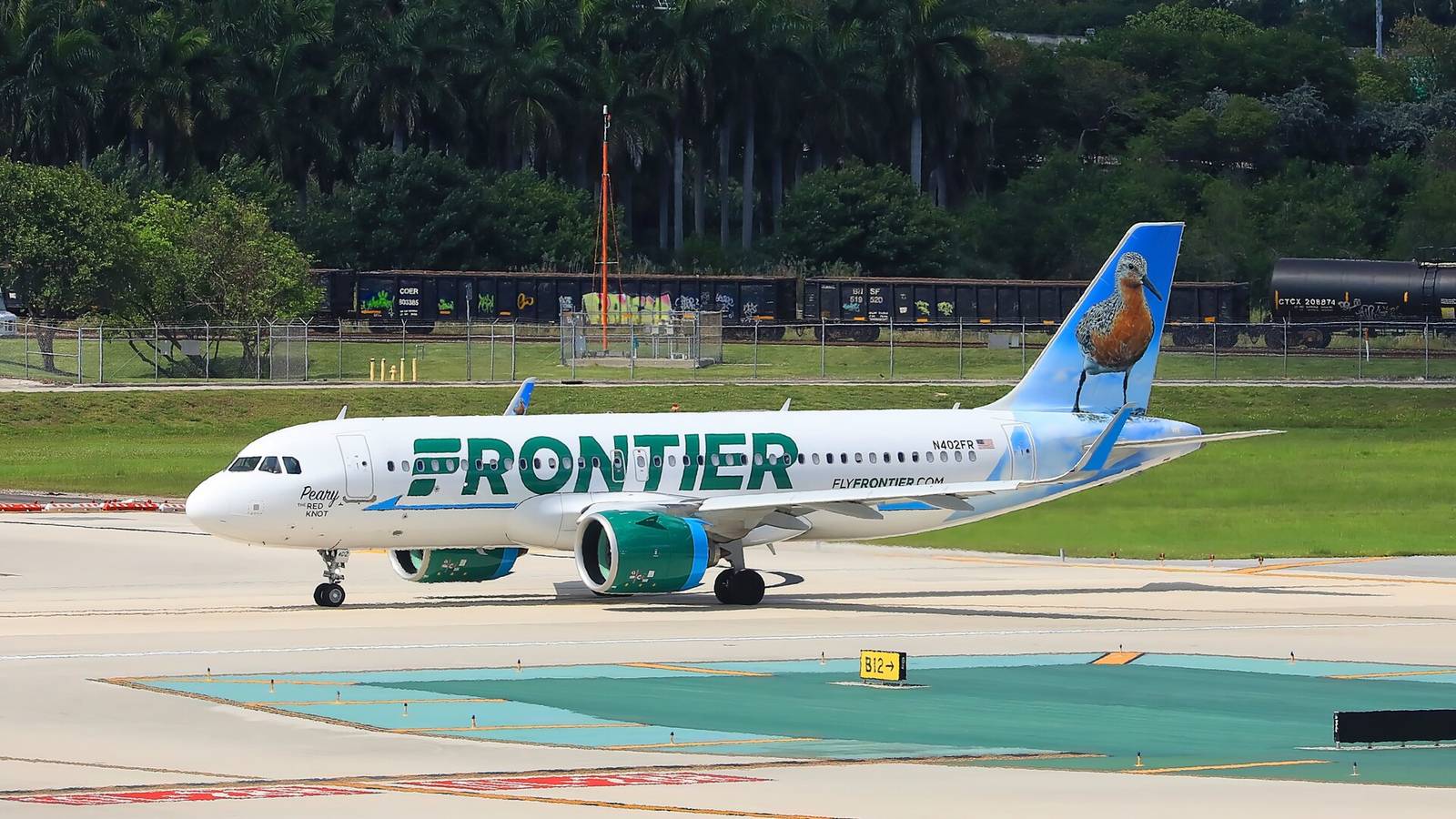


Frontier Airlines spent much of 2025 transforming Atlanta into one of the most important airports in its network. By December, the ultra-low-cost carrier was advertising 61 nonstop destinations from Hartsfield-Jackson Atlanta International Airport (ATL), having added domestic, Caribbean, Mexican and Central American routes at a rapid pace. Within months, Atlanta became the busiest airport in the Frontier network, eclipsing its long-time base at Denver International Airport (DEN).
Now, less than a year later, 21 of those routes have disappeared. At first glance, that looks like a retreat, but the underlying numbers suggest something different. An analysis of Bureau of Transportation Statistics (BTS) T-100 data shows that while Frontier has cut more than a third of its ATL routes, it has only trimmed about 5% of its actual seat capacity. So what does this mean for the future of Frontier at the world’s busiest airport?
Frontier’s Atlanta ambitions were unusually explicit. In February 2025, it announced that departures would increase 40% year-over-year, with 52 destinations planned by summer. By December, the route network had grown another 17%. The expansion was relatively easy to execute for Frontier, because Atlanta was already a large crew base with more than 1,200 employees, and the carrier had just moved into newly built gates on Concourse E that could underpin this growth.
Atlanta offered several things that Frontier wanted. The enormous presence of Delta Air Lines gives Frontier an incumbent against which it can differentiate heavily on price. Frontier claimed its fares were, on average, 60% lower than other ATL carriers. Meanwhile, Southwest Airlines had announced plans to eliminate roughly one-third of its Atlanta flights, while Spirit Airlines was in full retreat, creating much more room for another low-fare airline.
Allows routes to be tested with limited capacity
Makes Frontier more relevant to Atlanta travelers
Frontier’s goal went beyond simply adding a few leisure routes. Then-president James Dempsey told the Atlanta Journal-Constitution that the airline wanted to become Atlanta’s second-largest carrier, while recognizing Delta was untouchable in first place. Crucially, he said Frontier wanted its growth to be both profitable and sustainable, language that looks particularly relevant given what followed. Dempsey said:
“We’re never going to be the first. We know that. But we think we can have a very competitive product and a complementary route network.”
Frontier could also test many destinations cheaply by initially operating them only once, twice, or three times weekly. So the experiments just kept on coming. Frontier launched six more ATL routes in June 2025 and followed them with further additions in the fall. December brought another burst: St. Maarten, Nassau, Milwaukee, Providenciales, Puerto Vallarta and San José del Cabo, lifting the advertised network to 61 destinations. Five of those six routes would survive only a few months.
The expansion stopped almost as abruptly as it began. Frontier’s route-announcement archive shows that not a single new Atlanta route has been added this year. Instead, 2026 has been characterized by trimming, including six international routes removed from Frontier’s summer schedule in March. Simple Flying subsequently identified Atlanta as one of the markets most affected by Frontier’s international network cuts. The net result has been 21 routes removed, as detailed in the table below.
The shortest-lived routes are perhaps the most revealing. Nassau, Providenciales, Puerto Vallarta, San José del Cabo and St. Maarten had all begun in December 2025, only to disappear by April. AeroRoutes showed that all were removed from the originally planned summer schedule, while Simple Flying found particularly poor DOT-derived load factors of 17.6% for Providenciales and 22.2% for Nassau.
The domestic numbers tell the same story. BTS data through May shows Richmond averaging 40.7%, Milwaukee 42.9%, Fort Myers 46.0%, Grand Rapids 46.1% and Omaha 46.8%. Of course, the load factor is not the same as profitability: fares and ancillary revenue matter enormously. Nevertheless, repeatedly dispatching aircraft less than half full gives Frontier a powerful reason to put that capacity elsewhere.
The carrier is pruning thin routes while concentrating more flying in larger, higher-priority markets.
Frontier Is Pruning Atlanta, Not Abandoning It
The cuts also need to be viewed against Frontier’s wider financial reset. The airline lost $137 million in 2025, reversing an $85 million profit in 2024. In February, it also announced plans to return 24 Airbus A320neos early, and defer 69 future A320neo-family deliveries, saying the changes would help produce around $200 million of annual run-rate savings by 2027. CEO James Dempsey told Reuters that right-sizing the fleet was “central to bringing Frontier back to profitability.”
That makes the Atlanta traffic comparison especially important. Across Frontier’s domestic ATL operation from January through May. The routes subsequently cut performed dramatically worse than those retained, as detailed in the table below.
The routes Frontier eliminated were therefore approximately 25% emptier than those it retained. It is also noteworthy that while 21 routes were eliminated, these only accounted for about 5% of total seats that the airline was offering at ATL. That is compelling evidence of targeted pruning rather than indiscriminate downsizing. There are also signs the wider reset is working, even though Frontier has not yet returned to profitability.
Second-quarter revenue reached a company-record $1.28 billion, up 38% year-over-year, while RASM jumped 28% and load factor reached 80.3%. Frontier still posted a $90 million GAAP net loss, but that was primarily due to one-time costs associated with returning those 24 aircraft, as it ended June with a smaller 165-aircraft fleet. For Atlanta, that points toward a more measured next chapter. Frontier still wants a large presence in a huge market dominated by a higher-fare legacy competitor.
However, with fewer aircraft than previously planned, and profitability now paramount, another burst of route launches looks very unlikely in the near term. If the surviving network continues to perform, growth could return later. Still, Frontier’s ambition to become Atlanta’s second-largest carrier will now depend less on how many routes it serves than on choosing the right ones.
Orijinal Haberi Görüntüle