


The Airbus A321XLR is one of the most impactful new airliners on sale, as it’s a narrowbody airliner designed specifically for long-distance flights. While the Boeing 757-200 was prominently used on some long-haul routes in the past, this was never its original intended role, whereas the A321XLR uses the venerable A321neo platform and adds improvements to give it a range of 4,700 NM (8,700 km).
The aircraft is more capable than the 757 while burning dramatically less fuel, and Airbus is starting to deliver the type in higher numbers to customers. The practical benefit of using the A321XLR in a long-haul network is that it can be used to launch flights to smaller destinations, to fine-tune capacity through multiple frequencies better than a widebody, and to replace widebodies when demand is lower.
This may be during the off-season or even on certain days of the week. While it’s not going to permanently replace widebodies everywhere, it is being used by an increasing number of airlines and will soon become a staple on routes within its range.
IndiGo, India’s largest airline, has traditionally only flown narrowbody aircraft on short-haul flights, but is now experimenting with long-distance operations. It previously leased two Boeing 777-300ERs from Turkish Airlines until March 2026, and more recently, it’s been operating six damp-leased Boeing 787-9s from Norse Atlantic.
However, IndiGo will discontinue the 787 operations in October, and it will also suspend most of its long-haul services. Amsterdam will be an exception. In October, IndiGo will begin operating the Airbus A321XLR between Mumbai and Amsterdam. IndiGo has taken three A321XLRs, which are currently serving Athens and Istanbul from Mumbai and Delhi, while Denpasar has been announced from both hubs as well.
On paper, Amsterdam should be easy for the type, as the route is 3,707 NM (6,866 km), but current airspace restrictions mean that these flights will take significant detours. IndiGo has blocked the departing leg at 11 hours, making this the longest A321XLR flight by scheduled time thus far. IndiGo has ordered 69 A321XLRs in total, and it will use the type extensively, but its assignment on the Amsterdam route may be temporary.
It has mainly been using its leased planes to ‘test the waters’ with regard to long-haul routes, but it has 60 Airbus A350-900s on order set to start arriving in 2027. Most of the routes currently being flown by the Norse 787s will return once the A350s begin arriving, and the A321XLR will serve to complement the A350s in IndiGo’s future long-haul expansion.
Unlike many airlines, Qantas ordered the A321XLR primarily for its payload capacity to be used on domestic routes rather than to launch new, long-and-thin routes to exotic locations. Thus far, Qantas has only been flying the A321XLR domestically, but the type’s international debut was scheduled in October 2026, from Brisbane to Manila.
However, this has now been pushed back to 2027, although it remains on this list because it represents a unique way in which the A321XLR is being used in place of widebodies. Qantas restarted this route in 2024 using an Airbus A330-200, but the two cities are only 3,125 NM (5,788 km) apart.
It’s well within the capabilities of even a 200-seat A321XLR, and there’s only about a 55 to 74-seat difference between Qantas’s A321XLR and A330-200 (depending on the layouts), which isn’t that significant considering just how much bigger the A330 really is. It’s a comparatively massive aircraft, and what’s more, it uses prior-generation engines, which means that the operating cost delta between the two is enormous.
The A330-200, of course, has flat-bed business class seats, whereas the A321XLR has recliners and no seat-back screens, but Manila is traditionally a high-volume but lower-yielding market. Qantas also planned to boost service to daily with the A321XLR, but this change will now happen in November with the A330 and remain when the A321XLR comes onto the route.
As a whole, Qantas is generally using the A321XLR as a domestic aircraft. However, the plane’s legs can be stretched to serve destinations like Manila that are far but might not sustain a long-haul configured widebody.
Qantas will have one of the highest passenger capacities onboard its Airbus A321XLRs.
The Boeing 787 is the gold standard for fuel efficiency in the widebody market, but it’s still a large twin-aisle airliner that will seat over 250 passengers in most cases. The 787-8 exists for thin routes, but it has essentially the same operating costs as its larger siblings and is only really useful when a carrier is particularly focused on preserving yield integrity.
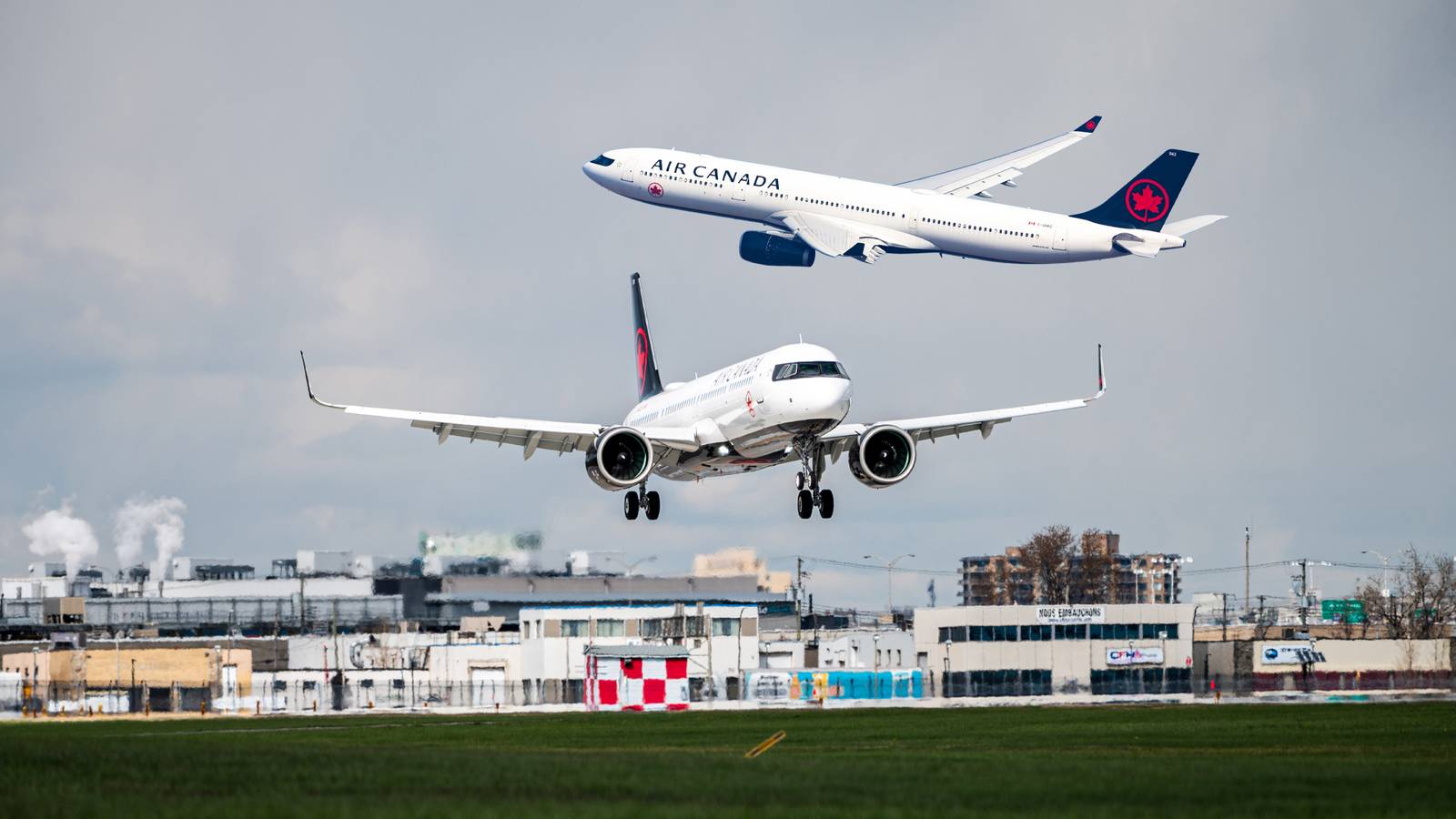
To address the operating cost and yield issues, however, you have the Airbus A321XLR, a plane that’s even smaller than the 787-8 while being cheaper to operate. Air Canada has taken delivery of two A321XLRs and is using them on three transatlantic routes from its hub in Montreal, but the Toulouse route was the first to see the aircraft, with the switch notably occurring at the beginning of the busy summer season.
The type replaced the 787-8, which has 73 more seats and burns significantly more fuel. Of course, the A321XLR earns less revenue, but markets like Toulouse have relatively low demand, and pricing integrity is extremely important to maintaining profits. The A321XLR also replaced the 787-8 on Air Canada’s route from Montreal to Berlin.
Meanwhile, it’s set to replace the Dreamliner in September on the airline’s routes to Lyon and Porto. Notably, Air Canada has also placed the A321XLR on its route to Nantes, which was not previously operated by the 787, but rather by the 737 MAX 8. The A321XLR can fly further, carries more payload, has a larger cabin, and features lie-flat seats, potentially enabling Air Canada to charge higher business class fares due to the upgraded product.
Until recently, Iberia’s smallest long-haul jet was the Airbus A330, which is still a massive aircraft. To appropriately meet demand on some of its routes, Iberia had to keep frequencies low, and most of its routes were operated seasonally. This is due to the fact that transatlantic demand drops significantly during the winter, and Iberia relies more heavily on leisure traffic than a carrier like British Airways.
While some destinations can support year-round service, spokes like Washington DC have long been summer seasonal destinations. Iberia serves Washington DC daily from its hub in Madrid, with the A321neo operating the route five times per week while the A330-200 serves this route twice per week.
During the winter, meanwhile, the route is cut down to six flights (with flights not operating on Sundays) per week, and the A321neo is assigned on all six days. The A321XLR has allowed Iberia to serve Washington year-round now, whereas this destination had to be served seasonally when it was solely served by the A330. The A321XLR makes it economical for Iberia to serve cities like Washington year-round due to its low operating costs and small size.
However, beyond simply making the route profitable during the slow winter season, this also helps Iberia’s position in the overall market. Full-service carriers like Iberia rely heavily on business travelers and corporate contracts. Not only does this segment prefer daily or almost daily service, but year-round service is key to maintaining market relevance with this demographic of customers, and the A321XLR makes that economically feasible.
It’s time to say goodbye to the Ferrari of the skies. Here are the planes that will replace the 757.
Iberia was the launch operator for the A321XLR, and Boston was the carrier’s first long-distance route with the A321XLR. Once again, this mainly replaced an Airbus A330, and Iberia now maintains year-round service, even flying to Boston daily during the winter months. Meanwhile, the carrier schedules two daily flights during the summer except on Fridays, and it uses a mix of the A321XLR as well as the A330.
On the route from Madrid to Boston, the A321XLR is mainly used to fine-tune available capacity to best match demand, which can vary significantly between different days of the week. The use of the small A321XLR allows Iberia to manage its capacity to a more precise degree, but it also allows Iberia to offer multiple flights on most days of the week. Business travelers tend to prefer having multiple schedule options, allowing Iberia to potentially charge higher fares.
The A321XLR is mainly being used to complement widebodies by full-service carriers, while some airlines are simply treating it as a standard narrowbody but with more range, like Qantas or budget airlines. However, it is one of the most versatile airliners on sale because its operating costs are so low due to its small size, and it will be exciting to see how other airlines will use the A321XLR as more examples enter passenger service.
Found an error? Send it info@simpleflying.com so it can be corrected.
Orijinal Haberi Görüntüle