
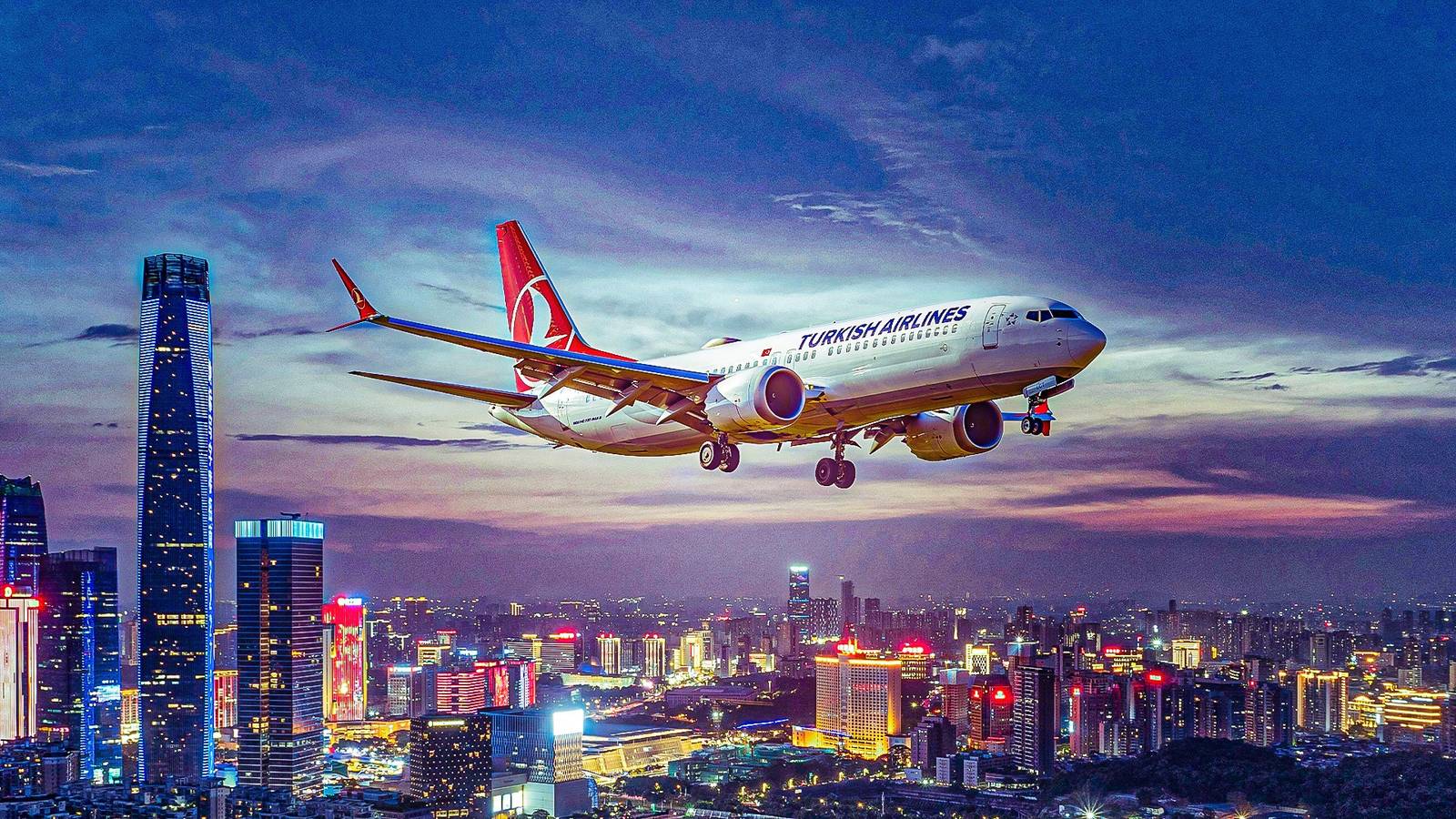


Turkish Airlines wants to add London City Airport (LCY) to its rapidly expanding UK network, potentially giving the carrier four separate London gateways. The Times reports that Chairman Murat Seker identified LCY as a future target while discussing the airline’s longer-term expansion. Its London operation already encompasses London Heathrow Airport (LHR), London Gatwick Airport (LGW) and, since March this year, London Stansted Airport (STN).
There is, however, an immediate problem: what would Turkish Airlines actually fly there? London City’s short runway and 5.5-degree approach severely restrict the aircraft that can use it. LCY hopes a new 4.49-degree approach will allow larger new-generation aircraft such as the Airbus A320neo from 2027, but Turkish Airlines mainline does not operate that type. Even its smaller Airbus A319-100s and Airbus A320-200s don’t provide the easy solution they might initially appear to.
Turkish Airlines Already Flies Up To 14 Times Daily To London
Turkish Airlines’ interest in London City certainly does not stem from a lack of London capacity. Schedule data for August 2026 shows 374 Istanbul-London departures, half of them to Heathrow, where the bulk of flights are operated by the airline’s Boeing 777-300ER and Airbus A350-900 widebodies. That equates to around 12 daily departures on average, rising to 14 on selected dates, and approximately 15% more flights than in the same month last year.
Largest London operation; extensive widebody flying
LCY would become Turkish Airlines’ fourth London airport
Stansted has driven most of that expansion. Turkish began passenger flights there in March, initially operating ten weekly flights, before increasing to twice daily over the summer. Unlike Heathrow, the airline uses its Boeing 737 narrowbody fleet for STN, with a split schedule that allows passengers to connect to/from different waves of flights at the enormous Istanbul Airport (IST). Fuat Fırat, Turkish Airlines VP of Sales, explained that adding Stansted was a case of investing in a market with proven growth:
“The United Kingdom continues to be one of the key strategic markets for Turkish Airlines, a market that more than delivers on our goal of 6% annual growth”
It is therefore unsurprising that Turkish Airlines is now considering LCY. The airport might be smaller, but its location close to Canary Wharf and the City would make a comparatively small operation particularly attractive for premium and business traffic looking to connect over Istanbul to financial capitals in Asia.
London City Is About To Become Accessible To More Aircraft
The underlying issue is LCY’s unusual approach. Aircraft currently descend at 5.5 degrees, versus around 3.0–3.5 degrees at most UK airports, and need specific capabilities and operational approval. The Airbus A318 was notably developed with a special steep-approach mode, and became famous for British Airways’ former operation from LCY to New York JFK Airport (JFK).
However, that capability was not shared by every member of the A320 family, and Turkish Airlines’ A319-100s and A320-200s aren’t able to be moved onto an LCY route today. Still, the approach rules could all be changing from 2027. LCY is proposing an additional 4.49-degree RNP-AR approach, 1.01 degrees shallower than today’s procedure, designed to accelerate the introduction of larger, more efficient aircraft.
The airport repeatedly identifies the A320neo as the key example, with the change possible from January 2027 at the earliest if approved by the UK’s Civil Aviation Authority. As of July, LCY said the CAA’s decision was expected by the end of September 2026. Could Turkish Airlines’ existing A319s or A320ceos eventually use the shallower procedure?
Operated By Turkish Airlines’ Mainline Fleet?
The new approach itself potentially broadens the technical possibilities, but LCY’s entire proposal is framed around moving toward “new-generation, efficient, larger capacity aircraft”, specifically the A320neo. Older A319s and A320ceos therefore run contrary to the environmental and fleet-modernization rationale underpinning the change.
Nor does A320neo access automatically mean Turkish’s larger Airbus A321neos or Boeing 737 MAX 8s will qualify; those types would require their own technical and operational approvals. Range and takeoff performance provide another complication. Istanbul would become the longest route from LCY, eclipsing the current British Airways operation to Skiathos.
The combination of distance and a short runway could restrict the number of passengers, and amount of fuel and baggage an aircraft could carry. Nevertheless, Embraer has specifically identified Istanbul as a destination its Embraer E195-E2 could ultimately reach from London City following planned takeoff-performance improvements. This suggests that the route itself is feasible if Turkish can find the right aircraft.
London City Airport heavily emphasized the Airbus A320neo’s ability to unlock new leisure routes.
Turkish Airlines’ Fleet Challenges for London City Airport
That leaves Turkish Airlines with an unusual fleet mismatch. Its mainline fleet includes the A319-100, A320-200 and a rapidly growing A321neo operation, but no A320neo. There is no obvious fix in its major Airbus order book either: the airline’s landmark December 2023 deal comprised 150 A321s and 70 A350-family aircraft. The carrier therefore has plenty of new Airbus narrowbodies arriving, but not the variant LCY is specifically working to accommodate.
There is, however, a tantalizing answer elsewhere within the group. Turkish Airlines’ low-cost subsidiary AJet currently lists 27 A320neos in its 118-aircraft fleet. The complication is that AJet is now a separate airline with its own Air Operator Certificate, so its aircraft cannot simply be rostered onto a Turkish Airlines mainline flight, so a commercial solution would need to be found. This would also need to consider that some A320neo aircraft are currently subject to lease terms requiring them to be operated exclusively by AJet.
LCY would need to accept older-generation types
Leasing a handful of A320neos may therefore be the cleanest solution, particularly given the Turkish Airlines group’s existing experience with both the aircraft and companies leasing it to AJet. Alternatively, the airline could wait to see whether LCY’s new procedure eventually accommodates an aircraft already in its fleet, but it is unlikely that Seker will have the patience for what could be years of delay.
Orijinal Haberi Görüntüle