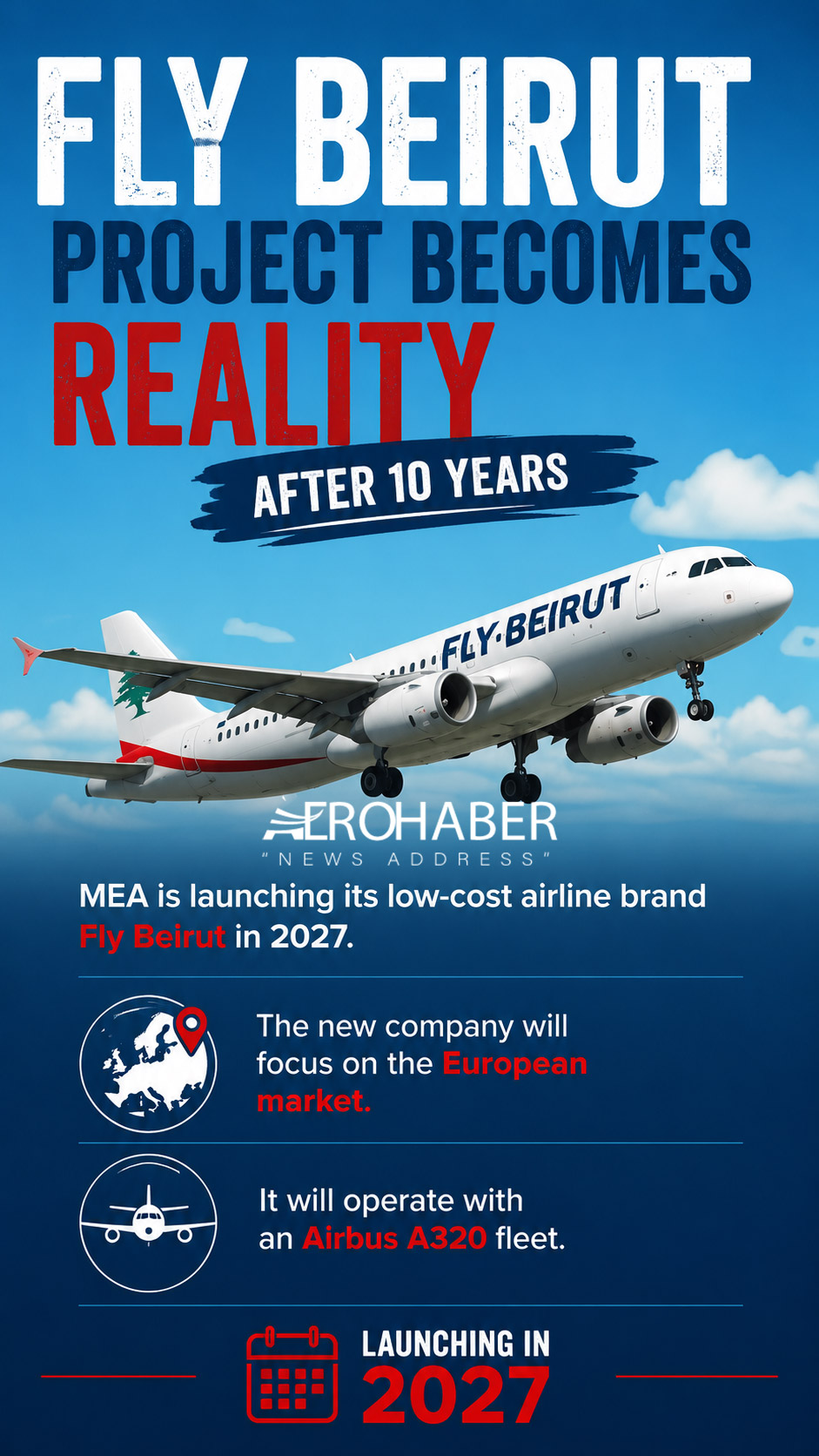




Middle East Airlines (MEA) plans to launch its Fly Beirut brand, which will operate under a fully low-cost business model, in June 2027. Initially, the new airline will focus on European routes with an Airbus A320 fleet.
Lebanon’s national carrier, Middle East Airlines (MEA), has reached a significant milestone in its long-planned low-cost airline project. MEA Chairman and CEO Mohamad El-Hout announced during the IATA Annual General Meeting in Rio de Janeiro that Fly Beirut is targeted to begin operations in June 2027.
The new airline will initially operate a fleet of up to six Airbus A320 aircraft. These planes, configured entirely in economy class with 180 seats, will have the first three sourced from leasing companies.
First Aircraft on the Way for Fly Beirut
According to El-Hout, the first Airbus A320 is scheduled for delivery in June next year. These aircraft will initially be used on new routes MEA will open to Berlin and Amsterdam, after which they will be transferred to Fly Beirut’s fleet.
The management emphasizes that the new brand will not merely be a different name, but a fully separate operational and commercial entity.
Positioned as a Low-Cost and Distinct Brand
Fly Beirut will operate as an independent low-cost carrier separate from MEA. The goal is to reach new customer segments with lower ticket prices, a different reservation system, and a distinct operational structure.
Mohamad El-Hout commented on the matter:
“One should be low-cost, the other a legacy carrier. Seat configurations will differ, flight schedules will differ, and more affordable fares will be offered. The reservation system will also be entirely separate. I believe this model will succeed in Lebanon.”
Fly Beirut Will Be Fully Owned by MEA
The new company’s shares will remain entirely within MEA. However, commercial management and operational decision-making processes will be conducted independently.
El-Hout noted that the aim is for the two companies to compete within the same market, stating: “I want to establish a fully independent commercial management for Fly Beirut. This way, both companies can compete internally and operate more efficiently.”
A 10-Year Project Finally Coming to Life
MEA’s idea to establish a low-cost airline emerged around ten years ago. However, due to economic and political conditions, the project was delayed for a long time.
El-Hout emphasized that today, the project enjoys strong support from the Central Bank of Lebanon, the Ministry of Transport, and the public, adding: “We are finally starting, and everyone is very pleased with this project.”
Regional Security Conditions Could Affect Growth
MEA, which has followed a controlled growth policy for many years, notes that regional instability directly impacts the airline sector.
El-Hout pointed out that security risks in the region could influence growth plans: “I don’t believe growth is possible during periods of war. Hopefully, conditions will be much better next year.”
European Routes Will Be Fly Beirut’s Priority
The company’s initial operational plans highlight Amsterdam, Berlin, Copenhagen, and Düsseldorf as key destinations. Due to relatively low business class demand in these cities, Fly Beirut is expected to offer a more competitive model.
In markets with high business travel demand, such as Paris, MEA and Fly Beirut are planned to operate jointly. For example, in addition to MEA’s two daily Paris flights, a third frequency may be operated by Fly Beirut.
Fleet Goals Will Depend on Economic Conditions
Fly Beirut’s long-term fleet size has not been officially announced. The management states that growth will entirely depend on Lebanon’s economic and political outlook.
El-Hout said, “Our growth rate will depend on developments in Lebanon. We have been managing MEA with the same approach for years,” signaling that the company’s cautious growth strategy will continue.