
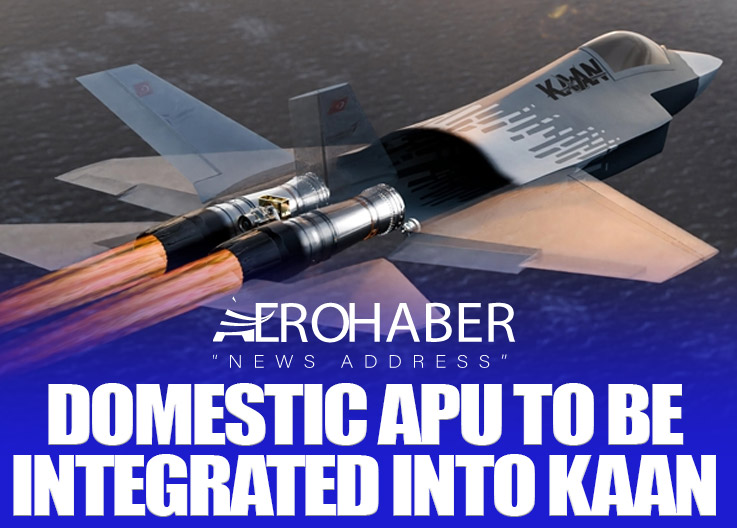


The first integration of the domestically developed auxiliary power unit APU-60 for the National Combat Aircraft KAAN is planned for 2026. TRMOTOR is reducing foreign dependency in engine and power systems.
A critical stage has been reached in the development of the domestic and national auxiliary power unit (APU) that will provide the energy required by the National Combat Aircraft KAAN before its main engine is started. The first integration of the APU-60 system, developed for the first time in Türkiye using domestic capabilities, is planned to be carried out within 2026.
Domestic Capability in Engine and Power Systems Is Strengthening
Türkiye continues its efforts to reduce foreign dependency in engine and power systems, as in every field of aviation. Projects carried out across a wide range of platforms—from UAVs to helicopters, from trainer aircraft to the 5th-generation combat aircraft KAAN—are finding concrete results in engine technologies.
Within this scope, TRMOTOR, operating within the Turkish defence industry, continues its activities with the mission of developing domestic, national and high-technology solutions in the fields of main engines and auxiliary power systems.
KAAN’s APU and ATS Systems Bear the TRMOTOR Signature
Aiming to bring design, development, production and verification capabilities in gas turbine engine technologies and power systems to Türkiye, TRMOTOR undertook significant roles in the R&D structuring for national power systems during the 2017–2021 period.
In 2021, the company took on the design and development work package for the Auxiliary Power Unit (APU) and Air Turbine Starter (ATS) systems, which are of critical importance for the National Combat Aircraft KAAN.
After signing the conceptual design contract for KAAN’s main engine in 2022, TRMOTOR entered into a consortium agreement with TEI in 2024 for the development of the TF35000 engine, described as the heart of KAAN.
During this process, APU and ATS activities were expanded to be compatible with different platforms, while critical stages were also completed in system development activities carried out in 2025 for a domestic platform.
APU-60 Will Prepare KAAN for Mission
According to the latest information shared in Turkish Aerospace Industries’ GÖKVATAN magazine, the first integration of APU-60 will be carried out within 2026.
The auxiliary power unit (APU) prepares the aircraft for mission by activating, before the main engine is started:
- Avionics systems,
- Electronic infrastructure,
- Air conditioning systems.
The pressurised air produced by the APU-60 is transferred to the ATS system; the ATS uses this pressure to rotate its turbine, imparting the initial motion to the main engine shaft and creating the necessary starting conditions for engine operation.
Thanks to this integrated system, the need for external ground equipment is reduced, operational flexibility is increased, and ground waiting times are shortened.
Next-Generation Auxiliary Power Unit: APU-40
In addition to APU-60, TRMOTOR is also continuing its work on a new auxiliary power unit called APU-40.
While core engine integration activities are ongoing within the APU-40 project, which is aimed to be integrated into fixed-wing and rotary-wing platforms, it is planned to start test activities in the first quarter of 2026.
The company also continues to deepen its expertise in high-precision subsystems such as electrical control, lubrication, fuel, ignition, activation, pneumatic systems and gearboxes.
“Domestic Engine Efforts Are a Matter of Survival”
TRMOTOR General Manager Osman Saim Dinç drew attention to the strategic importance of engine technologies and made the following remarks:
“Engine technologies today are not merely an engineering topic focused on performance calculations; they represent the intersection of independence, sustainability and supply security. We consider domestic engine efforts as a matter of survival.
With these projects, Türkiye will gain a capability that will create a catalytic effect in domestic aviation engine technologies. With the responsibility of contributing to Türkiye’s independent defence industry, we continue our work with a focus on interdisciplinary technologies.”