


British Airways operates one of the largest widebody fleets in Europe, comprising both older and next-generation aircraft from Airbus and Boeing. The oldest airframe in the carrier’s fleet is a Boeing 777-200ER registered G-VIIA. The nearly 30-year-old aircraft was delivered to the airline in July 1997, and holds the distinction of being the first-ever 777-200ER to roll off the production line.
According to data from ch-aviation, the carrier operates 43 Boeing 777-200ERs delivered between February 1997 and July 2009, with an average age of around 26 years. With ongoing delays to the Boeing 777X program pushing back its debut into the latter half of this decade, the 777-200ER remains central to the airline’s long-haul network.
The Oldest Active Jet In The British Airways Fleet
With manufacturer serial number 27483 and line number 41, G-VIIA was the first 777-200ER built by Boeing that took its first flight in October 1996 before its delivery to British Airways in July 1997. Interestingly, it wasn’t the first -200ER to join the British carrier’s fleet — that distinction is held by G-VIIC, which was delivered in February 1997.
Despite being the oldest airframe, G-VIIA was the ninth -200ER to arrive in the British Airways fleet, and was the lead aircraft during the variant’s certification program. As per ch-aviation, the widebody has accumulated over 120,000 flight hours and 17,500 flight cycles during almost three decades of service with British Airways, which includes more than 18 months of storage during the COVID-19 pandemic.
It has experienced one major incident during its operational history, which occurred back in June 2003. While it was climbing out of London Gatwick, a large access door detached from the airframe, causing damage to cabin windows, the fuselage and fin. With 272 passengers and 14 crew on board, fortunately no one was injured, although sections of the door landed dangerously close to people on the ground.
Flight tracking data shows the aircraft has been deployed exclusively on the airline’s transatlantic network this summer. So far in July, it has flown on nearly a dozen routes out of London Heathrow Airport (LHR), including multiple destinations in the US, such as Boston Logan International Airport (BOS), Chicago O’Hare International Airport (ORD), New York JFK Airport (JFK), and Washington Dulles International Airport (IAD).
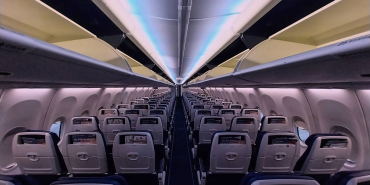
It has also flown extensively to the Caribbean, serving the airline’s routes to Barbados, Bermuda, Grand Cayman and Nassau. G-VIIA can seat up to 235 passengers in a four-class layout with eight First Class, 49 Club Suites, 40 World Traveller Plus and 138 World Traveller seats.
British Airways’ 777-200ER fleet is based out of both Heathrow and London Gatwick Airport (LGW), making up a core part of the carrier’s long-haul operation. In fact, the -200ER accounts for the entirety of the carrier’s widebody flying at Gatwick, although the Boeing 787-10 will start taking over duties by the end of this decade.
British Airways is going through a steady period of modernization for its passenger fleet.
The carrier’s 777-200ERs are its oldest widebodies by a significant distance, and the fleet’s reliability has come into question at times. Earlier this month, two US-bound British Airways 777-200ERs suffered technical problems on consecutive days, forcing both flights to return to London. G-YMMH and G-RAES, both over 25 years of age, encountered problems soon after setting off from London Heathrow.
With G-VIIA, the economic argument for holding onto a 29-year-old widebody is very clear. Delivered in 1997, the jet has long since been paid off, leaving British Airways with a fully depreciated asset. Although newer-generation jets are cheaper to operate in terms of efficiency and variable costs, a fully paid-for aircraft remains a valuable part of any fleet.
The airline is gradually replacing its old widebodies with newer 787 Dreamliner and Airbus A350 jets, as well as the higher-capacity 777-9. The 777-9 was supposed to make its debut as early as 2020, but its arrival at British Airways is not expected until 2028. The carrier now flies over 40 787s, and is one of the few airlines worldwide operating all three Dreamliner variants – the 787-8, 787-9 and 787-10. It also has 18 A350-1000s, which is the larger stretched model of the A350 program.
Orijinal Haberi Görüntüle