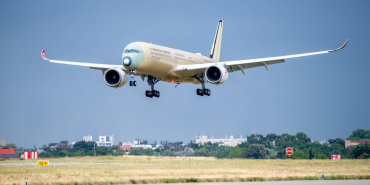



THY suspended its Middle East flights until further notice following Israel’s attack on Iran. Many countries, led by Iran, closed their airspace.
War Alarm in the Middle East, Air Traffic at a Standstill
After Israel launched a “pre-emptive strike” against Iran in the early morning hours, military tensions in the region escalated rapidly. While severe explosions occurred in Iran’s capital Tehran, the Iranian administration closed its airspace to flights.
Following the developments, Turkish Airlines (THY) announced that it had cancelled all Middle East flights until a second decision is made.
Explosions in Tehran, Flights Suspended
Iran’s official agency IRNA reported that at least three explosions were heard in central Tehran. It was claimed that missiles struck University Street and the Cumhuri area.
The complete closure of Iranian airspace directly affected long-haul flights on the Europe–Asia and Gulf–Türkiye corridors.
Iraqi Airspace Also Closed
Following claims that cruise missiles were seen in Iraqi airspace, the Iraqi administration closed its airspace to domestic and transit flights. The decision is said to have particularly affected transit traffic on the Europe–Gulf–Asia corridor.
Gulf Countries Also Involved
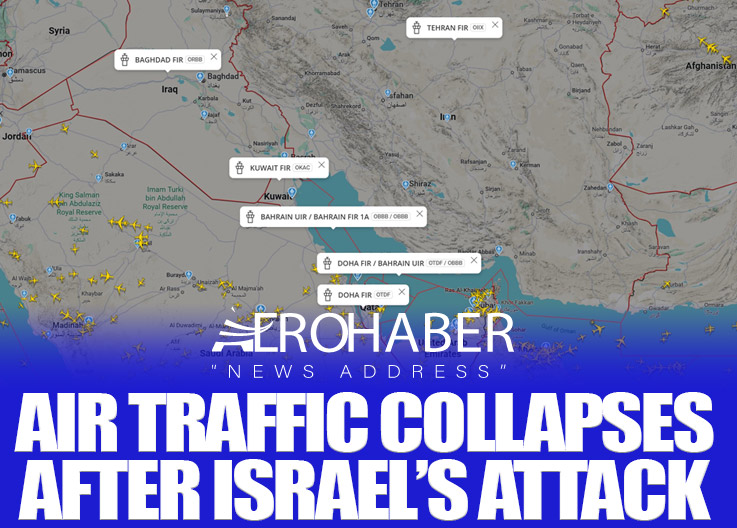
After Iran and Iraq, Qatar, Bahrain and Kuwait also temporarily closed their airspace. Thus, the Middle East’s most critical transit corridor was largely taken out of service.
Middle Eastern airspace is known as one of the busiest air traffic routes between Europe and Asia. If the crisis continues, route diversions and chain delays will be experienced on a global scale.
Extraordinary Congestion in Dubai
Following the closures, extraordinary congestion occurred at Dubai International Airport. Many aircraft were diverted to Dubai as an alternative, with holding patterns in the air and slot delays being experienced.
According to radar data, Iranian and Iraqi airspace were largely cleared, and transit flights were redirected to new corridors via Türkiye and the Caspian route.
Sirens Sounded in Israel
Amid claims regarding the involvement of United States elements, Israel’s Defense Minister confirmed the attack on Iran. It was reported that sirens were heard in Jerusalem and the public was called to head to shelters.
Risk Management Comes to the Fore in Global Aviation
Experts state that closures in the airspace of Iran, Iraq, Syria, Lebanon and Jordan could extend flight times on Europe–Asia and Gulf–North America routes, increase costs and create operational pressure on a global scale.
Airlines are calling on passengers to check their flight status and follow official announcements.
While military activity continues in the region, uncertainty remains as to when airspaces will reopen.

Implications of the Crisis on Aviation – Details of the Development
- Following Israel’s attack on Iran, chain closures occurred in Middle Eastern airspace and THY suspended its flights.
- In many Middle Eastern countries, particularly Iran, Iraq, Qatar, Bahrain and Kuwait.
- After the attack that began in the early morning hours.
- All international airlines in the region and transit passengers.
- Iran closed its airspace via NOTAM; Iraq took a similar decision. Subsequently, Qatar, Bahrain and Kuwait temporarily suspended their airspace.
- Due to increasing military risk and aviation security concerns.
Beginning of the Attack and Military Conflict
On 28 February 2026, the Israeli government announced that it had launched a pre-emptive strike against Iran. Israeli Defense Minister Yisrael Katz declared a “state of emergency nationwide” and stated that the attack was carried out to “eliminate existing threats.” The statements also included a warning for the public to head to shelters; sirens sounded and the airspace was closed.
News sources such as Associated Press and Euronews reported that the US military also supported the attack; initial reports indicated that US forces participated in Israel’s operations.
Retaliation from Iran and Military Responses
According to Iranian media and official news agencies, Iran launched a ballistic missile attack against Israel. According to Reuters-like sources, missiles were fired from various launchers in response to Israel’s attack, and these strikes reportedly triggered alarms in Israeli airspace.
Additionally, according to the Washington Post, the Iranian leadership threatened to consider both Israeli and US targets as legitimate targets of attack and declared that it would deliver an “overwhelming response.”
Impacts on Transportation, Commercial Aviation and Security
Following the outbreak of the conflict, airspaces in the region were closed; in particular, Israeli airspace was completely closed to civil flights. Many international airlines also cancelled their flights in the region or changed their routes.
International Reaction and Diplomacy
Some countries issued warnings and security advisories for their citizens living in the region. For example, the Indian government called on its citizens in Iran and Israel to exercise “the highest level of caution and security measures.”
Meanwhile, the United Nations and international organizations are calling for the conflict not to escalate further and for a resolution through dialogue. In addition, nuclear oversight bodies stated that they were unable to monitor Iran’s nuclear activities and expressed serious concern about the situation; this has further increased insecurity in the region.
Economic and Regional Consequences
The effects of the conflict on international financial markets and the energy sector were immediately visible:
- Oil and energy prices experienced volatility due to geopolitical risk.
- Security concerns created uncertainty in global stock markets.
- As civil aviation risks increased, trade and transportation in the region were also disrupted.
Regional and Strategic Background
This new attack is being evaluated within the context of the previous June 2025 conflict. At that time, Israel carried out extensive attacks on Iran’s nuclear facilities, and Iran responded with ballistic missiles. Since that conflict, the regional security environment had already been weakened.