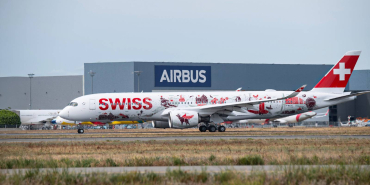

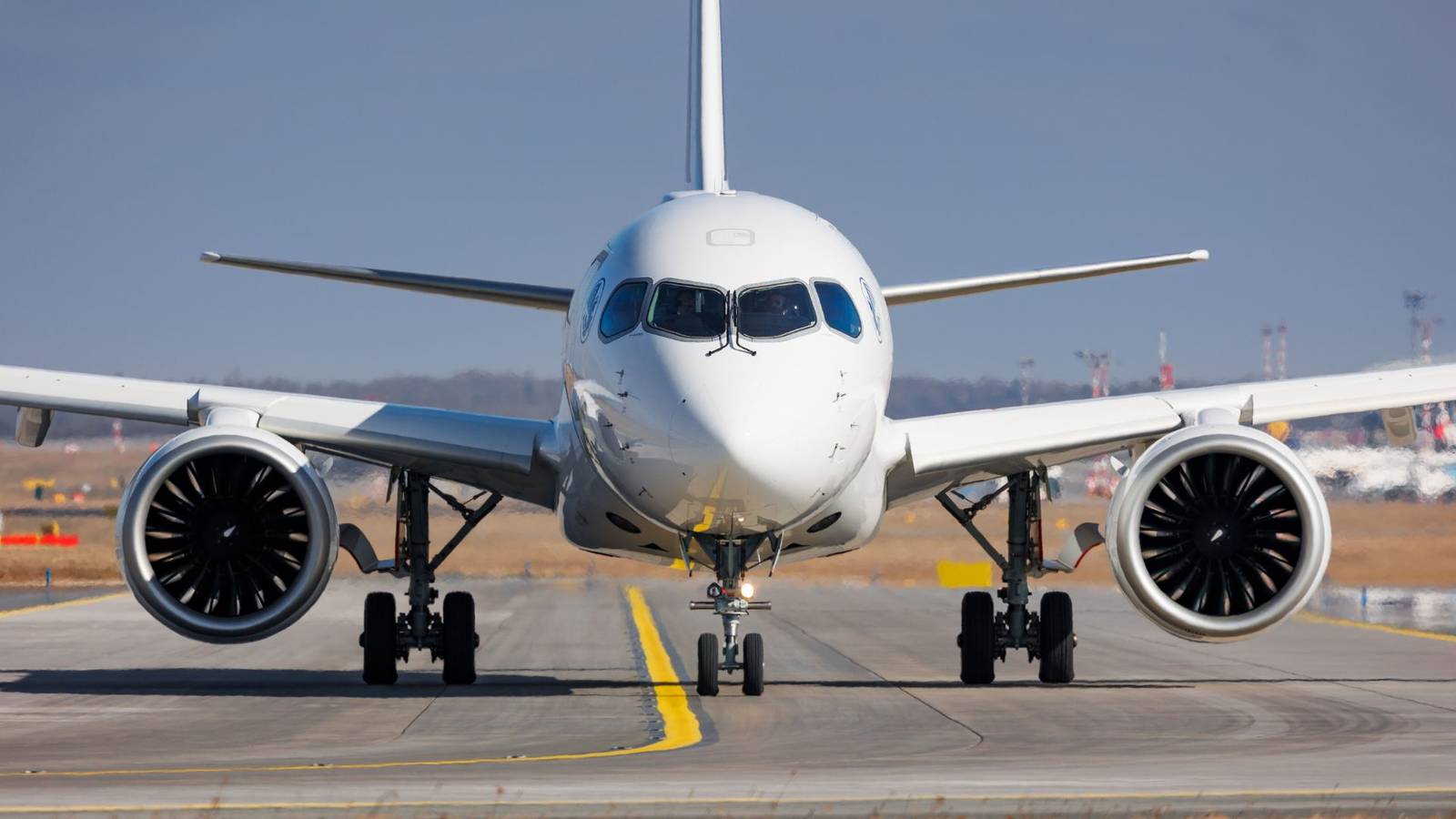


Airbus has started construction on a major extension to its Airbus A220 wing facility in Belfast, Northern Ireland, as it prepares to almost double the production tempo of its smallest commercial aircraft. The Irish News reports that the 6,221-square-meter (67,000-square-foot) expansion is scheduled for completion in the first half of 2028, while Airbus says the investment is critical to supporting its target of producing 13 A220s per month by 2028.
That target is not new, but the Belfast expansion shows Airbus is now putting the industrial infrastructure behind it. Belfast is the exclusive global source of A220 wings, feeding the final assembly lines (FALs) in Mirabel, Canada, and Mobile, Alabama. The investment also follows years of difficulties ramping up A220 production, including wing shortages under former owner Spirit AeroSystems, and Airbus’s subsequent decision last year to reduce its previous target of 14 aircraft per month in 2026.
When the purpose-built composite wing facility opened in 2013, then-Prime Minister David Cameron described the £520 million commitment as “the largest ever single investment in Northern Ireland.” The Belfast Telegraph describes the new multi-million-pound expansion as “a very significant investment” and a further show of confidence in Belfast’s skilled workers.
Airbus says the wing facility extension will house a third autoclave, new specialized wing tooling and additional cranage, while also adding high-voltage electrical substations, a new office block, IT systems and a larger 650-space parking lot. Forty new apprentices are also due to join the operation in September, while the extension itself is specifically intended to increase wing-manufacturing capacity as A220 production rises.
Perhaps the most important addition is the third autoclave. This large pressure vessel uses high temperature and pressure to cure carbon-fiber structures. Belfast pioneered the patented Resin Transfer Infusion process used for the A220’s composite wings, which Airbus says makes the structure around 10% lighter than a conventional aluminum equivalent. That weight saving contributes directly to the aircraft’s lower fuel consumption and superior economics.
Belfast’s position makes its capacity particularly important: Airbus cannot simply increase output at Mirabel and Mobile if enough wings are not arriving from Northern Ireland. Simple Flying has previously highlighted how problems supplying A220 wings from Belfast (when Spirit AeroSystems still owned the facility) have become one of the single biggest constraints affecting Airbus’ wider A220 production system.
Anthony Rouse, Head of Airbus Belfast Plant and Site, described the project as an investment in both capacity and the site’s long-term future.
“Enhancing our wing facilities is a direct investment in the future of A220 wing production here in Belfast, building the capacity required to meet the growing demand for this aircraft.”
The factory predates Airbus’ involvement with the aircraft. Bombardier originally developed the A220 as the CSeries, and assigned its advanced composite wing to the historic Short Brothers operation in Belfast. A purpose-built 600,000-square-foot wing manufacturing and assembly facility officially opened in 2013, shortly after the CSeries made its first flight.
Airbus took control of the financially troubled CSeries program in 2018 and renamed the CS100 and CS300 as the A220-100 and A220-300. But it did not initially acquire Belfast. Bombardier subsequently sold its aerostructures operations to Spirit AeroSystems, with the transaction closing in October 2020, and Spirit taking control of the entire A220 wing manufacturing work package.
That arrangement became increasingly problematic as Spirit’s finances deteriorated while Airbus tried to accelerate A220 production. Reuters reported in 2024 that Airbus had resorted to using Antonov AN-124 freighters to airlift A220 wing components from Belfast to Canada, while Spirit’s Belfast operation continued recording substantial losses. Wing shortages were still among the problems affecting A220 output in late 2025.
Spirit AeroSystems acquires Belfast operations
Airbus finalizes deal for Spirit’s Airbus work packages
Construction starts on wing-factory extension
Boeing’s decision to reacquire Spirit ultimately prompted an extraordinary carve-up of the supplier. Airbus agreed to take the Airbus-related operations, including A220 wing and mid-fuselage production in Belfast, and completed the acquisition last December. Airbus actually received $439 million in compensation for taking on the loss-making work packages. Less than nine months into ownership, it is now investing in expanding the plant it once relied on as an external supplier.
Its takeover of Spirit AeroSystems assets secures nearly 3,000 UK jobs and cements Britain’s vital role in wing production for Airbus jets.
Airbus Needs Higher Production To Make The A220 Work
The “rate-13” target represents a reset of Airbus’ earlier ambitions. As recently as April 2025, the manufacturer was still officially targeting 14 A220s per month during 2026. Supply-chain pressures subsequently forced Airbus to cut the 2026 goal to 12 per month, before establishing the current target of 13 in 2028. Airbus reaffirmed that timetable with its first-half 2026 results.
The increase remains substantial. Airbus delivered 93 A220s in 2025, equivalent to 7.75 per month. Producing 13 every month would equal 156 aircraft annually, around 68% more than last year’s deliveries. Airbus delivered another 44 A220s in the first half of 2026, demonstrating that considerable further ramp-up is still required.
Demand increasingly justifies the investment in the Belfast facility. Airbus had recorded 1,106 A220 orders and 532 deliveries by the end of July, leaving 574 aircraft outstanding. AirAsia alone ordered 150 A220-300s in May — the program’s largest single firm order, and also the equivalent to an entire year’s production even at rate 13. AirAsia also holds options for another 150 aircraft if Airbus launches the proposed larger A220-500.
But it’s not just about production rates. Another remaining challenge is profitability. Reuters has repeatedly reported that the A220 remains loss-making, and that increasing production is essential to reducing unit costs, while Airbus Canada has said reaching at least 13 aircraft monthly is crucial to program profitability. A larger A220-500 could improve the economics further, but first Airbus needs a stable industrial system that can supply today’s aircraft reliably.
Which is why Airbus’ new investment is so important. Taking Belfast in-house removed one source of uncertainty. Expanding it is Airbus’ attempt to ensure that wings no longer stand between the A220 and the scale that the program has long promised.
Orijinal Haberi Görüntüle