


Active Electronically Scanned Array (AESA) radar systems are among the most critical sensors in modern air combat. Thanks to the ability to apply different phase-shift values to each of their modules, AESA radars can electronically steer the transmission direction without requiring mechanical movement. As a result, the radar beam can be redirected to different directions within milliseconds.
This technology enables the execution of multiple search and tracking missions simultaneously without the need for the radar antenna to physically rotate. AESA radars can track targets in different regions or of different types at the same time, thus enabling the multi-role operational capability required by the modern battlefield.
Superiority over mechanical radars
Compared to mechanically scanned radar systems, AESA radars offer a much more flexible, faster, and more reliable architecture. These systems can detect low-observable targets with small radar cross-sections from long ranges, and their high-precision target tracking significantly increases weapon engagement success.
In today’s air combat environment, the growing electronic warfare threat further increases the importance of AESA radars. With their wide frequency spectrum, low probability of intercept (LPI) characteristics, and flexible waveforms, AESA radars can perform missions without being detected by enemy radar warning receivers.
Beyond radar: Communication and electronic warfare
With data processing capacities exceeding 500 gigabits per second and a flexible beam scheduling infrastructure, AESA radars can perform communication, data transmission, and electronic warfare tasks in a time-shared manner in addition to classical radar missions. This capability turns AESA radars into not just a sensor, but a multifunctional RF mission system.
The absence of mechanical steering requirements in AESA radar antennas means fewer moving parts. This reduces the likelihood of failures while lowering maintenance requirements and life-cycle costs. Moreover, since each antenna module operates independently, the radar can continue its mission without critical performance loss even in the event of module-level failures.
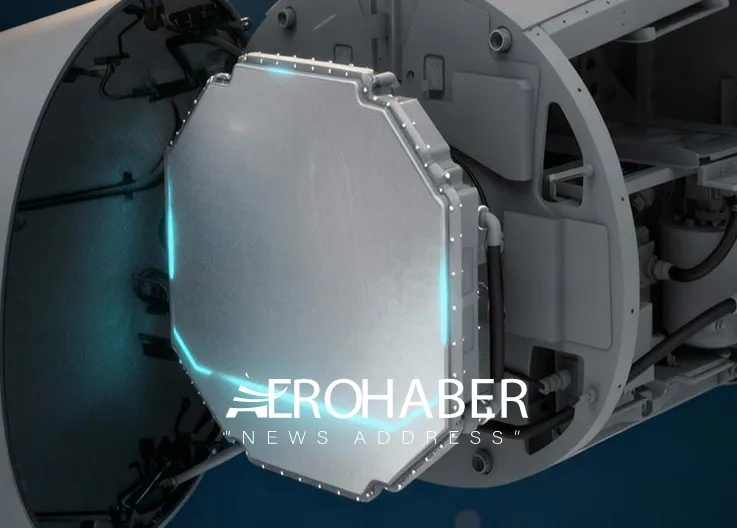
MURAD AESA Nose Radar Family: A Domestic and National Solution
Developed domestically and nationally by ASELSAN engineers from chip level onwards, the MURAD AESA Nose Radar Family meets Türkiye’s need for advanced AESA radar capabilities.
With different configurations adaptable to various platforms, MURAD radars both provide new capabilities to manned combat aircraft and shape the future of air combat by granting air-to-air engagement capability to unmanned aerial vehicles.
MURAD 100-A: Simultaneous multiple engagements
The MURAD 100-A AESA Nose Radar offers simultaneous air-to-air and air-to-ground engagement capability. By combining air-to-air engagement capability with BVR (beyond visual range) missile guidance, the system assumes a game-changing role in air warfare.
ANKA-III and new platforms next in line
The MURAD 100-A has been successfully tested on the F-16 Özgür, Bayraktar AKINCI, and Bayraktar KIZILELMA platforms. It is stated that efforts are ongoing to integrate the radar into the ANKA-III and other platforms.
In a historic test conducted within the Turkish defence industry, an unmanned combat aerial vehicle successfully destroyed an air target with a beyond visual range air-to-air missile for the first time in the world. Bayraktar KIZILELMA carried out the engagement using a fully national sensor and guidance chain.
During this process, the target was detected and tracked by the MURAD AESA Nose Radar, mid-course guidance was provided, and the GÖKDOĞAN BVR air-to-air missile developed by TÜBİTAK SAGE was guided to a direct hit by ASELSAN’s RF Seeker Radar.
AESA radars will remain at the centre of defence
Thanks to their high scan rates, low detectability, and ability to perform multiple missions simultaneously, AESA radars provide air platforms with early detection, high survivability, and superior resistance to electronic warfare.
In the future, with the widespread adoption of higher power density, digital beamforming, software-defined radar architectures, and integrated RF convergence (radar–communications–electronic warfare) concepts, AESA radars are expected to remain at the core of autonomous systems, unmanned aerial vehicles, and unmanned combat aircraft.