

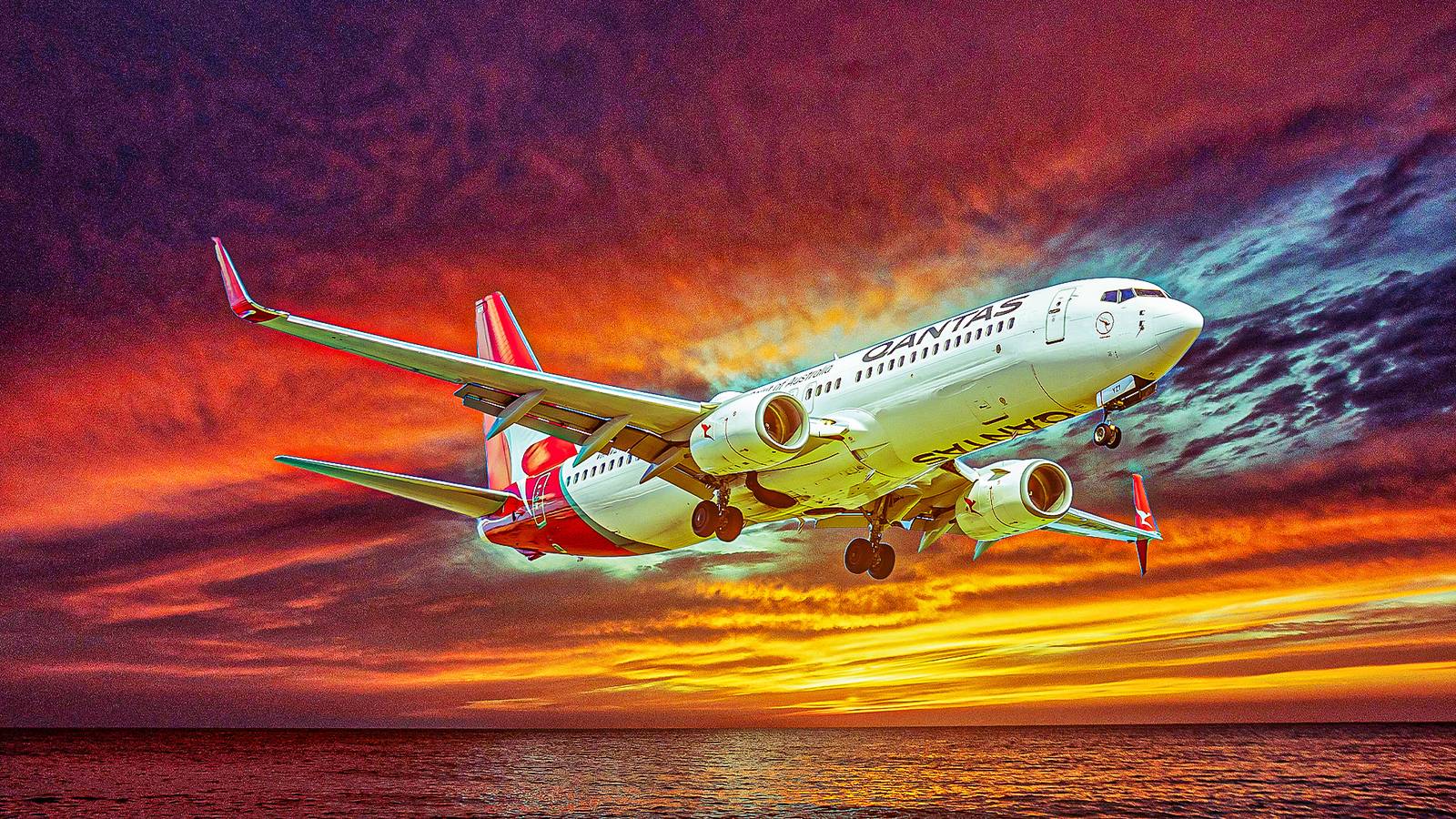


Most passengers associate the Boeing 737 with short domestic or regional hops lasting a few hours. However, airlines are increasingly stretching the limits of narrowbody aircraft, flying their single-aisle jets for several hours on longer city pairings, often across continents.
Australian carrier Qantas recently launched one of the longest 737 itineraries in the world, beginning its new Sydney–Auckland–Apia service connecting Australia’s east coast with Samoa via New Zealand. Operated as a same-aircraft service under one flight code, the full journey ranges from over nine hours to as long as 11.5 hours.
Starting on June 16, Qantas’ new service is an extension of its busy Sydney Kingsford Smith Airport (SYD) to Auckland Airport (AKL) trunk route, adding Samoa’s Faleolo International Airport (APW) with three weekly flights. The carrier uses its Boeing 737-800 fleet for this service, which offers both business and economy class. There are two different 737 configurations at Qantas, with total capacity ranging from 162 to 168 passengers.
Depending on the time spent stopping over in Auckland and the headwind conditions, passengers could spend up to 11.5 hours onboard the 737, although the outbound service is more favorable with a block time of nine hours and ten minutes. Qantas had to obtain fifth freedom rights in order to operate the Auckland-Apia portion of the itinerary.
Airlines closely analyze demand for travel between two airports before making network decisions. 2025 data shows that the Auckland–Apia market carried around 138,000 round-trip passengers, while around 43,000 were carried between Sydney and Apia. The schedule will see a morning outbound flight from Sydney at 7:10 AM for an early evening 6:20 PM arrival in Apia. The return flight from Apia will also be early, departing at 7:05 AM, touching down in Sydney at 3:10 PM.
Qantas last flew this one-stop service in 2022 and 2023 before discontinuing service, but has now responded to consistent levels of high demand. Air New Zealand has been the sole carrier operating service between Auckland and Apia in recent years, but will now face competition for the first time since 2022.
Samoa Airways ceased flights on this route in 2022. At the time, both Air New Zealand and Qantas were flying it. Qantas’ flights were initially operated by its Airbus A330 fleet out of Sydney and routed through Brisbane Airport (BNE). However, in the summer of 2023, the carrier switched to a direct flight from Brisbane, also switching its equipment to the 737-800. Qantas still flies from Brisbane to Apia today, along with Virgin Australia.
Some of these flights have block times in excess of six hours.
Qantas’ decision to use a narrowbody on this route indicates that, while demand is healthy enough for three weekly services, the use of a larger plane is not economical. Most of its 737-800s can seat up to 168 passengers and include a 12-seat business cabin, featuring Recaro recliner seats in a 2-2 configuration. The economy cabin also offers a sizable 48 Economy Plus seats with extra legroom.
The Boeing 737 is the most numerous airplane type in the Qantas fleet by some distance. According to data from ch-aviation, the airline has a total of 79 737-800s today, and was previously a major operator of the 737-300 and 737-400, retiring the last of these jets over a decade ago.
Orijinal Haberi Görüntüle