


Why did the Airbus A318 fail? The story behind the poor sales, high costs, and unfortunate timing in the aviation industry of the smallest member of the A320 family, known as the “Baby Bus.”
In the aviation world, while some aircraft are remembered for record-breaking sales figures, others remain in the shadows of history despite being technically impressive because they failed to achieve commercial success. The Airbus A318 became one of the most striking examples of the latter group.
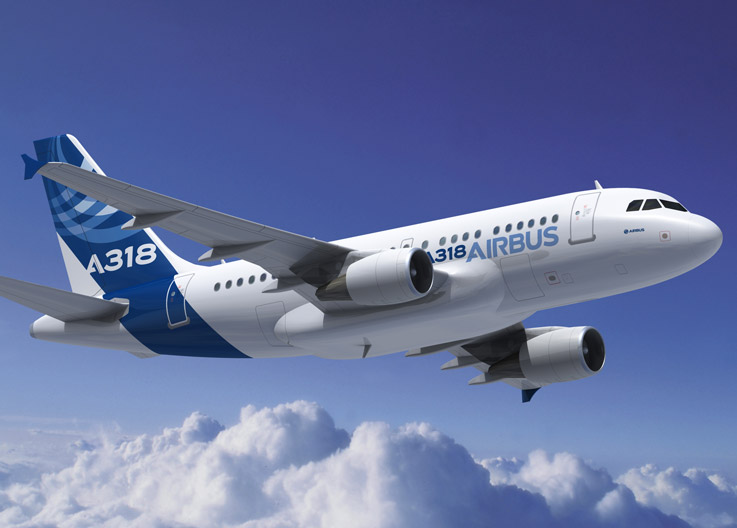
Known by the nickname “Baby Bus,” the A318 was developed as the smallest member of Airbus’s highly successful A320 family. However, while the A319, A320, and A321 received thousands of orders, the A318’s total delivery count remained at just 80 aircraft. Now, Air France, the type’s last major operator, is preparing to remove it entirely from its fleet.
This situation once again raises a critical question that has long been debated in the aviation industry: “Why does a technically good aircraft fail commercially?”
Airbus’s Small Narrow-Body Strategy Backfired
When developing a passenger aircraft, manufacturers usually create different-sized models based on a single core platform. Airbus followed this approach with the A320 programme. The longer A321 was developed from the A320-200, while the A319 and later the A318 were introduced to meet smaller-capacity market needs.
However, developing a downsized aircraft proved far more complex than simply shortening the fuselage. Airbus attempted to optimise the A318 by reducing structural weight, lowering engine thrust, and redesigning the maximum take-off weight. Despite these efforts, the resulting aircraft lagged behind its competitors economically.
At the centre of the problem was one of the most critical concepts in aviation economics: cost per seat.
Why Was the A318 Inefficient?
The A318’s biggest disadvantage was that it retained the same core structure as its larger siblings. The aircraft continued to carry many heavy structural components, including large wings, robust landing gear, and a six-abreast cabin configuration.
As a result, although the A318 carried significantly fewer passengers than the A319, it failed to provide a dramatic fuel-burn advantage. This disrupted the economic balance for airlines.
Particularly in the 100-seat segment, the impact of fixed costs is felt more sharply. Pilot salaries, cabin crew expenses, airport charges, and maintenance costs remain largely the same even when the aircraft becomes smaller. When passenger numbers decrease, these costs rise rapidly on a per-seat basis.
For this reason, many airlines turned toward regional jets that could offer similar capacity at lower operating costs. The Embraer E190 and Bombardier CRJ series stood out in this segment.
The A318 Had Niche Advantages, But the Market Was Small
The Airbus A318 was not an entirely unsuccessful engineering product. On the contrary, it offered highly effective capabilities for certain operations.
For example, thanks to its short-runway performance and steep-approach capability, it was able to operate at operationally challenging airports such as London City Airport. Because of this feature, British Airways created a dedicated A318 fleet for its London City–New York JFK route.
Its performance in hot-and-high airport conditions was also notable. However, the number of routes where these advantages could be utilised was extremely limited.
For airlines, the bigger issue was this: operating the same routes with the higher-revenue-potential A319 often made far more sense.
The PW6000 Engine Crisis Shook the Programme
One of the most critical factors affecting the A318’s fate was its engine problem.
Airbus initially planned to equip the aircraft with the PW6000 engine developed by Pratt & Whitney. On paper, this engine promised lower fuel consumption and reduced maintenance costs. However, the programme experienced serious delays.
More importantly, the engine failed to achieve the promised performance levels.
This development led many customers to switch to the CFM56 engine. Some airlines withdrew from the programme entirely. America West’s order cancellation is considered one of the major turning points in the A318’s loss of market confidence.
Ultimately, the only operator of the PW6000-powered A318 became LAN, part of the LATAM Airlines Group. However, these aircraft were also retired from the fleet within a few years.
The Post-9/11 Era Reduced the A318’s Chances
The timing of the A318’s market entry was also extremely unfortunate.
The aircraft entered service in 2003, during the period following the September 11 attacks when the global aviation industry was experiencing severe contraction. Airlines were under heavy cost pressure and increasingly favoured more flexible, higher-capacity aircraft instead of smaller fleet types.
During this period, mergers accelerated and orders were cancelled.
For example, TWA’s order for 50 A318 aircraft was completely cancelled after the airline was acquired by American Airlines. This development became a major blow for Airbus.
The Boeing 737-600 Suffered the Same Fate
The A318’s failure was not unique to Airbus.
Its rival, the Boeing 737-600, faced similar economic challenges. Boeing managed to deliver only 69 units of the 737-600.
Both aircraft became victims of the dilemma of being “too small for a mainline aircraft, too large for a regional jet.”
Aircraft in this segment were neither sufficiently advantageous for low-cost regional operations nor capable of generating strong revenue in mainline service.
The Last A318s Are Leaving the Skies
Today, the Airbus A318’s commercial career is approaching its conclusion.
After TAROM removed the type from its fleet, only Air France remained. The airline currently operates just four active A318 aircraft.
Air France plans to retire its entire A318 fleet by the end of 2026 and replace them with Airbus A220-300 aircraft.
Thus, the era of the “Baby Bus,” which left a short but remarkable mark on aviation history, will also come to an end.
Why Has the A318 Not Been Forgotten?
Even though it was commercially unsuccessful, the Airbus A318 continues to hold a special place for aviation enthusiasts.
This is because the A318 became one of the clearest examples showing that the aviation industry is not driven solely by engineering. For an aircraft to succeed, it is not enough to be safe or technically capable; it must also arrive at the right time, with the right cost structure, and address the right market demand.
Despite all of its technical capabilities, the A318 ultimately failed to achieve exactly that.