
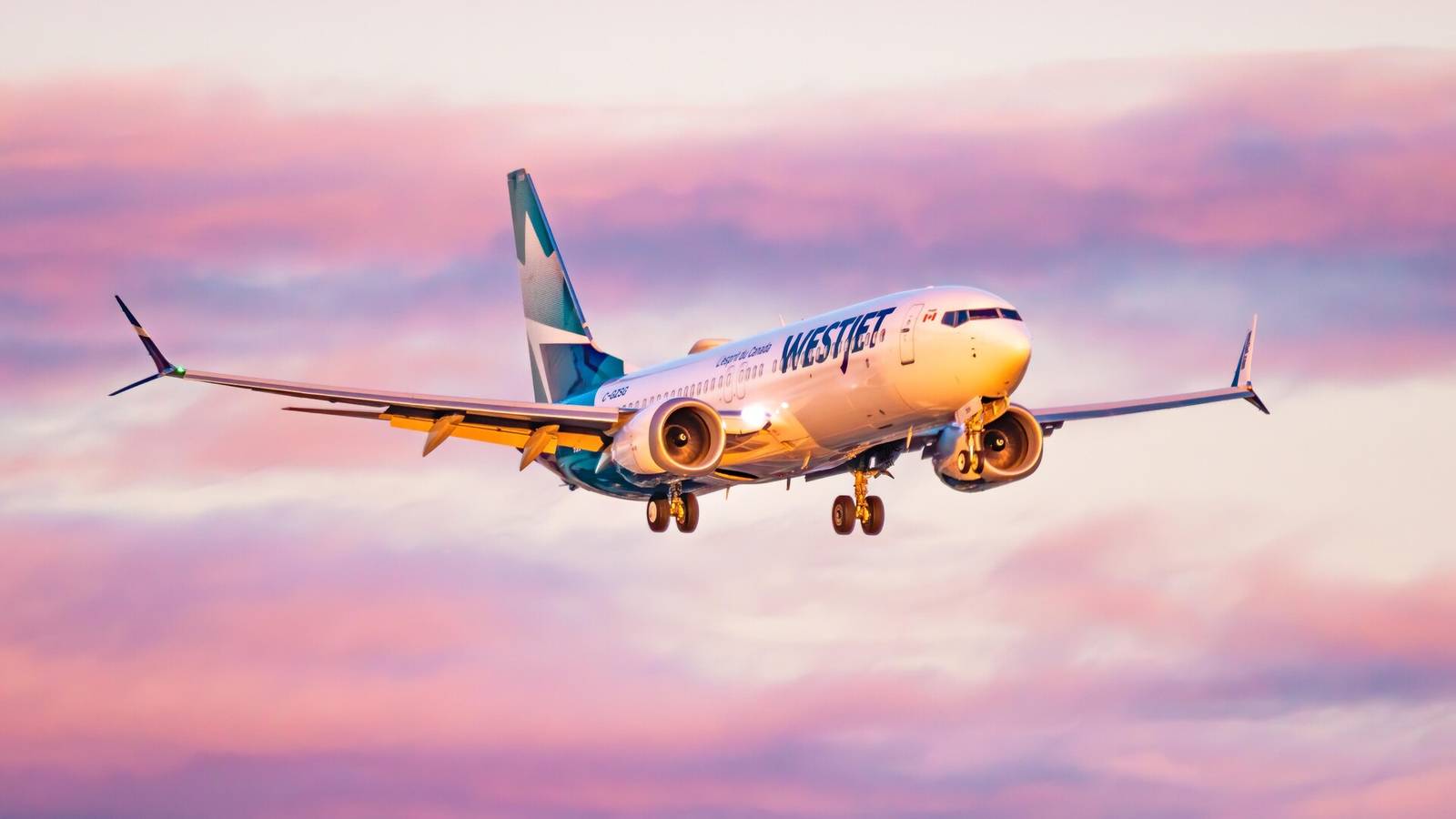


WestJet is making a sharp retreat from the US market this summer, with new schedule data showing the airline cutting its Canada-US flying sharply in Q3 2026 compared with Q3 2025. The move comes as Canadian travel demand to the United States remains under pressure, particularly in leisure markets, and as WestJet finds better uses for its Boeing 737 fleet on non-US vacation routes.
The pullback is not happening in isolation. Air Transat has exited the US market entirely in this comparison period, while Flair has also dropped sharply. However, the broader transborder market has remained largely flat year-over-year, indicating that the weakness is concentrated in more discretionary leisure flying rather than across every Canada-US market.
WestJet Is Cutting US Flying Much Faster Than The Wider Market
The scale of WestJet’s reduction is clear when Q3 2026 schedule data from Cirium is compared to the same period a year prior. WestJet operated nearly 9,000 Canada-US flights last year, but will see a decline of 1,260 flights in the upcoming quarter, or 14.1%. That is a significant reduction for Canada’s second-largest airline, and points to a deliberate network shift rather than a small seasonal adjustment.
Air Transat’s disappearance from the table is also notable. As a leisure-focused airline, its exit reinforces the theme that the weakest part of the market is discretionary Canadian travel to the United States. Flair, another highly price-sensitive carrier, is also down by more than half. By contrast, Air Canada and the legacy US airlines have held steady or even grown slightly, helped by larger hub networks, stronger business traffic, premium demand, and connecting flows.
Porter Airlines is the main exception, with Canada-US flying up 13% year over year, but that growth reflects its own expansion cycle rather than a reflection of transborder demand. The airline is rapidly building out its Embraer E195-E2 network from multiple Canadian airports with new or expanded routes to the likes of Boston, Austin, Nashville, and Chicago O’Hare. Its increase of 700 flights in the quarter equates to an additional four return routes per day, meaning Porter is growing from a smaller base and adding targeted business markets, while WestJet is pruning a more mature US leisure network.
Canadian Leisure Travel To The US Has Taken A Hit
The primary driver of WestJet’s pullback is weaker Canadian leisure demand to the US. Statistics Canada has repeatedly pointed to a shift in travel patterns since early 2025, when political and trade tensions between Canada and the United States began affecting consumer behavior. At the end of Q1, Canadian-resident return trips from the US were down 6.4% year over year, marking 15 consecutive months of decline, while air trips to the US fell 10.8%.
WestJet’s leadership has acknowledged that the US has become a tougher sell. Reuters has reported that the airline is increasingly shifting leisure capacity away from the United States as demand weakened, with CEO Alexis von Hoensbroech saying Canadians “are voting with their feet” and avoiding the US where possible. The result is 20 separate routes that have been cut from the WestJet network since Q3 2025:
These cuts make the leisure angle hard to miss. More than two-thirds are clearly leisure-centric or heavily vacation-oriented, including destinations such as Orlando, Tampa, Fort Lauderdale, Las Vegas, and Maui. The remainder are more mixed but where WestJet has the least traction, such that the overall pattern is clear: WestJet is pulling back hardest where Canadian discretionary demand is most exposed.
The first wave of this shift saw WestJet (as well as other Canadian carriers) shifting capacity from the US to its other North American neighbor — Mexico. In the first half of this year, Canada-Mexico flights increased by 46% compared to a year earlier, with WestJet leading the charge with a 59% increase and nearly 5,000 more flights. But that was just the start, and WestJet is also looking further afield as it recalibrates its network.
Canada-US flying continues to drop as Canadians choose alternative destinations.
WestJet has certainly grown its capacity to the Caribbean and Latin America, but it is also looking across the pond. The airline’s summer 2026 international expansion is the clearest example, as it leans into longer-haul narrowbody flying from Toronto, Halifax, Edmonton, and Winnipeg. WestJet has said the extended range of its new Boeing 737 MAX 8 aircraft allows it to connect Eastern Canada to “rich cultural destinations” suited to its leisure strategy.
The eight new European routes are supplemented by eight other routes that were launched last year and are returning in 2026, such as Halifax / Stanfield International Airport (YHZ) to Amsterdam Schiphol Airport (AMS) and St. Johns (YYT) to Paris Charles De Gaulle Airport (CDG). Collectively, this European expansion creates a meaningful amount of new non-US flying beyond the more obvious southern sun destinations.
The non-US shift goes even deeper. Aside from adding new routes, WestJet is also expanding existing routes, converting selected sun destinations from seasonal to year-round service. These include routes as diverse as Toronto-Puerto Plata and Québec City-Cayo Coco. The trend continues beyond our Q3 comparison, with Calgary International Airport (YYC) receiving a massive winter expansion, with new destinations such as São Paulo, Guadalajara, Panama City, and Cozumel.
That makes the US cuts easier to understand. WestJet is responding to macro trends it cannot control: weaker Canadian air demand to the US, political tensions, price sensitivity, and changing vacation preferences. But it is also making a strategic choice. Rather than fly marginal US leisure routes into a softer market, it is using its aircraft to chase increased demand to Mexico, the Caribbean, and Central America, as well as exploring new transatlantic routes. For Canadian travelers, that may ultimately mean fewer flights to some familiar US cities, but more exciting leisure options elsewhere.
Orijinal Haberi Görüntüle