
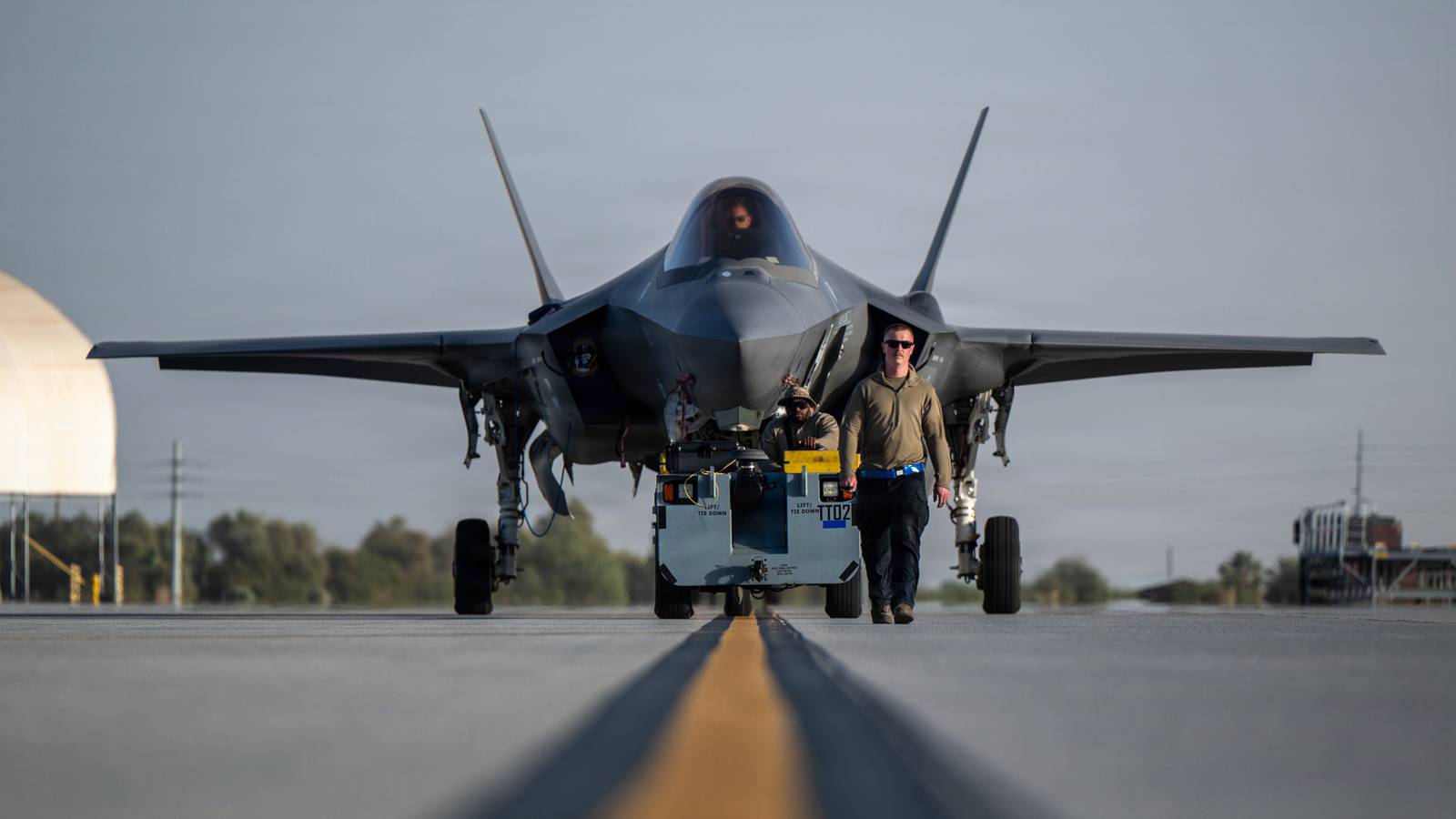


The United States and Australia have completed a world-first F-35A flight test designed to accelerate the certification of new weapons for the fifth-generation fighter, marking a significant milestone in allied air combat capability development. Conducted in late April and announced by the Royal Australian Air Force (RAAF) on June 19, the trial involved the first joint Weapon Fill Measurement Vehicle (WFMV) test flight on an F-35A Lightning II. The effort brought together Australian and US military organizations to gather critical engineering data needed for future weapons integration programs.
Defense officials say the achievement could substantially reduce the time required to certify weapons for use on the F-35. Rather than repeating extensive flight characterization work for each new weapon, future certification programs will be able to draw on the data generated during the test, streamlining a process that has traditionally been complex, expensive, and time-consuming. The US and Australia have a long history of collaboration and military alliance.
Certification, Not Manufacturing, Is The Real Bottleneck
The challenge in fielding a new air-launched weapon is often not producing the munition itself but proving it can be safely carried, released, and employed across an aircraft’s full operating envelope. Before a weapon can enter operational service, engineers must understand the aerodynamic forces, vibration levels, and environmental conditions it experiences while attached to the aircraft. The WFMV test was specifically designed to gather that information. An F-35A was flown with a specialized instrumented test store that measured the physical environment encountered during flight. The resulting dataset provides a detailed characterization of how external and internal stores behave on the aircraft under varying flight conditions. According to the RAAF, this information is essential for weapons certification and future integration efforts.
By establishing this baseline, future programs can avoid re-creating large portions of the engineering analysis from the beginning. Instead, developers can reference existing flight environment data, potentially shortening qualification timelines and reducing duplication of testing requirements. The Aircraft Stores Compatibility Project Arrangement (ASC PA) project manager, Captain Jae Yu, emphasized the benefit this joint work has on both countries.
“The key takeaway for me was how valuable the Australia and US alliance is… It’s not that we can’t do this work on our own, but working together lets us do it better, faster and with lasting benefit.”
The test involved a broad coalition of Australian and American organizations. Australian participants included No. 75 Squadron, the Air Warfare Engineering Squadron, the Aircraft Research and Development Unit, and the Air Combat Systems Program Office. US involvement came through the Air Force Seek Eagle Office and the 96th Range Support Squadron. The activity was conducted under the Aircraft Stores Compatibility Project Arrangement, a long-standing bilateral framework that allows both countries to share weapons integration data and coordinate testing programs.
Australian officials described the trial as an example of how allied cooperation can deliver capabilities more efficiently than either nation working independently. The agreement enables the two air forces to share technical findings, reduce redundant testing, and lower the overall cost and duration of certification activities. The test also reflects Australia’s growing role in advanced F-35 development and sustainment activities. The RAAF has increasingly participated in sophisticated integration and evaluation programs as its F-35A fleet matures and expands its operational capabilities.
Strategic Importance for Future Weapons Integration
The significance of the WFMV flight extends beyond a single test event. Modern combat aircraft are expected to integrate an expanding range of missiles, precision-guided munitions, and future weapons as threats evolve. Every new capability requires certification work before it can be fielded safely and effectively.
For the F-35 community, which includes numerous allied operators worldwide, reducing certification timelines can translate directly into faster deployment of new combat capabilities. The engineering data collected during the joint test may support future integration efforts by providing a validated understanding of the aircraft’s weapons carriage environment. This becomes increasingly important as F-35 operators pursue advanced weapons and software upgrades intended to expand the platform’s mission set.
In a rapidly changing security environment, the ability to field new weapons more quickly can offer a tangible operational advantage. While largely invisible outside defense circles, the world-first US-Australian WFMV test represents a foundational step toward faster, more efficient weapons certification for one of the world’s most important combat aircraft programs.
Orijinal Haberi Görüntüle