
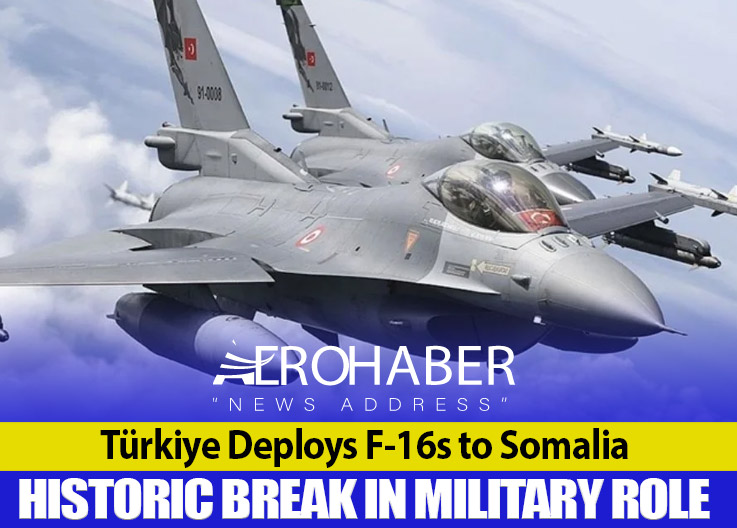


Türkiye has expanded its military presence in Somalia by deploying three F-16 fighter jets and helicopters to Mogadishu. The first direct clash between Turkish troops and Al-Shabaab has been confirmed.
Türkiye has entered a new and qualitative phase in its military presence in Somalia. With the deployment of three F-16 fighter jets and two military helicopters to Mogadishu, it has been confirmed that elements of the Turkish Land Forces have directly engaged in combat against Al-Shabaab for the first time. This development indicates that Ankara is shifting from its previous focus on training, advisory roles, and indirect support toward open combat participation and air power projection.
F-16s in Mogadishu
According to Somali government officials, three Turkish F-16 fighter jets landed at Aden Adde International Airport in Mogadishu on 28 January. The aircraft were accompanied by two military helicopters intended to support operations against Al-Shabaab in southern and central Somalia.
Although there is no official confirmation that the F-16s have conducted active airstrikes, their mere presence is being assessed as a new factor altering the operational balance on the ground. With this move, Türkiye has extended its role in Somalia beyond unmanned aerial vehicles, transport aircraft, and advisory activities.
Timing Draws Attention
The timing of the deployment is also notable, as it occurred roughly one month after Israel recognised Somaliland in December. The recognition was strongly condemned by the Somali federal government, while Türkiye, Egypt, the Arab League, and the Organisation of Islamic Cooperation described it as contrary to Somalia’s sovereignty and territorial integrity.
This short interval between diplomatic tension and military escalation has strengthened interpretations that Ankara is responding not only to security needs on the ground but also to shifting geopolitical dynamics in the Horn of Africa.
First Direct Ground Engagement
The F-16 deployment came shortly after Türkiye’s first direct participation in ground operations against Al-Shabaab. In the Middle Shabelle region, Al-Shabaab positions near Jabad-Godane, about 20 kilometres from the Somali National Army’s Qorilow base, were targeted.
The operation continued with an assault by Somali ground forces following intense artillery bombardment. Gorgor special forces led the operation, while Turkish land units and officers stationed at the Qorilow base provided direct support.
According to local sources, dozens of Turkish soldiers equipped with armoured vehicles and advanced weapons took part in ground fighting lasting about three hours. This situation is being regarded as a historic turning point in Türkiye’s Somalia policy.
Ankara’s Operational Threshold Crossed
Until now, Türkiye had limited its military presence in Somalia to training, equipment support, intelligence sharing, and the use of armed UAVs. Although it maintained a close presence through the TURKSOM Military Training Camp, it had avoided direct frontline combat.
The operation in Middle Shabelle effectively removed this boundary, making Türkiye a direct participant in kinetic clashes against Al-Shabaab.
Qualitative Leap in Air Power
From a military perspective, the entry of Turkish F-16s into Somali airspace represents a significant capability increase. Compared with unmanned systems, manned fighter aircraft provide greater payload capacity, flexibility, and rapid response capability, reshaping the operational environment in terms of close air support, rapid threat response, and deterrence.
Even without confirmed strike missions, the presence of F-16s stands out as a factor limiting Al-Shabaab’s mobility and increasing uncertainty
Strategic Message and Risks
This move is interpreted as a strong military affirmation of Türkiye’s support for Somalia’s territorial integrity. It also signals that external recognition efforts toward Somaliland may be countered not only diplomatically but also on the ground.
However, direct foreign combat involvement carries risks for Türkiye, including potential retaliatory attacks and propaganda challenges. How Ankara manages its level of military engagement in the coming period will be a decisive factor in shaping these risks.
Implications for Somalia and the Region
For Somalia, Türkiye’s increased military support has the potential to enhance operational effectiveness against Al-Shabaab. However, the presence of foreign troops on the ground requires a sensitive balance for the Somali administration in terms of perception management and domestic legitimacy.
Turning Point
In conclusion, the deployment of Turkish F-16s to Mogadishu and the first confirmed direct combat participation of Turkish troops mark a military and political turning point in Türkiye–Somalia relations. By shifting from an indirect partner to an active combat actor, Ankara is redefining not only the balance on the ground but also its position in the geopolitical equation of the Horn of Africa.