

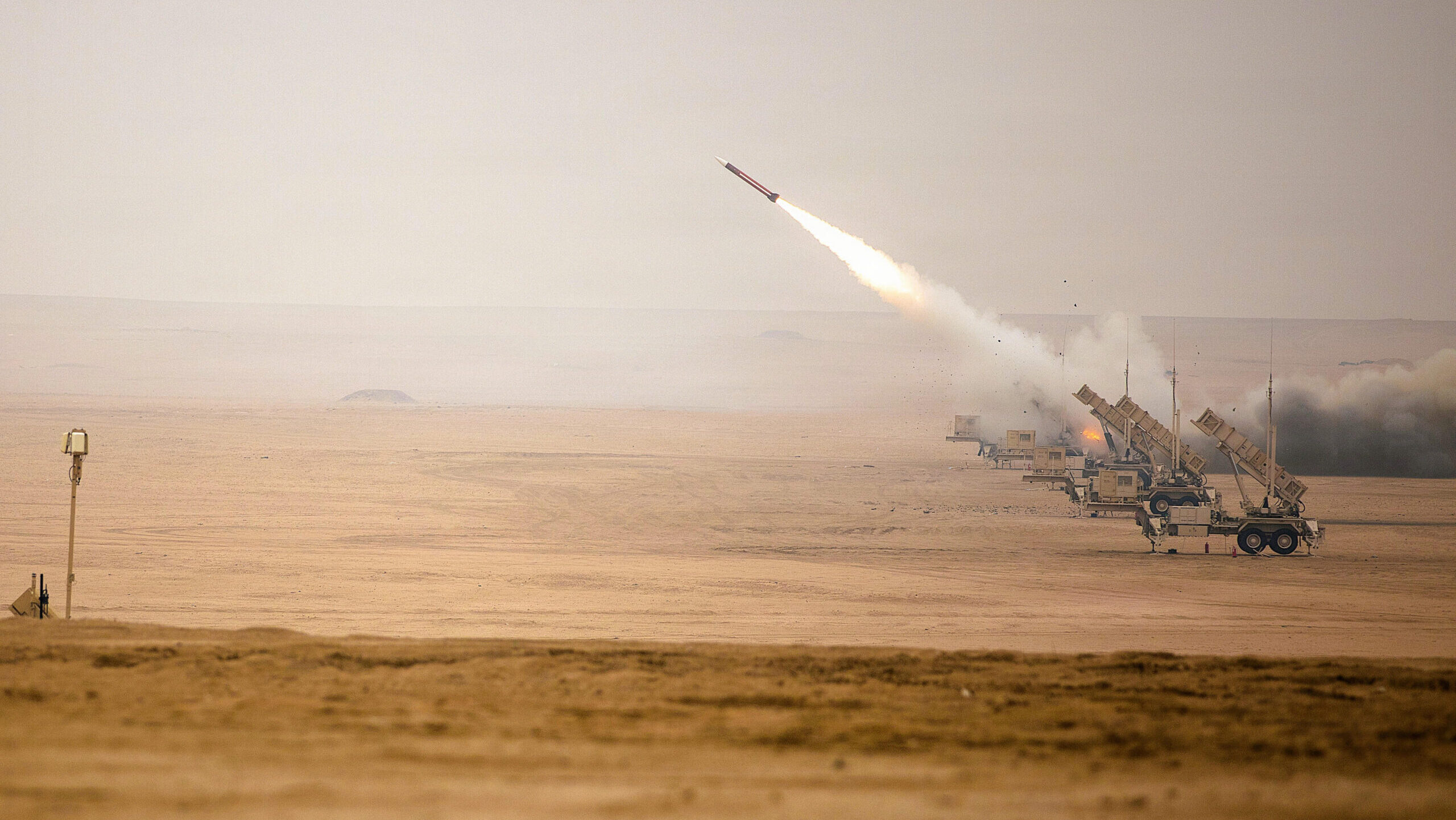


WASHINGTON — The Army’s recently announced low cost interceptor program is a step in the right direction for a new era of combat, but could run into obstacles when it comes to production capacity, budget constraints and safety and maturity standards, according to analysts and a former defense official.
Their analysis comes two weeks after the Army officially launched its LCI program, created to end the days of relying exclusively on multimillion-dollar exquisite systems to defeat airborne threats, especially low cost drones that only cost a few thousand dollars. Such reasoning is “really sensible,” Stacie Pettyjohn, director of the defense program at the Center for a New American Security, told Breaking Defense, especially with lessons learned from Operation Epic Fury.
“The existing threat is actually low-end systems,” Pettyjohn said in a recent interview. “We need more, cheaper missiles, we can’t just focus on the high-end threat anymore.”
The US military is experiencing a high “burn rate” of its exquisite systems like PAC-3 Missile Segment Enhancers and the Navy’s SM-3 and SM-6 missiles to defeat Iranian-made Shahed drones and other low cost systems, she said. The solution: “have a cheaper interceptor that can really bolster your stockpiles and allow you to more cost effectively use the air defense systems that have proven to be very effective to defeat these cheaper systems,” Pettyjohn added.
John Ferrari, a senior fellow at the American Enterprise Institute and former two-star Army general who served as the service’s director of program analysis and evaluation, said he wished the Army stood up such a program “five years ago.”
Ferrari believes the Army can produce LCIs in mass quantities by working with new vendors and venture capital-backed firms that leverage commercial practices and facilities used for civilian products, instead of bespoke defense equipment and factories.
“I think what you’re going to see actually is new firms up to the market, right, like the Andurils and other firms,” he said. “They can just buy commercial equipment, like you just need a factory floor, a big factory floor. Then you buy commercial equipment, and then you start producing these things.”
Europe rearms: Battle management, counter-UAS, and real AI at the edge
Mapping Europe’s modernization from the Eastern drone wall to actual artificial intelligence resident in tanks.
Another former defense official who backed the LCI program told Breaking Defense the service has an “urgency of need” to field LCIs. Like Ferrari, the former official predicted the Army will be able to scale LCIs quickly due to VC-backed companies.
“I know a lot of companies are investing in this space, especially in the VC world. You see companies investing in production capacity before the design is even finalized in order to be ‘first to market’ and to try to meet demanding timelines,” the former official said.
The former official added that if vendors use “less exquisite materials” — rather than hard-to-acquire components such as metal alloys and defense-specific semiconductors — the Army may be able to acquire LCIs at speed and scale. Typically, less complicated systems don’t require such materials, and with less bespoke material, the former official said, “there is a chance to dramatically increase our capacity in the [defense industrial base].”
Pettyjohn contended there will still be a need for some exquisite materials, especially for the seeker component that guides an interceptor to an incoming target, but leveraging commercial companies and practices could ease existing constraints.
Some parts will likely remain tricky to acquire, including solid rocket motor nozzles and rare earth minerals often sourced outside the US, Pettyjohn said. These are traditionally “two of the biggest limiting factors” on PAC-3 MSEs, Pettyjohn added. But with new vendors attempting to field LCIs at scale, this bottleneck could be loosened. However, this all depends on if the vendors’ orders “are significant enough,” she said.
Order volume depends on the budget, Ferrari said, which in turn will affect how quickly vendors can produce and the service can field LCIs.
“You got to have a production order from the Department of Defense, and you need money, and for all the yapping everybody’s doing, they still have to go over to Congress and get the $350 billion [referring to reconciliation fiscal 2027 funds] where all the money for all this stuff is sitting,” Ferrari said.
“No money, no production base, no new companies. So the trick is getting that through the process in a timely manner,” Ferrari added.
Another factor affecting the scale and speed of fielding LCIs is the test and evaluation community responsible for assessing and approving the missiles, Pettyjohn said. Last May, Defense Secretary Pete Hegseth slashed the DoD’s Director of Operational Test and Evaluation (DOT&E) workforce from 126 civilians to 30 civilians and cut some of the more conservative testing procedures.
“That’s a little worrying,” Pettyjohn said. “The US military has typically had a very conservative approach and wants to make sure that its weapons work and no one gets hurt, and that’s obviously something we want to continue in the future, but we can probably relax some of those requirements slightly. The question is, right now, do we have enough people to actually be doing the tests because of the workforce reductions?”
The former defense official said that although VC-backed firms can sometimes finish testing quicker due to more upfront investment, he added that he’s “not sure of the technical maturity of them across the board,” meaning it may take more time than anticipated to scale LCIs, and therefore the military writ large should continue to buy more expensive systems like the PAC-3 MSE. The former official added that “the proof will be in the pudding, though, and there is definitely risk.”
The former official said there should be a balance between the volume of exquisite interceptors and LCIs the Pentagon purchases, explaining that “having lots of lower cost missiles allows us to address a lot of the threats, leaving the more expensive interceptors to handle the advanced threats.”
“When all you have are expensive interceptors,” he added, “we burn through them against everything and spend a lot of money in doing so.”
Orijinal Haberi Görüntüle