
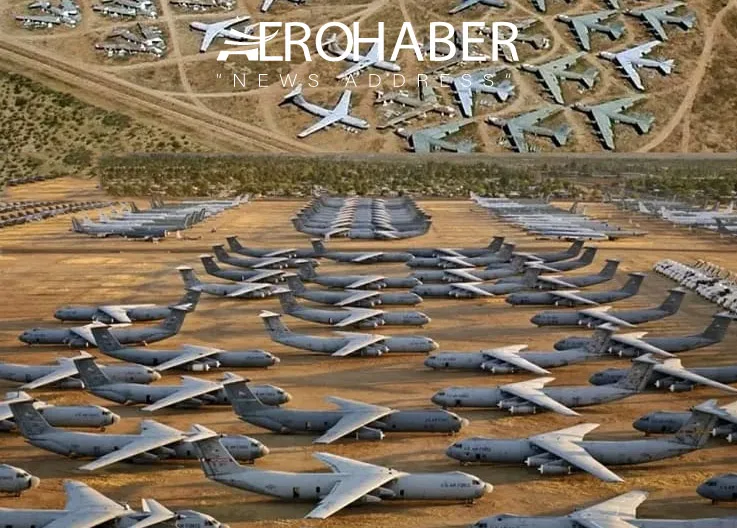


The Tucson Desert in Arizona, USA, may appear ordinary from the outside, but it houses the world’s largest aircraft boneyard. Built on the Davis-Monthan United States Air Force Base, this vast storage facility covers approximately 26.5 kilometers and serves as a strategic base that preserves 4,500 military aircraft and 40 spacecraft without rusting. The total value of this silently lined fleet in the desert has now exceeded $35 billion.
Many aircraft no longer in active service from the Air Force, Navy, Marine Corps, Coast Guard, and NASA have been transported to Tucson over the years. Witnessing different periods of American military history, this massive fleet continues to be preserved in the desert, quietly enduring each year it is not in use.
Why Tucson? A Natural Hangar Against Rust
The primary reason Tucson was chosen is the region’s climate. The desert climate ensures low humidity and minimal rainfall throughout the year. With annual precipitation below 28 centimeters, the metal surfaces of the aircraft can be stored for many years without rusting. This feature makes Tucson an ideal storage area for aircraft that the U.S. keeps for potential future use or spare parts.
A History Rooted in World War II
The foundations of the aircraft boneyard in Tucson date back to the immediate aftermath of World War II. With the war ending in 1945, the U.S. was left with a massive surplus of aircraft. The search for a large, dry area to preserve these planes without decay highlighted Tucson as the optimal location. By 1946, more than 600 B-29 Superfortress bombers and over 200 C-47 Skytrain transport planes were stored in the area.
Becoming the World’s Largest Storage Facility
In 1965, when the Department of Defense decided to close the Navy storage facility in Phoenix, all surplus aircraft were moved to Tucson. As a result, Davis-Monthan Base became the world’s largest aircraft storage area. Today, both aircraft that could return to active service and platforms designated for spare parts are strategically preserved here.
“A Silent Archive”: One of the Largest Visual Records of Aviation History
Although often referred to as an “aircraft boneyard,” the facility in Tucson is one of the most critical elements of U.S. postwar defense planning. This massive fleet of thousands of aircraft serves as both a silent archive of aviation history and a strategic reserve for the future.