
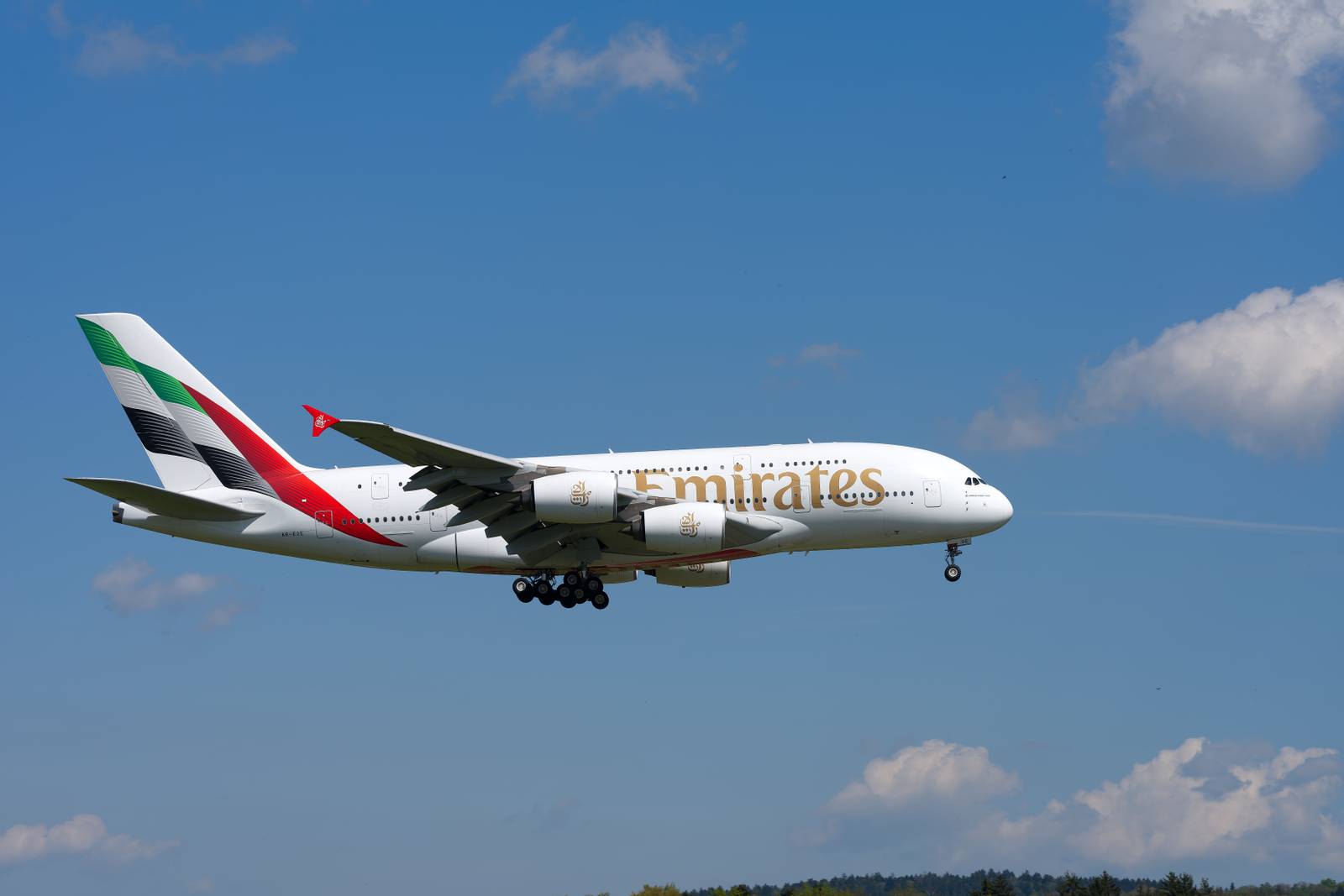


In 2026, around half of the world’s remaining operational Airbus A380s continue to be operated by Emirates, with more operated by Qatar Airways and Etihad in the Gulf. At the start of 2026, Emirates was working to bring more of its A380s back into service, including some aircraft that had been parked since COVID-19 in 2020. However, Operation Epic Fury against Iran and the large-scale Iranian strikes on the UAE and elsewhere in the Gulf have significantly impacted A380 operations.
As the A380 is the largest aircraft and is exceptionally expensive to operate, it is often one of the first aircraft to be grounded during periods of aviation crisis. As such, the A380 was particularly affected in the pandemic, and it has also been hit in 2026. Let’s examine the most frequent A380 routes for the first half of 2026 (January to June), according to data from Cirium, an aviation analytics company.
The eighth-thickest route for the world’s A380s in the first half of 2026 was from Dubai to Sydney. This is also the longest route on this list at 7,480 miles (12,037 km). Also notable is that many of these flights are fifth-freedom flights continuing onto Christchurch in New Zealand.
Around half (181) of the flights continued the extra 1,323-mile hop over the Tasman Sea (locally called “the ditch”) to Christchurch, which is the largest city in the South Island and vies as the second or third-largest New Zealand city overall. Even so, it is only a small city of around 400,000 people, making it one of the smallest A380 destinations.
The Emirates route to Australia’s Sydney carried 177,000 seats and generated 1.3 billion ASMs. Sydney is the largest city in Australia, and the greater Sydney area has more people than all of New Zealand combined.
Egypt is, by a considerable margin, the most populous Arab country with around 100 million inhabitants. However, its flag carrier, Egyptair, is comparatively modest with just 72 mainline aircraft, of which only 24 are widebody jets. This makes it smaller than the UAE’s second flag carrier, Etihad, and its mainline fleet of 126 aircraft (including 83 widebodies). Other Egyptian carriers include Nile Air and Air Cairo.
One of the thickest routes serving Egypt’s Cairo is Emirates from Dubai, and this was the seventh-thickest route for the A380 in the first half of 2026. The short-haul route (1,503 miles or 2,419 kilometers) saw 476 Emirates A380 flights in each direction, carrying 238,000 seats and generating 358 million ASMs.
Besides its A380s, Emirates also operates its Boeing 777s on the route to Cairo, with a total of five flights a day between both aircraft types. Egyptair operates around three flights a day on this route, split between its narrowbody and widebody aircraft. There are also thick routes to the UAE’s Abu Dhabi and Sharjah airports (not operated by Emirates) as well as minor routes to other UAE airports.
Compared to June, the airline is scheduled to operate its A380s to four additional destinations during the month of July.
The flight from Dubai to Jeddah in Saudi Arabia across the Arabian Peninsula is only 1,057 miles (1,700 kilometers), making it one of the shortest routes for the superjumbo. These short-haul flights are more frequently served by narrow-bodied aircraft like the A320 around the world. However, Emirates uses its A380s.
The route is also significant as not only does it connect two of the Arabian Peninsula’s leading cities (Jeddah is the business capital of Saudi Arabia), but it also connects with the Holy Islamic cities of Mecca and Medina. From Jeddah, pilgrims can take the high-speed rail trip to the nearby city of Mecca and to Medina further away.
In the first six months of 2026, Emirates flew 482 A380 flights to Jeddah with the same number returning. These carried 246,000 seats and generated 261 million ASMs. As this is essentially the Arabian equivalent of a domestic flight (at least in duration), Emirates uses specially configured high-density A380s with 615 seats on this route, although these jets are being reconfigured.
Like Thai Airways, Air France completely retired its fleet of ten Airbus A380s in 2020 during the COVID-19 pandemic, and now it relies heavily on its fleet of A350s for long-haul routes. However, even without having any superjumbos based in Paris, Paris’s Charles de Gaulle Airport still manages to be part of the fourth-thickest A380 route.
All of these flights are operated by Emirates, which flew 497 flights in each direction between the two hubs. This is not as much as it operated between Dubai and London-Heathrow (981), but still one of the most popular destinations for its superjumbos and more than any other European destination.
The route is an average of 3,259 miles (5,244 kilometers), although the actual route could be a little higher since, as noted in the introduction, the Middle East has seen significant flight disruptions and rerouting around closed airspace in 2026. As such, the actual flight distance may be greater. These flights carried 257,000 seats to Paris, generating 838 million ASMs.
The route from Singapore to London Heathrow Airport (LHR) is flown by both Qantas and Singapore Airlines using the A380. The third airline that could potentially operate superjumbos on this route, British Airways, doesn’t. Instead, BA serves the route with its Boeing 777s. The distance from Singapore to London Heathrow is 6,764 miles (10,886 kilometers).
Singapore Airlines operated 362 flights in each direction on the route in the first half of 2026, while Qantas contributed another 182 A380 flights, giving a total of 544 rotations. The Singapore Airlines flights carried around 171,000 seats, while Qantas’ aircraft had around 88,000.
Singapore Airlines was the launch customer for the A380, and it formerly had the largest fleet of 24 examples. However, this was reduced to 12, and they are expected to eventually be replaced by the Boeing 777-9s that Singapore has on order. Singapore’s other widebody aircraft currently include 27 Boeing 777s, 28 Boeing 787s, and 65 Airbus A350s.
Emirates is the largest operator of the Airbus A380 in the world.
The popular Dubai to Bangkok route was the second-busiest A380 route by a single airline and narrowly the third-busiest overall, after the Singapore to Sydney route. While several operators fly A380 flights into Bangkok, Emirates is the only one flying from Dubai. Separately, Thai Airways was formerly one of the A380 operators, but it retired its entire fleet of six A380s in 2020.
Emirates flew 591 Airbus A380 flights in each direction in the first six months of 2026. These had a total of 322,000 seats in each direction and generated 982 million ASMs. The distance between Dubai and Bangkok is around 3,050 miles (4,908 kilometers), making it one of the shortest destinations on this list outside of the Middle East.
As of the time of writing, Emirates still has around 116 of its original 123 A380s remaining in inventory. Of these, 97 are listed by Planespotters.net as active, and 19 are listed as parked. Emirates has previously said it has stocked up on spare parts and wants to fly them for as long as feasible.
The second-busiest route for the Airbus A380 is Singapore Airlines’ route from its base in Singapore to Sydney. In the first half of the year, the airline’s A380s flew 388 one-way flights on this route (around twice a day), carrying around 170,000 seats in each direction and generating 666 million ASMs. Singapore Airlines continues to operate a fleet of 12 A380s, and it is tied for second place with British Airways in having the world’s second-largest remaining A380 fleet.
The Singapore to Sydney route rises in the rankings if Qantas’ A380 flights are added. During the first half of the year, Qantas flew 206 flights in each direction on the route. These Qantas flights are fifth-freedom flights on their way to London Heathrow. As Qantas brings its new A350-1000ULRs into service, it will fly direct from Sydney to Heathrow.
Taken together, there were around 594 flights in each direction on the Singapore to Sydney route. That makes it one of the busiest superjumbo routes in 2026. It can also be noted that Qantas returned its final A380 into service in December 2025, so the arrival of the A350-1000ULRs does not spell the immediate end for the jet.
The busiest route for the A380 is between Dubai and London Heathrow. This is exactly the sort of route the A380 was designed for, as both airports are major hubs and Heathrow has restricted available slots. Having fewer available slots makes larger aircraft more attractive. Most flights are operated by Emirates, which operated 981 superjumbo flights on the route in the first half of the year.
British Airways is the other airline operating on the route and it operated 78 flights in each direction between January and June. The Emirates flights carried a total of 463,000 seats, while the British Airways A380s contributed another 37,000 seats each way. The distance is around 3,420 miles (5,500 kilometers).
It’s also worth noting that most of British Airways’ A380 flights are to destinations in the United States, although none feature in the top eight thickest A380 routes. Emirates also operates extensive A380 flights to the US, but its focus is more globally distributed than British Airways.
Orijinal Haberi Görüntüle