
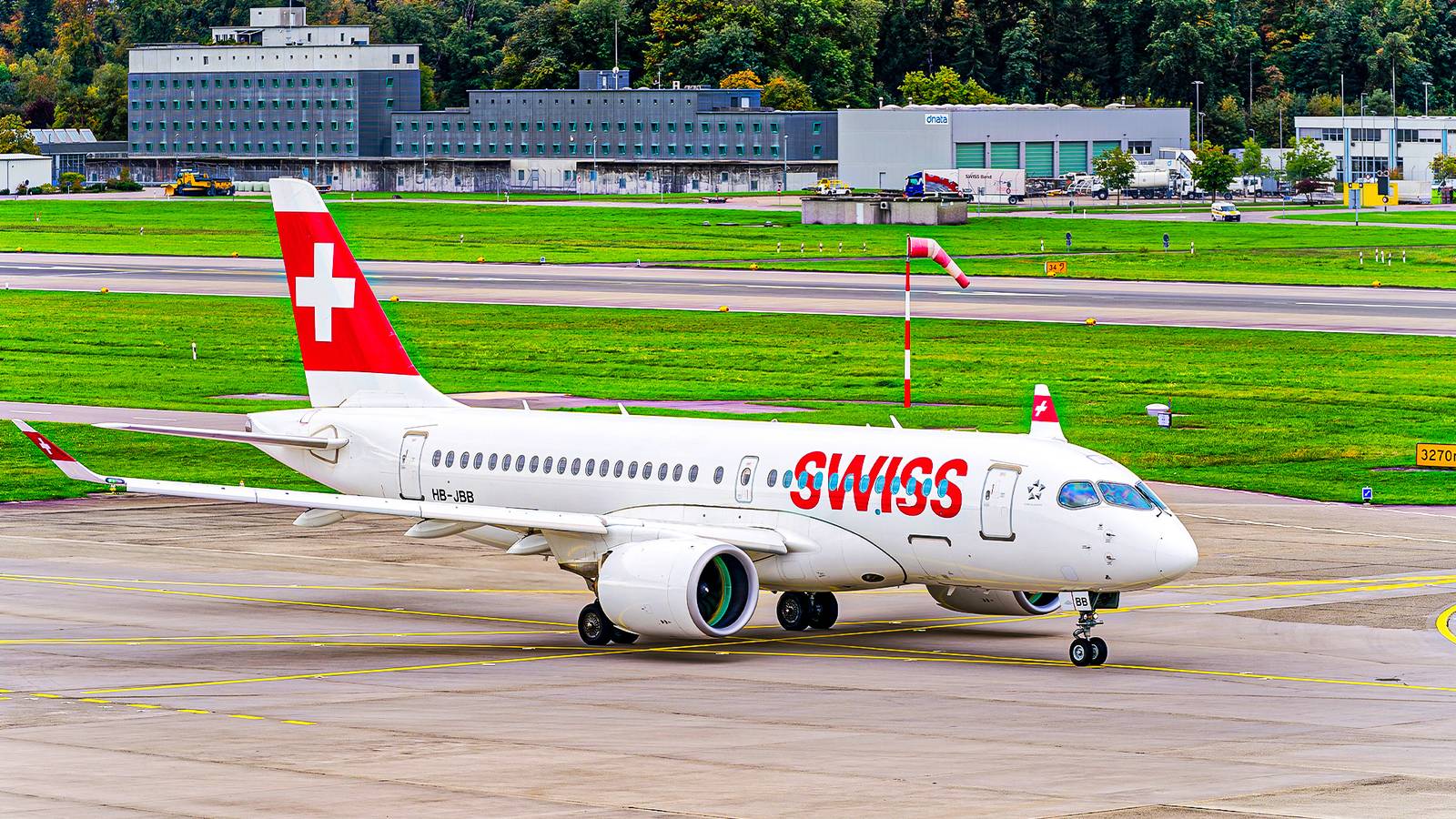


The first week of August 2026 came with a surprising announcement when SWISS International Air Lines announced that it would retire the Airbus A220-100. SWISS was the launch operator for the A220 in 2016 (with the A220-100 variant as well), and the oldest of these planes is only ten years old. To be clear, SWISS is only retiring the A220-100s, and it will continue to operate 21 A220-300s. SWISS is currently suffering from issues relating to the A220’s Pratt & Whitney engines, and the A220-100s are being removed so that the engines can be used to keep the more economical A220-300s flying.
The Pratt & Whitney issues have been hugely problematic for the type, and SWISS isn’t the first or even the second airline to retire A220s (that would be EgyptAir, followed by Air Austral). SWISS’s A220-100s, however, will be the first A220-100s to be retired, and it’s especially notable given that SWISS was the type’s launch customer. We still have a month until these rare planes are retired, so let’s explore where we can look for it before SWISS retires the A220-100 for good.
The Simple Flying Flight Tracker can be used to view aircraft in real-time, and filters can be used for airlines as well as aircraft. You can therefore use it to view SWISS A220-100s only, as well as a specific aircraft (via its registration), a flight (via the flight number), and all flights operating a specific route at once. To use this to effectively track the SWISS A220-100 fleet in its final days, however, it’s important to know what to look for in terms of routes and specific aircraft.
First, it’s important to note that the A220-100 is formally coded by the ICAO as ‘BCS1’ (the aircraft was originally developed by Bombardier as the CS100). At one point, SWISS operated nine A220-100s, but it’s already retired two examples and sent them for scrapping. Another four examples are currently parked and are unlikely to return to passenger service. This leaves just three examples that operate scheduled flights, which are registered as HB-JBA (the carrier’s first A220), HB-JBF, and HB-JBI.
The A220s primarily operate out of SWISS’s hub at Zurich Airport (ZRH). While they also occasionally fly between ZRH and SWISS’s secondary hub in Geneva Airport (GVA), they’re concentrated at ZRH, whereas the larger A220-300 fleet operates out of both hubs. While the A220-100 is known in part for having excellent range, it’s mainly used by SWISS on shorter flights within continental Europe. The primary purpose of the A220-100 for SWISS is to optimize capacity on specific routes, given its small size.
Aircraft assignments on short-haul routes within Europe can be incredibly dynamic, changing by the day, and this not only applies to specific aircraft assignments, but also aircraft types. European airlines like SWISS prefer to right-size capacity, and so you’ll see the same flight operated by multiple aircraft types in a given week. While airlines in other parts of the world also mix in different aircraft types on the same route, you don’t typically see as much variability in the US or Australia as in Europe.
SWISS has not announced a firm retirement date for the aircraft type, and has not confirmed what the A220-100’s final routes will be. As it stands, the A220-100s are flying to a wide variety of destinations over the week, most of which are more or less regional routes that are within one to two hours of flying time away from ZRH. Alicante and Athens are the two biggest exceptions, and the route from ZRH to Athens is the longest set to be operated by SWISS’s A220-100s in the near future, coming in at 886 NM (1,641 km).
SWISS A220-100 Scheduled Destinations Next Seven Days
Rome Fiumicino Leonardo da Vinci International Airport (FCO)
Krakow John Paul II International Airport (KRK)
The A220-100s primarily visit one of these destinations once or twice a week, which can be viewed on the Simple Flying Flight Tracker, and they sometimes fly to the same city multiple times per week while operating different flights. Nearly all of these are regional routes, and the three A220-100s sometimes operate alongside Embraer E2s flown by Helvetic Airways on the same route, and they typically operate multiple flights throughout the day.
Japan Airlines dominates the world’s busiest Airbus A350-900 routes in 2026, while other carriers across Asia make up the rest of the top seven.
For those who are able to catch these planes in the air before they retire, the A220 provides one of the most modern flight experiences in commercial aviation. The aircraft is praised by passengers for its large windows and spacious overhead bins. The noise levels are below prior-generation aircraft (although some note that the A220 may be louder than current-generation widebodies), and the five-abreast layout results in fewer middle seats.
The interior is the same as the A220-300, but the main difference is that the A220-100 is configured with 125 seats, 20 fewer than the A220-300. Both aircraft feature the standard intra-European business class product consisting of a blocked adjacent seat and upgraded soft product, while there is no in-flight entertainment or power ports. Meanwhile, the seat pitch and width are fairly standard.
The A220-100 and A220-300 are essentially the same, with the main difference being that the A220-100 is shorter. In a sense, though, this also applies to how the aircraft function within a fleet, as there’s little difference between the two in real-world operations, except that one is larger. This spells trouble for the smaller A220-100 because it’s a less compelling aircraft than its sibling, especially considering how SWISS uses the type.
The issues with the A220’s Pratt & Whitney GTF engines have been more than challenging. Essentially, durability issues with the GTF have necessitated early repairs and full engine replacements in many cases, but Pratt & Whitney can’t build the engines fast enough for existing operators and for new planes at the same time. This has resulted in Airbus producing gliders while some in-service A220s have been grounded. The GTF also powers the Airbus A320neo and Embraer E2, but the A220’s variant of the GTF has been impacted the hardest.
The A220-100 was the original model of the A220/Bombardier CSeries, while the A220-300 is the stretched model. However, the aircraft also has a beefed-up structure to support a higher takeoff weight, which increases fuel burn but allows it to have nearly the same range as the A220-100. While this would otherwise be a more balanced tradeoff, these planes tend to operate shorter routes, which means that the impact of the A220-300’s slightly higher fuel burn is minimal.
The fuel burn delta between the A220-100 and A220-300 is far smaller than the difference in revenue potential between the two, which makes the A220-300 much more economical. The A220-300 also has the flexibility to operate practically any route that the A220-100 can fly. Therefore, if you’re SWISS, facing a limited supply of GTF engines, then it’s a straightforward choice to rip the engines and parts off of the A220-100s to keep as many A220-300s in the air as possible.
A closer look at the revamped Simple Flying Flight Tracker and its sleek, user-friendly redesign that makes navigating live flight data a breeze.
The Airbus A220 has been a popular aircraft, but nearly all of its sales success has come from the A220-300 variant, which has received nearly 1,000 orders on its own. In contrast, the original A220-100 variant has received just over 100 orders, most of which have already been delivered. With SWISS retiring the A220-100, there will be just four operators of the A220-100 worldwide: Bulgaria Air with two, Croatia Airlines with two, ITA Airways with 12, and Delta Air Lines with 45.
Delta Air Lines is by far the largest operator of the A220-100 and the A220 family, while also being the only A220-100 operator in the Americas. These aircraft are a fairly common sight at select Delta hubs like New York, Salt Lake City, and Seattle, while Europe is the only other place where the A220-100 can be seen today. Meanwhile, LOT Polish Airlines has ordered 20 A220-100s, alongside 20 A220-300s, which will make it one of the largest A220 operators in the world and Europe’s biggest A220-100 operator, while Air Niugini has outstanding orders for eight A220-100s.
The A220-100 has a role as a small mainline plane, but it’s simply being overshadowed by its larger sibling because the A220-300 is simply too compelling. Airbus is now looking at stretching the A220-300, and it’s likely that the A220-100 will receive very few orders in the future as Airbus focuses on the larger variants that are more popular with buyers.
Orijinal Haberi Görüntüle