
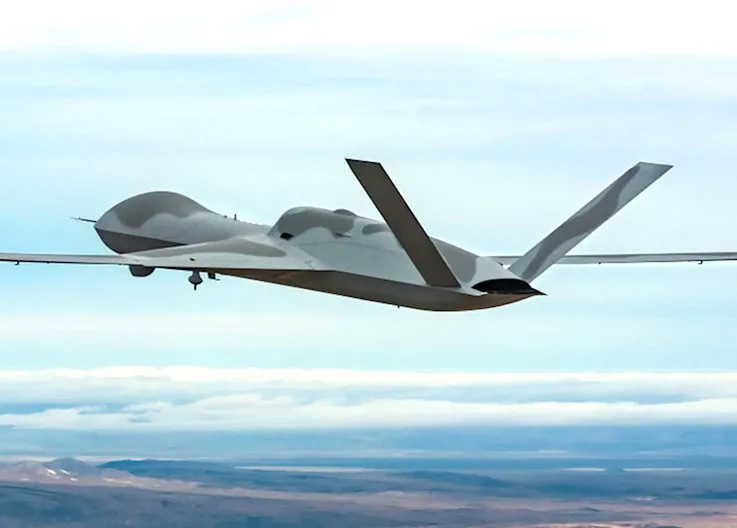


The U.S. Navy has inaugurated a new era in unmanned aerial systems by successfully flying the MQ-20 Avenger, an unmanned aerial vehicle (UAV) produced by General Atomics, using the Unmanned Carrier Aviation Mission Control System (UMCS) for the first time.
MQ-20 Avenger: A Critical Backup for the Future MQ-25 Stingray
The MQ-20 Avenger was developed as an alternative option to replace the Navy’s MQ-25 Stingray unmanned tanker aircraft. Through this initial test with the MQ-20, the UMCS demonstrated its ability to support multiple types of UAVs simultaneously. The flexible architecture of the UMCS thus shows the potential to manage different types of unmanned aircraft together in the future.
Beyond Line of Sight (BLOS) Communication with UMCS: Orbit-Supported Satellite System
The UMCS manages UAV flight commands and gathers mission data through Beyond Line of Sight (BLOS) connections. Supported by a proliferated low Earth orbit (pLEO) satellite constellation, this system enables the control of carrier-based UAVs from distant locations, allowing the Navy to conduct unmanned missions in remote regions.
USS George H.W. Bush: The First Carrier Equipped with UMCS
As part of the new Unmanned Air Warfare Center (UAWC) program, UMCS is being integrated into Nimitz- and Ford-class carriers. The USS George H.W. Bush became the first aircraft carrier to be equipped with UMCS, underscoring the Navy’s commitment to creating a fleet outfitted with unmanned systems.
MQ-25 Stingray: The Future Strategic Power of Aircraft Carriers
Despite delays in the MQ-25 Stingray’s development, the Navy aims to add this unmanned tanker aircraft to its inventory by 2026. The MQ-25 is intended to extend the operational range of carrier-based F/A-18E/F Super Hornets by reducing their refueling dependency. Alongside E-2 Hawkeye squadrons, this new aircraft will support tanker missions and aid early warning systems.
In the Navy’s long-term vision, at least 60% of the fleets are expected to consist of unmanned systems. This goal is supported by collaborative efforts with the U.S. Air Force and Marine Corps to develop joint control systems and cooperative working capabilities. Defense industry leaders like General Atomics and Anduril are also advancing this vision by developing UAVs as part of the U.S. Air Force’s Collaborative Combat Aircraft (CCA) program.
© AeroHaber.com
Aviation News and Defense Industry news published on our website cannot be used without proper attribution.
Note: You can read all aviation news published on our English site in Turkish at www.airportgundem.com