
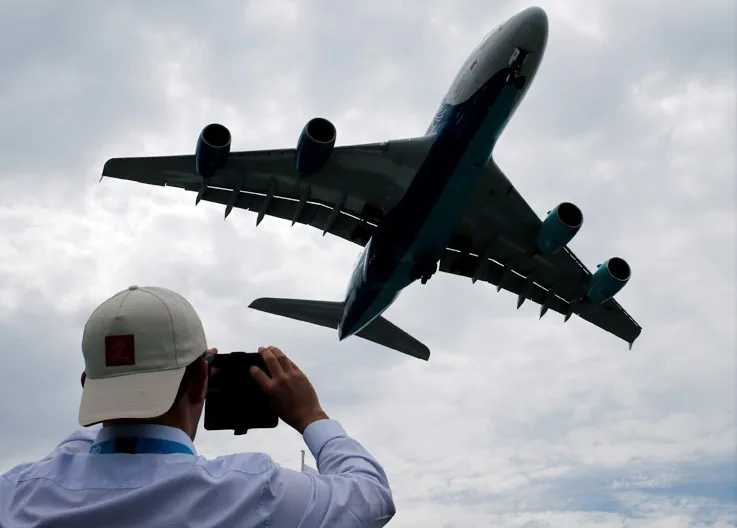


Known as the world’s largest passenger aircraft, the Airbus A380 made a rapid return to the skies with the recovering air transport demand after the pandemic. However, the aircraft’s enormous size and technical complexity mean increasing maintenance costs and operational risks for airlines.
The European Union Aviation Safety Agency (EASA) has issued 95 airworthiness directives for the A380 since 2020 alone. This number is about twice that of Boeing models of similar size. The directives cover a wide range of malfunctions, from leaking evacuation slides to tears in landing gear axles.
EASA emphasizes that maintenance of the A380 is more complex than other aircraft due to its scale, while underlining that safety is always the priority. Particularly for aircraft that remained grounded for long periods during the pandemic, hardware deterioration caused by humidity and temperature poses a serious safety threat.
Giants Like Qantas and British Airways Struggle
The impact of mechanical failures can be even greater in giant aircraft like the A380, which carry nearly 500 passengers. For example, a Qantas A380 cancelled its flight on May 7 in Singapore due to a fuel pump failure, and passengers were able to travel on another flight delayed by more than 24 hours. Similar issues recurred in July.
An A380 in British Airways’ fleet remained on the ground in Manila for over 100 days. After returning to London, the aircraft was able to take off only seven times throughout the month. Despite all this, the airline confirmed it will keep the aircraft in service by announcing plans to start cabin renovations on the A380 from 2026.
The Unavoidable Giant: Forced Loyalty to the Super Jumbo
The production of the A380 has already stopped, and production of high-capacity replacement aircraft is not progressing quickly enough. The Boeing 777X is constantly delayed, and the Airbus A350 is struggling to meet orders. This situation forces airlines to keep the A380 active.
It is stated that a comprehensive overhaul of the A380 requires 60,000 man-hours of labor. Airlines such as Lufthansa Technik, British Airways, and Emirates have their aircraft maintained in Germany, the Philippines, and China. All of this increases pressure on global maintenance resources.
Statements from Airbus and Airlines
Airbus announced that the A380 flew with 99% operational reliability over the last 12 months and that support services continue uninterrupted.
Qantas stated that the cabins of the A380s have been completely renovated and that the aircraft are “indispensable” for its international network.
British Airways described the aircraft as “a vital part of our long-haul fleet.”
Singapore Airlines considers the A380 operationally important but did not comment on technical details.
Emirates continues to actively use most of its fleet and plans to operate the A380 until the late 2030s.
What Will Be the Future of the Super Jumbo?
As the A380 returns to the stage after the pandemic, reliability and cost issues continue to test flight operations. Although it is a passenger favorite with its flight comfort and capacity advantages, airlines must balance the maintenance and logistical demands of this giant.
Aviation finance expert Eddy Pieniazek drew attention to the financial aspect of the process, saying, “Because the A380 has four engines and is large, maintenance costs rise much more sharply compared to other aircraft.”