
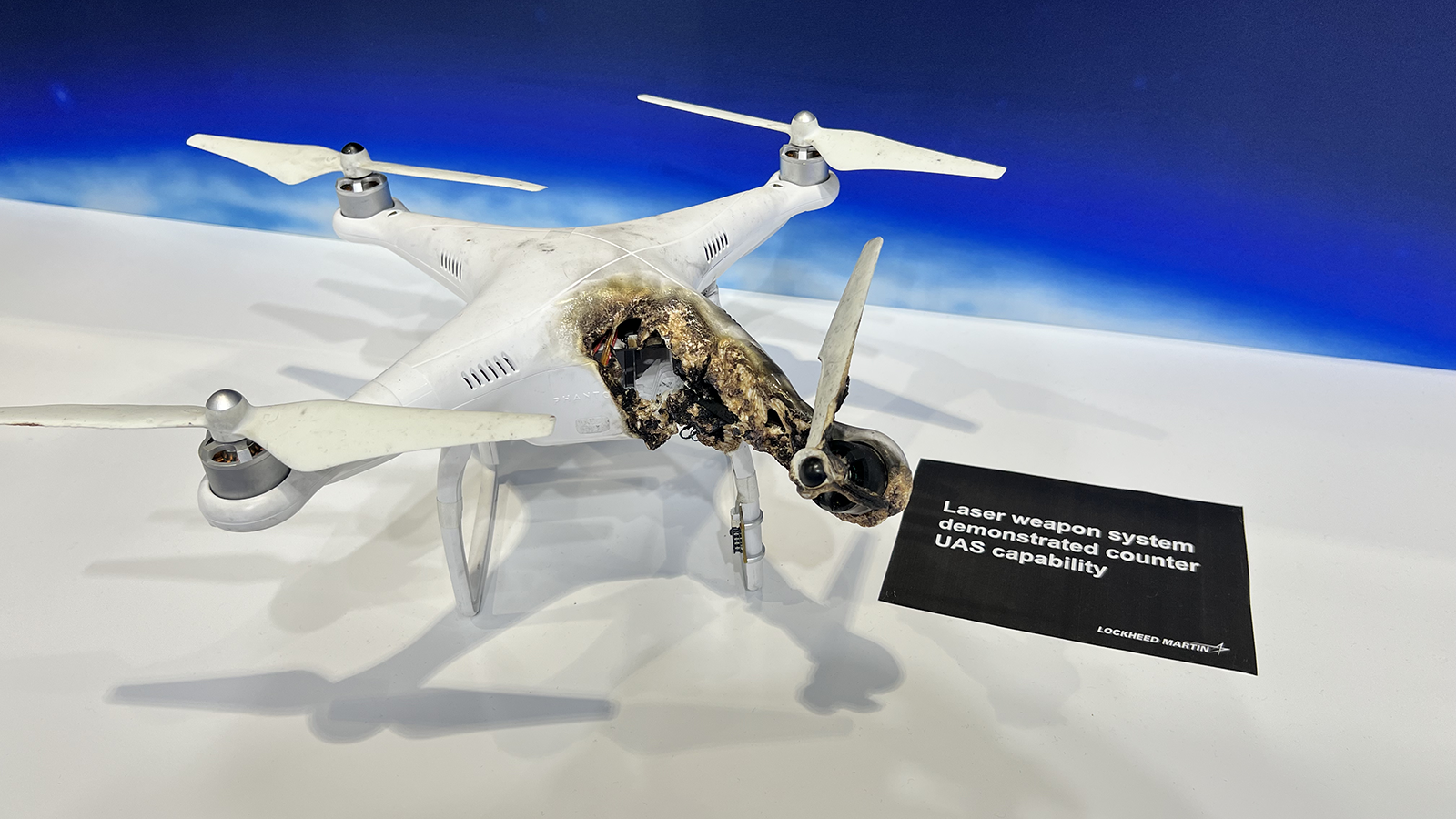


FARNBOROUGH — The Pentagon should have high-energy lasers that can melt inbound aerial threats by 2030, a top Lockheed Martin executive told Breaking Defense.
“They’re here, they’re effective, and they are working,” Stephanie Hill, president of Lockheed’s rotary and mission systems division, said in an interview at the Farnborough Airshow on July 21. The company has successfully demonstrated “a number” of laser intercepts, she said, predicting that the directed-energy weapons would be ready for operations “before the end of the decade.”
Laser systems are often seen as a holy grail for air defense. They’re a cheaper way to knock down weapons like missiles and drones than the pricey interceptors the US has burned through in recent conflicts. The Pentagon has pursued defensive directed-energy weapons for years even as technical problems surfaced, but the potential upside has kept the department invested in solutions.
“If you have power[…] you have basically an infinite magazine,” Hill said. “So highly effective, highly cost-effective as well.”
An arm of Lockheed Martin earlier this month secured a major Pentagon contract to get some of those laser systems into the hands of troops. In parallel with the specialist firm nLIGHT, Lockheed under the Joint Laser Weapon System program will develop a prototype system with 150 kilowatts of power for “urgent operational demands,” which can then be scaled up to as high as 500 kW for cruise missile defense, the Pentagon announced. (The contract award did not specify a period of performance, and Hill did not comment directly on the program.)
Lockheed’s lasers use spectral beam combining technology, which has been demonstrated against small- to mid-size drones and “surrogate” cruise missiles at sea and on land, Hill said, using an industry term for a modified platform used to simulate enemy munitions. Referencing a common refrain that laser systems are always just five years away, Hill said, “Not anymore.”
While lasers weren’t debuted at the show, Lockheed last week unveiled two new systems aimed at lower-cost intercept solutions, including a cheaper version of its sought-after PAC-3 missile and an X-rotor system dubbed MORFIUS that can fly into drone swarms and fry them with a high-powered microwave.
The company is also offering an overarching system called Sanctum for defending military installations and civilian infrastructure from emerging drone threats, which Hill said uses an AI model to choose to employ different sensors and effects based on what type of threat is incoming.
Several European countries are also pushing for sovereign control over weapon systems as the continent ramps up defense spending. Hill emphasized Lockheed can support that desire with systems like Sanctum, including hardware and software.
“We can do that same thing with Sanctum if there are modifications that are needed for that country, or that country would want to have additional capability,” she said. “We understand that sovereignty and tech transfer is important, and we have solutions to be able to do that from a software perspective and a track record of being able to build workforce in other countries to deliver that.”
A Grizzly With ‘Pretty Much Everything’
Lasers would just be one element of what military officials have called a “layered” defensive system that they hope to build out across the force. Tim Cahill, chief of Lockheed’s missiles and fire control division, said during the interview with Breaking Defense that the company has tied in its Grizzly ground-based, containerized launcher with the Sanctum system to bring a wide range of interceptor options to bear.
“The intent for the containerized launcher approach is to have containers [with] everything from the smallest missiles we have all the way up [to] THAAD,” Cahill said. The Grizzly launcher, he added, “can be outfitted with pretty much anything, of any size.”
Using Sanctum and a Grizzly launcher armed with an AGM-179 JAGM, Cahill said the company “knocked down a Shahed surrogate” — referring to the low-cost kamikaze drone used extensively by Iran — in a recent demonstration.
“Our intent is to have a whole set of tools that we can bring in to adapt to whatever the situation is for a country,” Cahill said, similarly underscoring that sovereignty will be a key trait offered to foreign buyers.
An industry notice published by the Air Force July 17 is querying prospective vendors for a ground-based launcher that can defeat cruise missiles and drones of all types. At the time of the interview, Cahill said he had not yet had an opportunity to review the posting and its requirements, but said the Grizzly system could theoretically be a viable option.
“That is the intent, is that it is a multi-use [system], and it’s just a really simple little lid pop, raise up, and fire,” he said. “It just waits and does what it’s told, and goes.”
Orijinal Haberi Görüntüle