


Airports are built around constant updates. Gates change, flights cancel, boarding groups shift, customer service lines move, and the most important information often appears first on screens, apps, signs, or departure boards. For most passengers, that can be stressful. For blind and visually impaired travelers, it can mean being left behind by an airport system that assumes everyone can see what is happening.
A recent USA Today report about blind traveler Anthony Maglione shows how quickly that system can come up short. Maglione said he struggled to get the assistance he needed while traveling with American Airlines earlier this year, including after a cancellation that he says was not communicated to him by the airport assistance worker who had been helping him. The result was a deeply human moment in a busy airport: a traveler who had paid for a ticket, asked for help, but still had to turn to strangers to get him where he needed to go.
A Blind Traveler Left To Ask Strangers For Help
Maglione was traveling from Pittsburgh International Airport (PIT) to Sarasota Bradenton International Airport (SRQ) when his journey began to unravel during his connection at Philadelphia International Airport (PHL). When a wheelchair met him at the gate, he knew he wasn’t being accommodated properly, and he says the airport assistant who had helped him did not return when his flight was canceled.
Maglione only learned about the cancellation because his American Airlines mobile app alerted him. There was no verbal announcement of the cancellation that he could hear. While that may sound like a backup system working as intended, it also reveals the problem: the person who needed direct, accessible information had to discover a major disruption on his own. Eventually, Maglione decided he could not simply keep waiting for the assistant to return, and he’d need to rely on other passengers for help. “I stood up and said, ‘I will pay somebody to take me to the American Airlines desk,’” he told USA Today.
A fellow traveler helped him for free, and he was ultimately re-booked on a flight via Charlotte Douglas International Airport (CLT), but the moment is striking because it captures the larger issue. Blind travelers should not have to rely on the kindness of strangers to receive basic information about a canceled flight or to reach an airline desk after the airline operation changes. American Airlines has said that it is reviewing the incident, while also stressing its broader commitment to assisting passengers who need help.
“American Airlines is committed to providing a positive travel experience for all of our customers, including those who need special assistance. We are reviewing this with our vendor that handles special services at Philadelphia to help improve future experiences. Our team has been in touch with the customer to apologize, learn more and extend a gesture of goodwill.”
The problem for airlines is that these incidents are not judged by policy language, but by what happens in the terminal. A passenger can request help, an airline can have a special assistance page, and an airport can have procedures in place. But if the person assigned to assist a blind traveler disappears during a cancellation, the practical outcome is still failure.
The Rules Are Clear, But The Handoffs Still Fail
US laws already require airlines to provide passengers with disabilities access to key travel information. The US Department Of Transportation’s Airline Passengers with Disabilities Bill of Rights says passengers who identify as needing visual or hearing assistance must receive prompt access to the same trip information as other passengers at the gate, ticket area, customer service desk, and onboard. Federal rules also specify that this information includes flight delays, cancellations, schedule changes, boarding information, connections, gate assignments, baggage information, and emergencies.
That sounds comprehensive, but airport journeys are built around handoffs. A traveler may request assistance during booking, then interact with check-in agents, contractors, TSA staff, gate agents, customer service staff, and sometimes another airline during a connection. During normal operations, those handoffs may work well enough. During disruption, they can collapse. A cancellation or gate change is exactly when blind travelers need clear, direct, and repeated communication, but it is also when staff are busiest and systems are most strained.
There have been plenty of other examples. Last year, Simple Flying reported on two blind Southwest Airlines passengers traveling from Louis Armstrong New Orleans International Airport (MSY) to Orlando International Airport (MCO) who were left behind after all other passengers were rebooked onto another flight due to a long delay. They remained at the original gate for five hours, eventually boarding the delayed aircraft as the only passengers. Southwest apologized, while saying the passengers were not forgotten and could not be located in time for rebooking. Either way, the incident showed the same core problem: if information moves visually or informally through the gate area, blind travelers can be excluded from the real operation happening around them.
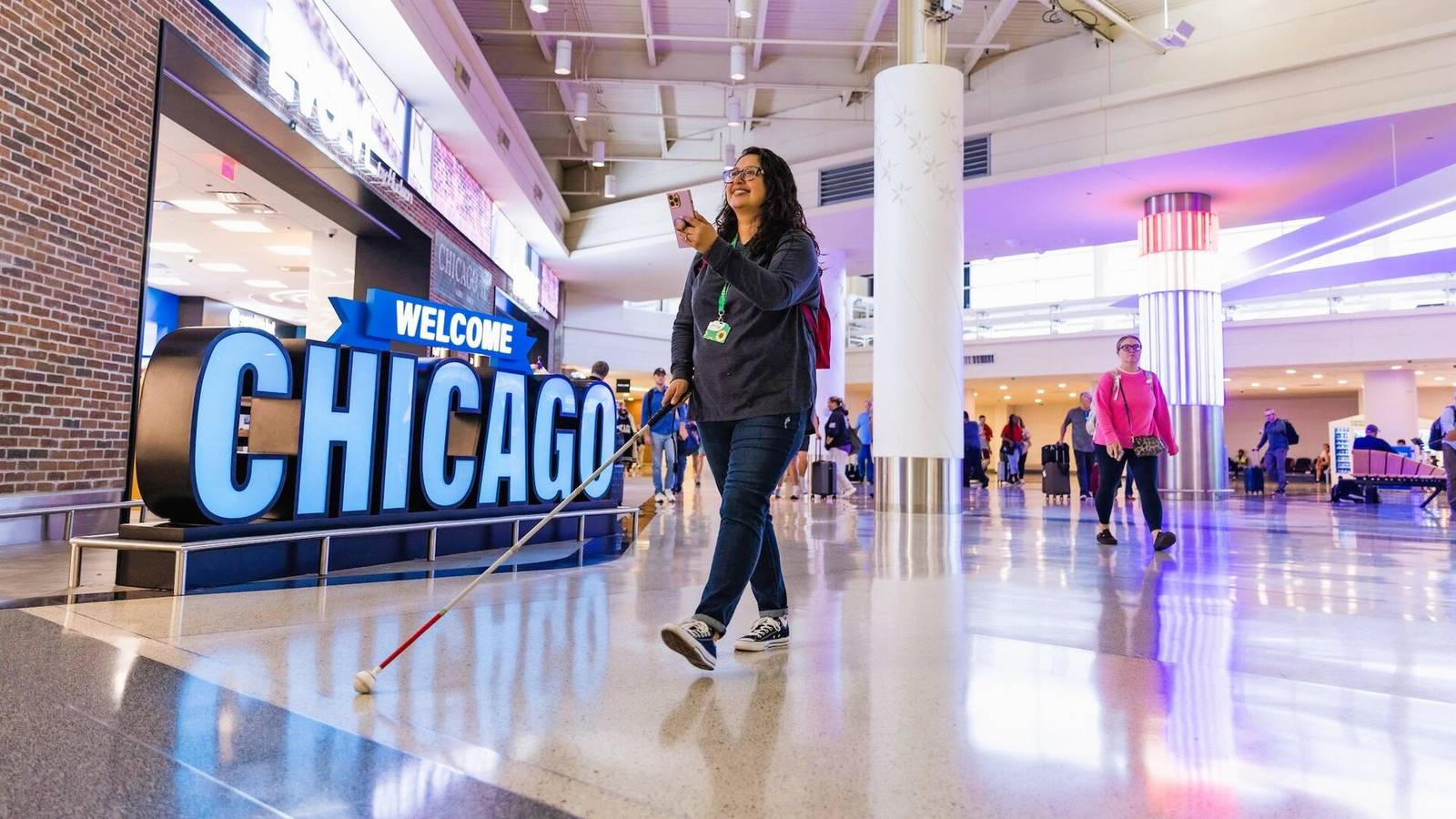
Some airports are trying to close that gap with technology that is specifically designed for independent navigation rather than one-time assistance. There are multiple examples of airports across the US that have recently rolled out solutions like Aira Explorer and GoodMaps Explore:
Free visual interpreting through a smartphone camera and microphone
Connects users with trained visual interpreters for real-time support
Louisville Muhammad Ali International Airport
Indoor navigation tool using detailed mapping and positioning
3D indoor mapping with step-by-step and turn-by-turn directions
Free on-demand remote visual interpreting for blind and low-vision travelers
Aira Explorer and GoodMaps Explore solve different parts of the same problem. Aira is remote visual interpreting: a blind or low-vision traveler points a smartphone camera, and a trained interpreter describes the surroundings, reads signs, or helps locate a gate. GoodMaps is closer to indoor GPS: it maps terminals and gives turn-by-turn directions inside spaces where traditional GPS often does not work. Neither replaces airline assistance, but both show that airports can do more than simply tell blind passengers to ask an employee.
How Other Travelers Can Help When The System Fails
When the airline systems fail, however, other travelers may still need to step in to help. But according to Mark Riccobono, president of the National Federation of the Blind, it shouldn’t mean taking over, grabbing someone’s arm, or assuming that a blind traveler is helpless. He advises that the first step is simple: asking “Do you need any help?” and don’t do more than they ask for.
“A lot of people jump to superhero mode. A lot of times, if a person with a disability asks you a question, don’t jump to three steps down the line, just answer the question.”
The most useful assistance is often specific information. If a gate agent has just announced that a flight is canceled, say that directly. If the customer service line has moved, explain where it is. “The desk is about 30 feet to your left” is more useful than “it’s over there.” If a traveler wants to be guided, let them take your arm rather than pulling them. If they are using a guide dog, do not pet, feed, call, or distract the dog while it is working.
Fellow travelers should also remember that the goal is not to replace the airline’s responsibility. It is to help reconnect the passenger with the airline or airport staff who should be providing the service. That might mean walking with someone to the desk, alerting a gate agent that a blind traveler has not received the necessary information, or helping them understand what was just announced.
Airports work best when information is redundant, accessible, and human. Until that is consistently true, the kindness of strangers may remain an uncomfortable backup system for travelers who should never have been abandoned in the first place.
Orijinal Haberi Görüntüle