
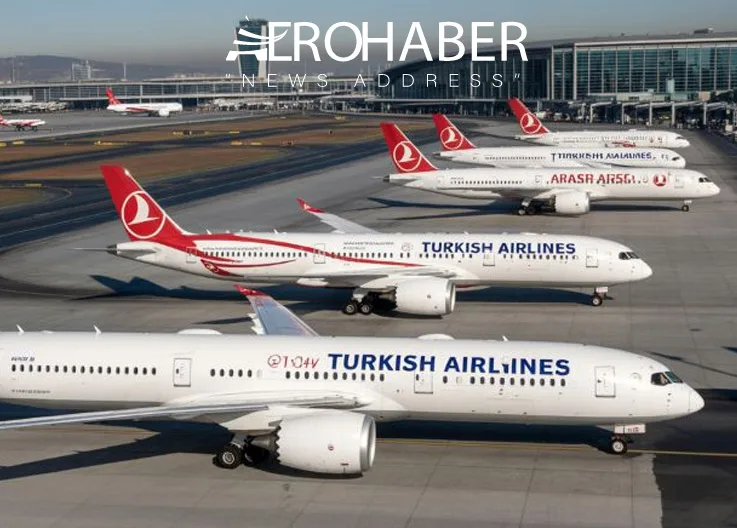


Turkish Airlines (THY) has initiated a strong transformation in its Asian flight network by activating its comprehensive change and development programme prepared for the 2026 winter season. This strategic plan, centred on network expansion, fleet renewal and route modernisation, focuses on capacity increases and fuel efficiency across a wide geography extending from China to Vietnam and from Japan to Thailand. The programme aims to enhance passenger comfort while elevating operational efficiency to a higher level.
A New Era on China Routes: Strategic Transition from the 777-300ER to the 787-9 Dreamliner
Turkish Airlines has implemented a significant change in the Chinese market by renewing its long-standing Boeing 777-300ER fleet with the modern Boeing 787-9 Dreamliner. The new fleet configuration stands out with fuel efficiency, long-range capability and improved cabin comfort.
Beijing & Guangzhou
- Weekly flights are operated in a balanced structure with 4 Boeing 777-300ERs and 6 Boeing 787-9 Dreamliners.
- This strategy provides a significant reduction in fleet costs while maintaining flight frequency.
Hong Kong
- Flights are operated with 4 Boeing 777-300ERs and 6 Boeing 787-9 Dreamliners.
- Major improvements are targeted in range, apron movements and take-off optimisation processes.
The Dreamliner’s low fuel consumption, high cabin pressure stability and spacious interior not only strengthen the competitiveness of the China route but also significantly increase passenger satisfaction.
A Solution to Record Demand in Vietnam: Capacity Increase and Modern Fleet Deployment
Positioning Vietnam as a key market in its Asian growth strategy, Turkish Airlines has implemented a strong capacity increase in response to rising passenger demand.
Istanbul – Hanoi
- Weekly flight frequency has been increased to 10.
- All flights will be operated with the wide-body Airbus A350-900.
- The A350’s high comfort standards and advanced range performance enhance the passenger experience.
Istanbul – Ho Chi Minh
- Flight frequency has been increased to 10.
- This route has been fully planned with the Boeing 787-9 Dreamliner.
The Dreamliner’s low emissions and fast turnaround times increase operational flexibility.
The capacity increase enhances the ability to respond instantly to local demand in Vietnam while improving the efficiency of the regional transfer network.
Fleet Modernisation in Japan and Taiwan: A Strong Move with New-Generation Aircraft
Turkish Airlines’ fleet renewal strategy in the Japan and Taiwan markets offers a more efficient and comfortable flight experience with the introduction of high-technology aircraft.
Osaka (Japan)
- A mixed fleet model is applied in weekly operations.
- 3 flights will be operated with the 777-300ER and 4 flights with the A350-900.
- The A350 provides significant advantages on the Osaka route with its cabin comfort and long-range performance.
Taipei (Taiwan)
- All 10 weekly flights will be operated with the 787-9 Dreamliner.
- The Dreamliner’s advanced air quality system enhances in-cabin comfort to the highest level.
Phuket (Thailand)
- To meet holiday season demand, 10 weekly flights are planned with the A330-300.
- This modernisation aligns with sustainability goals in many areas, from emission reduction to fuel savings.
- Operational Excellence: Faster, More Efficient, More Sustainable
Turkish Airlines’ new programme is not limited to changes in aircraft types alone.
Planning has been optimised according to flight safety, maintenance processes, airspace density and the technical requirements of routes. Thanks to new-generation aircraft with advanced cabin pressurisation systems, aerodynamic improvements and heat-management solutions, flight times are expected to shorten and passenger comfort to rise.
Turkish Airlines Is Launching a New Era in Asia
This extensive transformation makes Turkish Airlines’ position in the Asian market stronger, more competitive and more sustainable. With its renewed fleet structure and increased route capacity, the airline aims to boost its market share, maintain profitability and further strengthen passenger loyalty.