
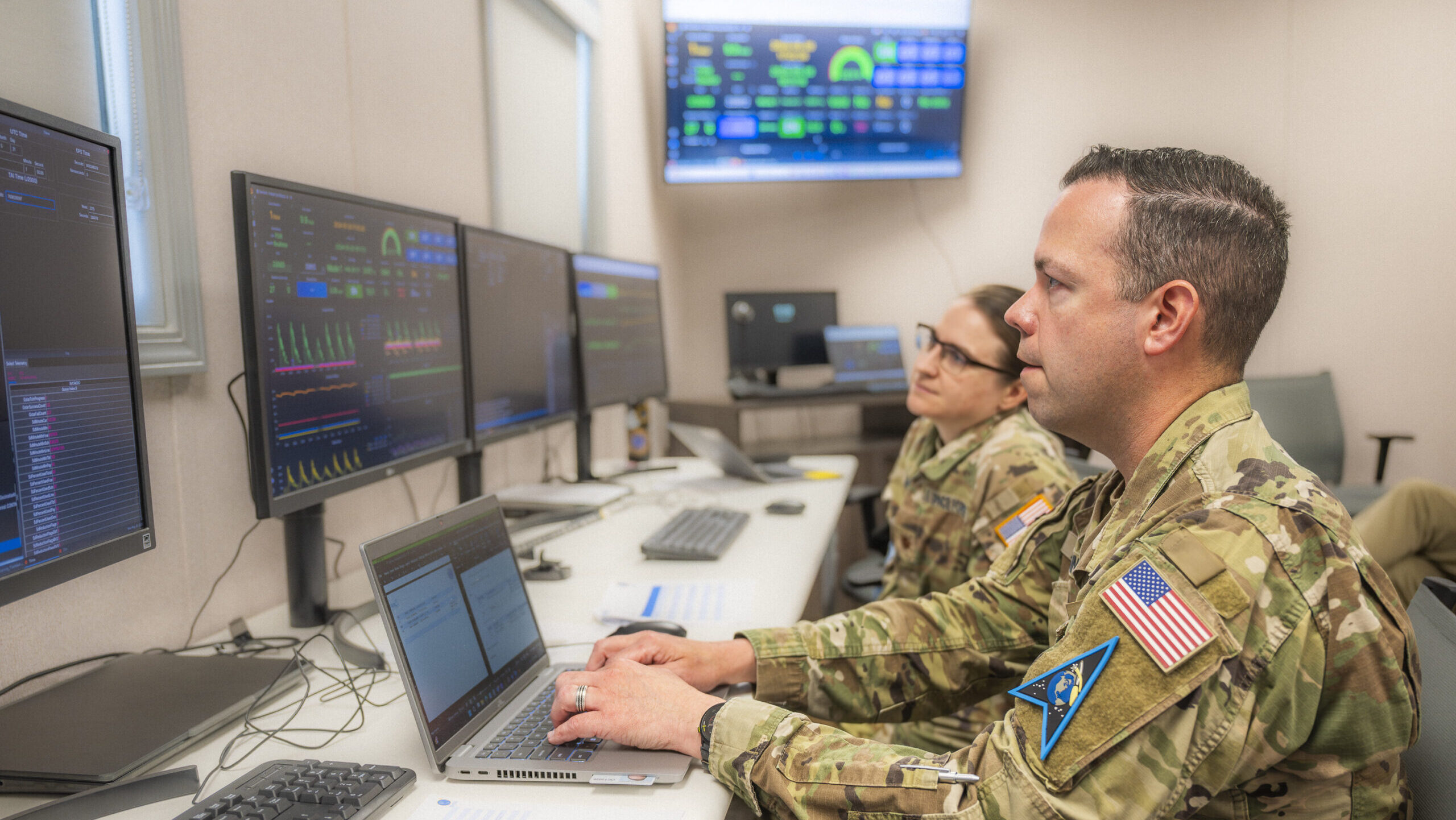


WASHINGTON — The Space Force has tapped 15 vendors to compete for a $981 million contract pool aimed at getting training capabilities to Guardians over the next five years, as senior officials fret gaps caused by a lack of instructors, facilities and simulators needed for key mission areas.
The effort has a heck of a moniker, according to an announcement today from Space Systems Command (SSC): the National Space Test and Training Complex (NSTTC) Innovative Technology & Engineering — Space Test and Range (NITE-STAR) Capability Development. The multiple-award indefinite delivery/indefinite quantity contract vehicle is designed to “accelerate” the development of “advanced” training tools to ensure that Guardians “are prepared for engagements against peer adversaries.”
The 15 winning companies are: Amentum Technology, BAE Systems, CACI, Firefly Aerospace, L3Harris Technologies, Lockheed Martin Space, Northrup Grumman, Pacific Crest Alliance, Parsons Government Services, Redwire Space Missions, Rocket Lab USA, Sierra Space Corporation, Boeing, Viasat, and York Space Systems.
The NITE-STAR contract, managed by SSC’s System Delta 81 responsible for delivering capabilities to Space Training and Readiness Command (STARCOM), will support the sprawling Space Force effort to create an Operational Test and Tracking Infrastructure (OTTI).
The multifaceted OTTI architecture will be comprised of physical infrastructure, simulators and live assets including spacecraft, and now falls under the purview of the Space Forces new(ish) portfolio acquisition executive (PAE) office for infrastructure.
Senior Space Force operators have become increasingly agitated over the past few years about a lack of training facilities and capabilities, especially as the size of the force expands along with the service’s growing number of mission sets.
Lt. Gen. Greg Gagnon, head of Combat Forces Command responsible for providing ready forces to US Space Command, told the Mitchell Institute on July 17 that there remain a number of challenges, in particular a lack of simulators in a number of key mission areas that the Space Force is working through.
“I have a report card,” he said.
The need for simulators is particularly acute, because otherwise active systems, such as space tracking radars or GPS satellites, have to be off-lined to provide training opportunities, he explained.
“I’ve spent a lot of time on that in the last seven months with both the chief of space operations, Gen. [Chance] Salzman, and with [Maj. Gen. James Smith], who runs Training and Readiness Command,” he said. “We’ve also spent it with the key people in SSC to get an assessment of where we are. It’s a mixed bag.”
For example, he said, in the area of missile warning and tracking, simulated training is robust, with “a green checkmark.”
And while the Space Force delta responsible for orbital warfare (Delta 9) still has to work primarily with “real mission equipment,” Gagnon said the service has “resourced the requirement” for simulators and is “on the the glide path to [a] green checkmark.”
On the other hand, he said, simulators for the space domain awareness and intelligence deltas are sorely lacking.
“Both of them are really unique,” Gagnon said, because each of those deltas use a number of specialized mission systems. “It’s confluence of different unique systems that do precise things, and then we aggregate them. So, I’m still kind of red-Xed on those.”
Orijinal Haberi Görüntüle