
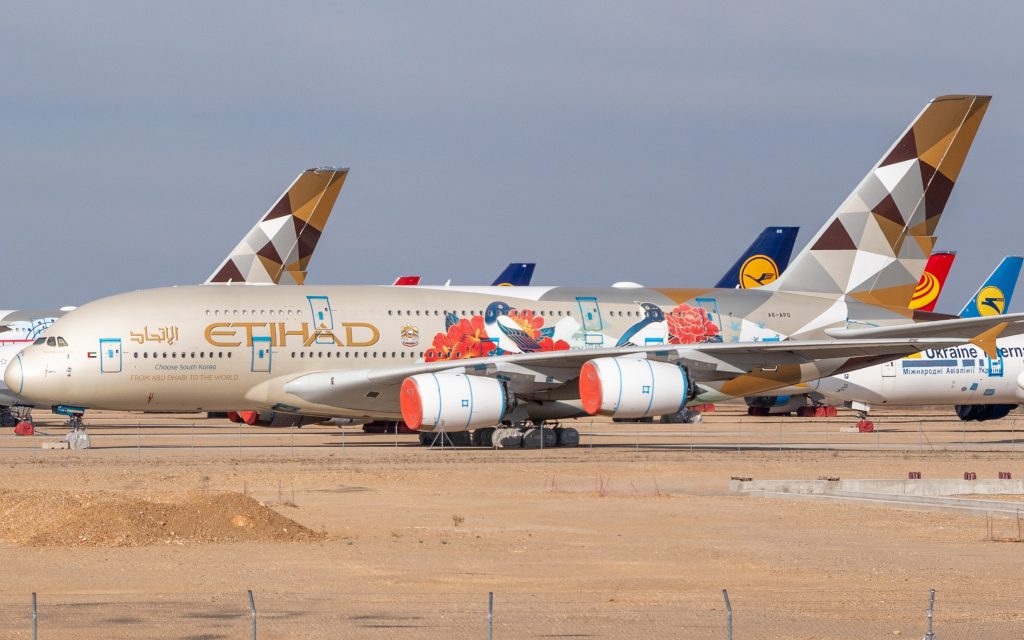


Etihad Airways’ final Airbus A380, which was stored and intended to return to service, has reappeared in Abu Dhabi.
The aircraft reappeared after six years parked, marking a full-circle moment after more than half a decade on the ground following a decision made at the height of the COVID-19 pandemic.
Etihad Airways‘ ferry flight of A6-APB from Tarbes–Lourdes–Pyrénées Airport (LDE) to Abu Dhabi Zayed International Airport (AUH) represents the last and ninth surviving A380 to be reactivated
A6-APB departed Tarbes on 17 September 2026 after spending from 2020 in storage at an airport known for long-term aircraft parking and dismantling.
The Airbus A380 had been initially grounded in Abu Dhabi when the airline pulled the plug on the world’s largest passenger plane in March 2020. In December of that same year, the airline transferred the jet to Tarbes for what was initially believed to be permanent parking.
The latest flight data showed the aircraft returning to its home base and being the ninth; however, it will not return to service immediately, as it requires heavy maintenance at the Abu Dhabi base before re-entering passenger operations.
Etihad Airways’ A6-APB is the ninth returning aircraft, but before the COVID-19 pandemic the airline had ten of these, with nine returning; it follows A6-APA, the lone aircraft in the pre-pandemic fleet that didn’t return, which was dismantled at Tarbes in July 2025.
As a result, the pre-pandemic fleet and the A380 fleet today are very close, but losing even one aircraft reduces the capacity of the world’s largest passenger plane.
Even with an Airbus A380 removed, the airline has begun taking delivery of new next-generation jets at a high rate, which has lessened the blow for the Abu Dhabi-based carrier.
Etihad Airways’ Airbus A380 programme across the 2020s has been shrouded in mystery and marked by one of the industry’s most significant reversals.
Led at the time by Tony Douglas, the airline reached the difficult decision by 2021 to remove the aircraft entirely, arguing that it was no longer a commercially viable solution to passenger needs.
In the evolving landscape, with heightened restrictions and drops in passenger demand for international travel, losses were spurred on by aggressive expansion in the 2010s.
With travel demand plummeting, Etihad Airways’ assessment reflected broader industry decisions not just to ground the world’s largest passenger plane, but to axe the type permanently to reduce the risks of operating the four-engined aircraft.
Tony Douglas continued to back the grounding and retirements, with uncertainty around the fleet and demand trajectory necessitating a push toward more efficient jets from Airbus and Boeing.
A couple of years after the first decision to park the types, however, demand surged back faster than expected, and where new models were expected to take over the reins, emerging supply chain problems delayed handovers and forced the return of these quad-engined superjumbos.
Initially, the A380 was reactivated on London Heathrow flights only, but since Etihad Airways has found a new role for the type on its densest route segments, the resurgence of the type, even if only for the medium term, has become apparent.
Make us your go-to for aviation news
Add us as a preferred source on Google and see our latest stories first in Top Stories.